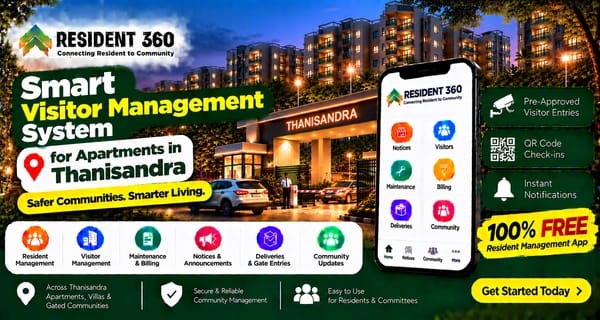
Thanisandra has a mix of apartments, gated communities, and residential societies where visitor movement can vary throughout the day. A visitor management system helps security teams organize guest entries, verify visitors, contact residents, and maintain clearer records without depending entirely on paper registers or informal messages. It can support routine guests, unexpected visitors, delivery personnel, domestic staff, and service providers through a more consistent process.
For residents and committee members, the value is better coordination at the gate and more organized visitor information. For security teams, it means a clearer way to manage entry, exit, confirmation, and follow-up. The right process can also reduce confusion when several visitors arrive at the same time or when a visitor-related issue needs to be reviewed later.
Why Karnataka Societies Need Visitor Management
Residential communities in Thanisandra and across Karnataka may receive visitors with different purposes, timings, and access requirements. Guests may arrive for a social visit, while delivery personnel, technicians, domestic workers, and facility staff may enter regularly. Managing each category through a consistent visitor management process helps the security desk know who is expected, whom to contact, and what information should be recorded.
A digital process can support resident confirmation before entry, visitor verification at the gate, and entry and exit tracking after access is granted. It can also improve communication between residents, guards, facility managers, and society committees. Instead of searching through handwritten pages, authorized teams can refer to organized visitor information when handling a question, repeated entry, or unexpected visit.
For communities with multiple blocks or busy access points, an organized system may also help reduce queues and improve accountability. The process should remain practical for the size of the community, the number of gates, and the working habits of the security team.
Common Visitor Management Problems Faced by Societies in Karnataka
Many residential communities experience similar visitor-related difficulties, especially when entry processes rely on manual registers, calls, and separate messages.
- Manual visitor entry can make handwriting difficult to read and records difficult to review.
- Long queues may form at security gates during office hours, evenings, or weekends.
- Security personnel may struggle to verify an unfamiliar guest quickly.
- Residents may not respond promptly when confirmation is requested.
- Delivery personnel may arrive while residents are unavailable to answer calls.
- Service providers and recurring workers may need repeated checks without an organized reference.
- Entry and exit details may be incomplete, delayed, or stored in different places.
- Communication gaps can occur between residents, guards, housekeeping staff, and facility managers.
- Visitor-related complaints may be difficult to review without clear records.
- Unexpected visitors may create confusion when the receiving resident cannot be reached.
These issues do not always indicate poor security practices. They often show that the community needs a clearer and more consistent way to collect, share, and review visitor information.
How Visitor Management Solves These Problems
A visitor management system creates a structured flow from arrival to departure. At the gate, security personnel can follow a defined process for registering a visitor, checking the purpose of the visit, contacting the resident, and recording the outcome. This reduces reliance on memory and helps ensure that similar situations are handled in a similar way.
For example, a guest arriving at a Thanisandra society can be identified, linked to the relevant home, and presented for resident confirmation before entry. Delivery personnel can be directed through a separate process, while service staff can be managed according to the community’s own rules. At departure, exit information can be recorded so that the visitor journey is easier to review.
Societies exploring a wider Visitor Management System approach can also consider how visitor processes fit into their broader administrative needs. Related Visitor Management System resources may help committees compare the type of workflow they want, without replacing the need to assess their own gate and resident communication requirements.
Useful processes may include:
- Registering expected and unexpected visitors.
- Verifying visitor details before entry.
- Sending relevant notifications or confirmation requests to residents.
- Maintaining entry and exit records.
- Separating guest, delivery, and service personnel workflows.
- Giving security teams organized information at the gate.
- Retaining details that may help with follow-up or issue resolution.
A society can also connect visitor coordination with a broader apartment management app or use maintenance management software where visitor activity is related to service requests, repair visits, or facility operations.
Visitor Entry, Security, Delivery, and Complaint Management
Visitor Entry Management
Organized visitor entry starts with a clear procedure for identifying the visitor, confirming the intended resident or unit, and recording access. Security teams can follow the same basic steps for guests, relatives, technicians, and other visitors. This helps prevent incomplete records and makes the gate process easier to understand for new guards or replacement staff.
The detailed visitor management system page can help committees understand the broader purpose of structured visitor entry. Each society can then define practical rules for identification, resident approval, waiting areas, and exit recording based on its own requirements.
Security Management
Security teams need timely visitor information without having to search through multiple registers or message threads. A consistent process can help guards coordinate with residents, note whether access was approved, and identify visitors who are expected to return. It can also support handover between shifts by keeping visitor-related information more organized.
A visitor process should complement, not replace, the judgment of trained security personnel. Clear instructions from the society committee remain necessary for handling restricted access, emergencies, visitor disputes, and situations where a resident cannot be contacted.
Delivery Management
Deliveries can create frequent activity at residential gates. Food, courier, grocery, and large-item deliveries may arrive at different times and require different handling. A society can establish rules about gate access, resident confirmation, delivery waiting areas, and handover points.
A visitor management system can help keep delivery information separate from guest visits and make communication more focused. This may reduce repeated calls and help residents understand when a delivery has reached the gate. The exact process should reflect the community’s layout, staffing, and access rules.
Complaint Management
Visitor-related complaints may involve noise, unauthorized access attempts, delivery disputes, parking concerns, or conduct at the gate. Organized visitor information can help the society review what happened, identify the relevant time or visitor category, and communicate with the appropriate resident or staff member.
A committee may use a defined complaint process to record the issue, assign follow-up, and document the outcome. Visitor records should be accessed responsibly and only by people who need the information for legitimate society operations.
Resident Communication, Staff, Facility, and Record Management
Resident Communication
Residents need timely information when a guest, delivery person, or service provider reaches the gate. A clear communication process can help them respond to confirmation requests and give security teams instructions without relying only on repeated phone calls. A Resident communication app may be considered as part of a wider communication approach, while the society should still define which visitor messages are necessary and appropriate.
Good communication also includes clear guidance for residents. They should know how to inform security about expected visitors, what details may be recorded, and how to respond when an unfamiliar person requests access.
Staff Management
Visitor coordination often involves more than guards. Housekeeping supervisors, maintenance staff, facility managers, reception personnel, and committee representatives may need to understand the process. A defined workflow helps each person know when to contact a resident, escalate an issue, or update the security desk.
A society using rwa management software can evaluate whether its broader administrative processes support visitor coordination. The key requirement is practical cooperation between staff members, not the use of a particular tool or terminology.
Facility Management
Visitors may need access to clubhouses, meeting rooms, sports areas, event spaces, or other common facilities. Communities can set rules for resident guests, event attendees, vendors, and temporary service personnel. These rules may cover booking confirmation, permitted timings, entry points, and responsibility for the visitor.
Visitor management can support facility operations by helping staff understand who is expected and why. It can also reduce confusion during resident events, provided that access decisions remain aligned with the society’s approved policies.
Record Management
Reliable visitor records can help a society review entry and exit activity, recurring visits, delivery patterns, and unresolved issues. Records should be accurate, easy for authorized personnel to access, and retained according to the community’s internal policies.
A Maintenance management system may be relevant when service visits need to be coordinated with repair or upkeep work. Similarly, committees should keep any payment information separate from visitor records and handle financial data through appropriate processes.
Visitor Management System for Small Societies and Gated Communities
Visitor requirements vary according to the structure and daily activity of a community. A small society may need a straightforward process for guest confirmation, delivery handling, and basic entry and exit records. The workflow should be simple enough for a small security team to use consistently.
A large gated community may require different procedures for several towers, multiple entrances, frequent deliveries, and a larger number of residents. High-rise and multi-block communities may need clearer coordination between the main gate, block-level staff, and residents. Communities with multiple security gates should define how visitor information is shared and how a visitor’s exit is recorded if departure occurs through another gate.
The right approach depends on practical questions such as:
- How many gates require visitor coordination?
- Are guards stationed at every entry point?
- How are recurring staff and service providers verified?
- Does the community need separate guest and delivery processes?
- Who can review records or handle visitor-related concerns?
- What happens when a resident does not respond?
A process that is suitable for a small society may need more role clarity and record organization in a larger gated community. Committees should adapt the workflow rather than copy a process designed for a different layout.
How Resident360app Simplifies Visitor Management
Resident360app can be considered by societies and residential communities looking for a more organized approach to visitor management and related resident coordination. The supplied Resident360app resources cover visitor management alongside areas such as resident communication, maintenance, society administration, and community operations.
This makes it relevant for committees that want to examine visitor activity as part of a wider residential process. For example, a society may review how visitor entry relates to resident communication, service visits, maintenance work, and issue follow-up. The aim should be to identify a workflow that security teams and residents can understand and use consistently.
Communities can begin by documenting their current visitor process, noting where delays or communication gaps occur, and then assessing whether Resident360app fits those requirements. Any evaluation should be based on the society’s actual gate structure, staff responsibilities, record needs, and operating policies rather than on assumptions about features or outcomes.
How to Choose the Right Visitor Management System
Societies should evaluate a visitor management system against everyday gate operations rather than selecting one only because it has a long feature list. The security team should be able to understand the visitor entry process, residents should know how confirmation works, and committee members should be able to review relevant records when needed.
Consider the following factors:
- Ease of use: The process should be clear for guards, residents, staff, and committee members.
- Entry workflow: Check whether guest registration, verification, approval, and exit recording match community rules.
- Security usability: The system should support practical coordination at busy gates and during shift changes.
- Resident communication: Consider how residents receive and respond to visitor-related information.
- Delivery handling: Review whether delivery personnel can be managed without mixing every delivery with guest access.
- Service coordination: Assess how recurring workers, technicians, and vendors will be identified and followed up.
- Complaint handling: Ensure visitor-related concerns can be documented and reviewed through a defined process.
- Community size: Match the workflow to the number of homes, blocks, residents, and security staff.
- Gate requirements: Consider single-gate, multi-gate, high-rise, and multi-block operations.
- Record accessibility: Clarify who can view visitor information and how long records should be retained.
- Overall usability: Prefer a process that can be followed consistently rather than one that creates additional confusion.
Committees may also review practical examples such as Visitor Management System in Yelahanka, Visitor Management System in Uttarahalli, and Visitor Management System in Kanakapura Road to understand how location-focused visitor topics can be presented. These references should support research, while the final choice must reflect the needs of the Thanisandra community.
Conclusion
A well-planned visitor management system can help Thanisandra societies organize guest entry, resident confirmation, delivery handling, service visits, security coordination, and visitor records. It gives committees and security teams a clearer process for routine and unexpected visitors while supporting better resident communication and issue follow-up. By matching the workflow to the community’s size, gates, staff, and policies, residential communities can improve visitor coordination without adding unnecessary complexity.
Get Started with Resident360 Today
Resident360app can be considered by societies and residential communities looking for a more organized approach to visitor management. To learn more, visit Resident360app.
Download the Resident360app Today