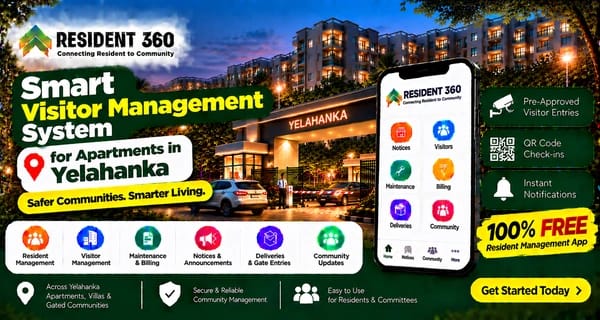
A visitor management system can help residential communities in Yelahanka organize guest entries, visitor verification, delivery access, and communication between residents and security teams. For apartment societies, RWAs, and gated communities, a structured process reduces confusion at the gate and makes visitor information easier to manage.
Yelahanka communities may receive guests, domestic workers, maintenance personnel, delivery executives, vendors, and service providers throughout the day. A clear visitor management process helps security teams record relevant details, seek resident confirmation, coordinate entry and exit, and respond to visitor-related concerns with better information.
Why Yelahanka Societies Need Visitor Management
Yelahanka includes a mix of apartment communities, gated layouts, and residential societies with different visitor patterns. Security teams may need to handle school visitors, guests, cab drivers, delivery personnel, technicians, housekeeping staff, and recurring domestic workers from the same gate. Managing these entries through notebooks, calls, or informal messages can create delays and gaps in information.
An organized visitor management system gives societies a clearer process for registering visitors, confirming access with residents, and maintaining entry and exit details. It can also improve coordination between the security desk, residents, facility staff, and society committee. For communities that want better day-to-day coordination, a society management app or resident-facing system can support visitor-related communication without making the process dependent on scattered messages.
The approach should match the community’s size and operating pattern. A smaller society may need a simple visitor register and resident confirmation process, while a larger gated community may require clearer coordination across multiple blocks, gates, and security shifts.
Common Visitor Management Problems Faced by Societies in Yelahanka
Societies in Yelahanka can face visitor-related issues when information is recorded manually or shared inconsistently. Common challenges include:
- Manual visitor entry that takes time and may contain incomplete details.
- Long queues at the security gate during busy morning and evening periods.
- Difficulty verifying whether an unexpected guest is known to a resident.
- Delayed resident confirmation when calls are missed or contact details are unavailable.
- Unorganized visitor records that are difficult to review later.
- Confusion while handling delivery personnel at the entry point.
- Coordination issues involving domestic workers, technicians, vendors, and service providers.
- Communication gaps between residents, guards, housekeeping teams, and facility staff.
- Difficulty tracking visitor entry and exit times across different shifts.
- Visitor-related complaints without clear information about who entered or when.
A digital process can help address these issues by keeping visitor information more organized and making responsibilities clearer at the security desk. It can also help committees review recurring concerns and improve their visitor policies over time.
How Visitor Management Solves These Problems
A visitor management system supports a defined process from arrival to exit. At the gate, security personnel can record visitor information and follow the society’s verification rules. The resident can then confirm or decline access based on the community’s established process. This is more structured than relying only on handwritten notes or repeated phone calls.
For example, when a guest arrives at a Yelahanka society, the security team can register the visitor, identify the intended flat or resident, and seek confirmation. Once access is approved, the entry can be recorded for future reference. Exit information can also be captured so the community has a clearer record of visitor movement.
The same process can be adapted for deliveries and service personnel. Delivery staff may be directed according to the society’s gate rules, while technicians or recurring workers can be handled through a consistent verification procedure. Relevant visitor information can be shared with residents and authorized society personnel, helping reduce communication gaps.
Societies evaluating a broader digital approach may review how a Visitor Management System fits into resident and committee coordination. The focus should remain on practical use: accurate registration, timely confirmation, clear security communication, and accessible records.
Visitor Entry, Security, Delivery, and Complaint Management
Visitor-related activities involve more than recording a name at the gate. Entry procedures, security coordination, deliveries, and complaints should work together so residents and staff have a shared understanding of what happened.
Visitor Entry Management
A defined visitor entry process helps security teams collect relevant details before allowing access. The process may include identifying the visitor, confirming the destination, contacting the resident, recording approval, and noting the exit when the visitor leaves. This creates a consistent routine for guests, vendors, technicians, and other visitors.
For regular visitors, societies can establish clear rules for verification and access. Unexpected visitors should still follow the same confirmation process rather than being admitted based only on verbal assumptions. A society maintenance app may be useful as part of broader community coordination, but visitor entry rules should remain clear to guards and residents.
Security Management
Security teams need organized visitor information to coordinate activity at the gate and across the community. A visitor management system can support communication about expected guests, approved access, delivery arrivals, and service personnel. It also gives different security shifts a more consistent reference point instead of depending on informal handovers.
The process should be practical for guards. If visitor information is difficult to enter or review, it may slow down the gate. Societies should therefore define which details are necessary, how confirmation is obtained, and how entry exceptions are handled.
Delivery Management
Delivery personnel often arrive throughout the day and may include food, grocery, courier, pharmacy, and other service deliveries. Communities can use visitor management procedures to identify the recipient, notify the resident, and follow rules for gate access or designated delivery areas.
A clear delivery process can reduce confusion between security personnel and residents. It may also help the society distinguish a short delivery visit from a longer service visit. Rules should be communicated consistently so delivery staff receive similar instructions at each gate and during each shift.
Complaint Management
Visitor-related concerns may involve unauthorized access attempts, missed deliveries, waiting times, noise, parking, or disagreements at the gate. Organized records and resident-security communication can help the society understand the sequence of events before responding to a complaint.
A society may use a defined reporting process that records the issue, relevant time, visitor details, involved staff, and action taken. This does not replace fair review or resident communication, but it can provide a clearer factual basis for follow-up.
Resident Communication, Staff, Facility, and Record Management
Visitor management works best when residents, security teams, staff, and committee members follow the same communication process. It should support daily coordination without creating unnecessary complexity for the community.
Resident Communication
Residents need timely information when a guest, delivery person, technician, or service provider arrives for them. Clear notifications or confirmation requests can reduce missed calls and help residents respond while the visitor is waiting at the gate.
A Resident communication app may support broader communication between residents and the society. For visitor management, the key requirement is that relevant information reaches the right resident or authorized contact and that the security team receives a clear response.
Staff Management
Visitor coordination may involve guards, housekeeping personnel, maintenance workers, supervisors, facility managers, and committee members. Each role should understand who verifies visitors, who handles delivery questions, and who receives escalations when an issue occurs.
A defined responsibility chart reduces dependence on one person’s memory. Societies considering rwa management software should assess whether their wider coordination process can support visitor-related responsibilities without making the gate procedure difficult to follow.
Facility Management
Visitors may need access to clubhouses, meeting rooms, sports areas, community halls, or other shared facilities. Societies can define whether access requires resident confirmation, prior booking, staff approval, or a time-based rule.
Connecting visitor information with facility-use procedures can help staff understand who is expected on the premises and why. The process should respect community rules and avoid granting broader access than necessary. A society maintenance management software approach may assist wider operations, while visitor access remains governed by the society’s own policies.
Record Management
Visitor records help societies review entry and exit activity, investigate concerns, and understand recurring visitor patterns. Records should be accurate, relevant, and accessible to authorized personnel. Committees should also define how long information is retained and who can review it.
A digital record can be easier to search than a collection of notebooks, but the value depends on consistent use. Security teams should record information carefully, and residents should understand that visitor verification is part of the community’s safety process. Societies can also keep related payment information separate from visitor records and handle each type of information appropriately.
Visitor Management System for Small Societies and Gated Communities
Visitor management requirements vary by community structure. A small residential society may have one gate, a limited number of homes, and a single security shift. Its process can focus on resident confirmation, visitor details, delivery coordination, and a straightforward entry and exit record.
A large gated community may have multiple blocks, several entrances, more security personnel, and a higher volume of visitors. It may need clear gate-level responsibilities, consistent visitor categories, shift handovers, and procedures for guests moving between common facilities and residential blocks.
High-rise and multi-block communities may need to identify the correct tower, floor, or flat before entry. Communities with multiple security gates should decide how visitor information is shared between gates and how exit records are updated. The process should be adapted to the physical layout rather than copied from another society.
Before choosing a tool, committees can map the visitor journey: arrival, identification, resident confirmation, entry, movement where relevant, exit, and follow-up. This helps a community select a process that is practical for its size, staff availability, and gate arrangement.
For additional context, committees can review the Visitor Management System discussion and compare the considerations with their own visitor flow. The aim should be better organization, not unnecessary complexity.
How Resident360app Simplifies Visitor Management
Resident360app can be considered by societies and residential communities looking for a more organized approach to visitor management and related resident coordination. Its relevance should be assessed against the community’s actual requirements, including visitor entry processes, resident communication, security desk coordination, and record handling.
A society may also review the broader Visitor Management System information to understand how a digital residential coordination approach could fit its needs. Committees should involve security personnel and facility managers in the evaluation because a process that works for residents must also be practical at the gate.
Resident360app may be considered alongside other digital tools, including a Maintenance management system, when a society is reviewing several areas of residential coordination. However, visitor management should be evaluated on its own requirements: visitor registration, verification, resident communication, delivery handling, service personnel coordination, and accessible records.
Communities can also refer to the visitor management system page for more information about the central solution category. No system should be adopted solely because it appears broad; the society should confirm that its intended visitor process is understandable and suitable for its residents and security team.
How to Choose the Right Visitor Management System
Societies in Yelahanka can evaluate a visitor management system by reviewing how well it supports real gate activity. The following factors can guide the decision:
- Ease of use for residents, guards, committee members, and facility staff.
- A clear visitor entry process that does not create unnecessary delays.
- Practical usability for security teams during busy periods and shift changes.
- Resident communication for expected guests, unexpected visitors, and deliveries.
- Visitor records that are organized, searchable, and available to authorized users.
- Support for delivery management and service personnel coordination.
- A defined process for visitor-related complaints and follow-up.
- Suitability for the community’s number of homes, blocks, gates, and facilities.
- Clear handling of recurring visitors, domestic workers, vendors, and technicians.
- Appropriate record access and internal rules for visitor information.
Committees should ask guards to describe common gate problems before finalizing a process. Residents can explain where confirmation or communication currently breaks down. Facility managers can identify how visitor access affects shared spaces. This practical review is often more useful than choosing a tool based only on general descriptions.
A community may also compare a visitor process with its existing maintenance management software and broader communication methods. These systems may serve different purposes, so the evaluation should focus on whether visitor-related tasks remain clear and manageable.
For local planning, societies can also read about a Visitor Management System in Uttarahalli, Visitor Management System in Kanakapura Road, and Visitor Management System in Chandapura. These location-focused topics can help committees think about visitor processes in communities with different layouts and operating patterns.
Conclusion
A visitor management system helps Yelahanka societies create a clearer process for guest entry, visitor verification, delivery coordination, resident communication, and exit records. It supports security teams with organized information and gives committees a practical way to review visitor-related concerns. The right approach should match the community’s size, gate structure, staff workflow, and privacy practices while keeping daily entry management simple.
Get Started with Resident360 Today
Resident360app can be considered by societies and residential communities looking for a more organized approach to visitor management. To learn more, visit Resident360app.
Download the Resident360app Today