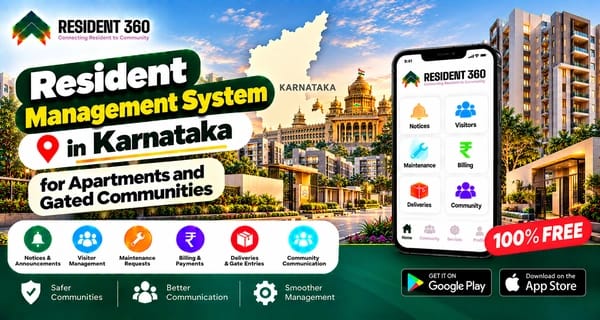
For societies, gated communities, and Resident Welfare Associations (RWAs) across Karnataka, managing residents involves much more than collecting monthly dues. Committees and facility teams must coordinate maintenance requests, visitor entry, security updates, staff responsibilities, complaints, facilities, notices, and resident records. A Resident Management App can help bring these activities into a more organised process, reducing dependence on scattered registers, chat messages, spreadsheets, and repeated follow-ups. Whether a community is in Bengaluru, Mysuru, Mangaluru, Hubballi, or another part of Karnataka, a structured resident management approach can make routine coordination clearer for residents, committee members, security personnel, and facility managers.
The right system should support practical daily work without making resident participation difficult. It should help communities maintain clear information, encourage timely communication, and give management teams a consistent way to track responsibilities.
Why Karnataka Societies Need a Resident Management App
Karnataka has a wide mix of housing societies, apartment communities, gated developments, and smaller residential associations. Each community may have different facilities, staffing arrangements, rules, and resident expectations, but most need a reliable way to coordinate everyday operations. A resident management system can help connect maintenance, communication, security, complaints, records, and facility activities in one structured process.
For committee members, this may mean fewer disconnected follow-ups. Residents can have a clearer way to raise requests, view relevant updates, and understand the status of community activities. Security teams and staff can also benefit from better coordination when responsibilities and information are shared through an organised channel.
Common Problems Faced by Residents and Societies in Karnataka
Residential communities often rely on multiple communication channels and manual records. This can make simple tasks harder to track, especially when committee members change or when several people handle the same responsibility.
- Maintenance collections may be recorded in different files or registers.
- Pending dues can require repeated reminders and manual reconciliation.
- Visitor information may not reach residents or security staff at the right time.
- Important notices can get lost among unrelated group messages.
- Complaints may be shared verbally without a clear follow-up record.
- Staff tasks can be difficult to coordinate across shifts and areas.
- Common facilities may need clearer scheduling and maintenance communication.
- Resident records may be spread across paper documents and spreadsheets.
- Security updates may not be communicated consistently to the community.
These gaps affect residents, committee members, security personnel, housekeeping teams, and facility managers. A structured Resident Management System can help create a clearer trail for requests, updates, responsibilities, and records without making daily administration unnecessarily complicated.
How a Resident Management App Solves These Problems
A Resident Management App can bring separate resident-management activities into one more organised workflow. Instead of depending only on paper registers, personal messages, or different spreadsheets, a community can use a consistent process for sharing information and tracking routine work.
For example, a resident may submit a maintenance request, while the management team reviews the issue, assigns the required follow-up, and communicates an update. Similarly, a visitor-related request can be shared with the appropriate resident and security personnel through an organised process. These steps do not remove the need for human judgement, but they can make responsibilities easier to understand.
Communities evaluating their options can review this guide to choose a resident management system based on their size, administration needs, communication preferences, and daily operating procedures. A more focused Resident Management App may also help committees bring recurring activities into a single resident-focused environment.
Maintenance, Visitor, Security, and Complaint Management
Maintenance, visitor handling, security coordination, and complaints are closely connected to the daily resident experience. A clear process can help the relevant people receive information, record actions, and follow up without relying entirely on memory or scattered conversations.
Maintenance Management
Maintenance activities may include recurring charges, repair requests, vendor follow-up, pending dues, and updates to residents. A resident management system can support a more consistent way to record these activities and communicate relevant information.
Useful practices may include:
- Recording maintenance requests and their current status.
- Maintaining clearer records of pending dues and payment-related updates.
- Sharing maintenance notices with the relevant residents.
- Tracking follow-up responsibilities for repairs or common-area issues.
- Using a Maintenance management system to organise recurring maintenance information.
Committees should also provide clear payment information when communicating about digital payments, due dates, or transaction-related processes. Accurate information can reduce confusion and help residents understand what action is required.
Visitor Management
Visitor handling can become difficult when guests, domestic workers, delivery personnel, and service providers arrive throughout the day. An organised visitor management system can help communities structure visitor entry, resident confirmation, delivery coordination, and visitor records.
Practical processes may include:
- Recording expected visitors where appropriate.
- Helping security personnel confirm resident-related entry requests.
- Sharing delivery or service-provider information more clearly.
- Maintaining visitor records according to community policies.
- Communicating unusual or important entry situations to the relevant resident.
Security Management
Security teams need timely information about visitors, access requests, deliveries, and community instructions. A resident management system can support clearer coordination between residents, committee members, and security personnel. It may also provide a more organised reference for routine entry-related activities, subject to the community's own rules and security procedures.
Complaint Management
Residents need a practical way to report issues involving maintenance, cleanliness, noise, facilities, or common areas. A structured complaint process can help record the concern, share it with the responsible person, and support follow-up. It does not guarantee immediate resolution, but it can make the status and ownership of an issue easier to communicate.
Resident Communication, Staff, Facility, and Record Management
Resident management also depends on clear communication and organised records. These areas support the work of committees and facility teams while helping residents stay informed about matters that affect daily life.
Resident Communication
Residents may need notices about maintenance schedules, water interruptions, facility availability, security instructions, meetings, and community updates. A Resident communication app can help place important information in a more focused channel instead of leaving every update among unrelated conversations.
Good communication practices include:
- Sharing clear notices with relevant residents.
- Separating urgent updates from general announcements.
- Providing a consistent place for resident queries and information.
- Recording community decisions and important instructions.
- Making updates easier for committee members to manage.
Staff Management
Housekeeping, security, maintenance, and other residential staff may work across different shifts and areas. Clear task communication can help the management team coordinate daily responsibilities, share instructions, and follow up on work that affects common areas or resident services. The process should remain practical and aligned with the community's staffing structure.
Facility Management
Shared facilities such as clubs, halls, play areas, gyms, and other common spaces require communication about availability, upkeep, usage rules, and repairs. A resident management system can help communities organise facility-related information and reduce confusion around schedules or maintenance responsibilities.
Record Management
Resident information, maintenance records, notices, payment-related records, complaints, and community decisions should be organised carefully. A structured record approach can make it easier for authorised committee members to locate relevant information and maintain continuity when responsibilities change.
Resident Management System for Small Societies and Gated Communities
A smaller society may have fewer residents and facilities, but committee members may handle several responsibilities themselves. A larger gated community may have more staff, multiple entry points, extensive facilities, and higher communication requirements. Both types of communities need resident management, although their workflows and priorities may differ.
The right resident management system should be adaptable to factors such as:
- Number of residents and homes.
- Volume of maintenance requests and dues.
- Visitor and security coordination needs.
- Staff roles and working shifts.
- Number and type of shared facilities.
- Communication preferences of residents.
- Administrative and record-keeping responsibilities.
A smaller community may value simplicity and quick communication, while a larger community may need more structured coordination across teams. Before selecting a system, the committee should map its actual processes rather than choosing only by the number of available features.
How Resident360app Simplifies Resident Management
Resident360app can be considered by communities that want a more organised approach to daily resident management. Its relevance should be assessed against the community's own requirements, including maintenance, payments, communication, visitors, records, complaints, staff coordination, and facilities.
Depending on the community's processes, it can help support areas such as:
- Maintenance and payment tracking.
- Follow-up on pending dues and resident-related records.
- Visitor and security coordination.
- Complaints and service requests.
- Resident communication and community updates.
- Resident and apartment records.
- Staff and facility coordination.
- Routine activity management.
For committee members, a resident-focused platform may provide a more consistent place to organise recurring work. Residents may also find it easier to follow updates and submit requests when the process is clearly communicated. Communities should review the available workflows and decide how they fit with existing rules, roles, and operating practices.
How to Choose the Right Resident Management System
Selecting a resident management system requires more than comparing feature lists. Committee members, residents, and the management team should consider how the system will fit into actual daily routines and whether people can use it without unnecessary complexity.
Key considerations include:
- Usability: Residents, committee members, security personnel, and staff should understand the basic workflow.
- Resident management requirements: The system should match the community's needs for maintenance, communication, visitors, complaints, facilities, and records.
- Resident adoption: Clear instructions and practical processes can make participation easier.
- Scalability: The approach should remain useful if resident numbers, staff responsibilities, or facilities change.
- Communication: Notices, announcements, queries, and updates should be easy to organise.
- Maintenance: Requests, dues, payment-related records, and follow-ups should have a clear process.
- Visitor management: Entry coordination and visitor records should align with community security policies.
- Complaint management: Issues should be recorded, assigned where appropriate, and followed up.
- Record organisation: Authorised users should be able to manage relevant resident and community information carefully.
- Staff and facility coordination: Daily responsibilities and shared-space activities should be communicated clearly.
Communities may also compare a broader Resident Management System with their existing registers, spreadsheets, and messaging groups. The goal is not to digitise every activity without purpose, but to create a practical resident management process that improves clarity and accountability.
Conclusion
A Resident Management App can help Karnataka societies, RWAs, and gated communities organise the activities that shape everyday residential life. From maintenance and payments to visitors, complaints, communication, staff coordination, facilities, and records, a structured resident management system may reduce confusion and support clearer follow-up. Communities should assess their own requirements and choose an approach that residents, committee members, security teams, and facility staff can use consistently.
Get Started with Resident360 Today
Resident360app can be considered by societies and residential communities looking for a more organized approach to resident management. To learn more, visit Resident360app.
Download the Resident360app Today