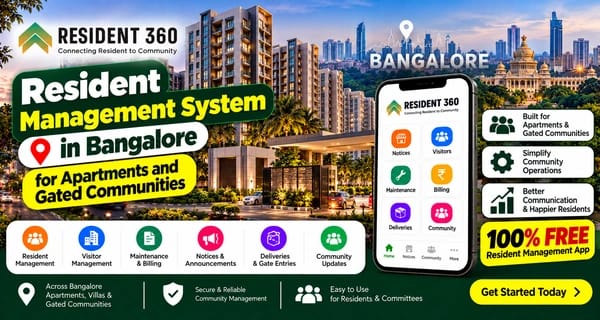
A Resident Management App can help residential communities in Karnataka bring everyday coordination into one more organized process. Residents, committee members, security teams, facility staff, and management groups often handle maintenance, visitors, complaints, notices, payments, and records through separate channels. A structured resident management system can reduce confusion by giving communities a clearer way to share information, track requests, coordinate responsibilities, and maintain important records. For societies and gated communities in Karnataka, the right digital approach can support smoother administration without replacing the people responsible for making decisions.
The needs of every community are different, so resident management should be planned around actual daily activities, resident expectations, and committee responsibilities rather than software features alone.
Why Karnataka Societies Need a Resident Management App
Residential communities in Karnataka manage a wide range of activities every day. Residents may need to report maintenance concerns, receive notices, confirm visitors, access payment details, or ask questions, while committee members and facility teams need a reliable way to coordinate these activities.
A Resident Management App can help bring these tasks into a more consistent process. It may support resident coordination, maintenance tracking, visitor handling, complaint follow-up, staff communication, facility scheduling, and record organization. Instead of depending only on paper registers, scattered messages, or individual spreadsheets, a community can create clearer processes for routine work.
This approach is especially useful when a community has several buildings, active facilities, rotating committee members, multiple service providers, or a large volume of resident requests. The goal is not simply to digitize records, but to make resident management easier to understand and maintain.
Common Problems Faced by Residents and Societies in Karnataka
Many residential communities face similar administrative difficulties, even when their size and facilities differ. These challenges can affect residents, committee members, security personnel, service staff, and the wider management team.
- Maintenance requests may be shared through calls or messages and become difficult to track.
- Pending dues and payment-related records may require repeated follow-up.
- Security staff may need clearer information about expected visitors and deliveries.
- Important notices can be missed when communication happens across several groups.
- Resident complaints may not have a consistent record, assigned person, or follow-up status.
- Housekeeping, security, and maintenance responsibilities may not be clearly coordinated.
- Facility bookings and shared-area maintenance can become difficult to organize.
- Resident information may be stored across paper files, spreadsheets, and personal devices.
- Committee members may spend considerable time answering repeated questions.
- Community updates may not reach all residents at the same time.
A structured Resident Management System can help communities create a clearer operating method. It can also give residents a more consistent place to find updates, share requests, and review the status of routine matters.
For communities comparing options, this overview of Resident Management System in Karnataka can provide useful local context when reviewing resident-management requirements.
How a Resident Management App Solves These Problems
A Resident Management App can connect several routine activities within one resident-management process. The committee can organize requests, notices, records, and follow-ups in a way that is easier to review, while residents may have a clearer way to communicate their needs.
For example, a resident could submit a maintenance request with relevant details instead of explaining the same issue to several people. A committee member or assigned staff person could review the request, coordinate the next step, and update the record when appropriate. This does not guarantee immediate resolution, but it can make responsibility and follow-up more visible.
The same principle can apply to notices, visitor coordination, facility use, payment-related information, and community records. A Resident Management App may help reduce scattered communication and support a more organized relationship between residents and the people managing daily operations.
Communities can also compare their requirements with a broader guide to resident management in Bengaluru before deciding which processes should be digitized first.
Maintenance, Visitor, Security, and Complaint Management
Maintenance, access coordination, security communication, and complaints are closely connected to the daily resident experience. A resident management system can help organize these activities while keeping human review and community rules at the centre of the process.
Maintenance Management
Maintenance work can involve requests, vendor coordination, recurring tasks, pending dues, payment-related records, and follow-up communication. A community may benefit from recording each request with enough detail to understand the issue and decide who should handle it.
A maintenance management software approach can help with:
- Recording maintenance requests and relevant descriptions.
- Reviewing open, pending, or completed work.
- Organizing follow-up with staff or service providers.
- Sharing maintenance-related communication with residents.
- Maintaining payment-related records and payment information responsibly.
- Reducing dependence on informal messages for routine tracking.
The process should also define who reviews requests, how urgent issues are identified, and how residents receive updates. Clear responsibility is often as important as the digital record itself.
Visitor Management
Visitor handling requires coordination between residents, security personnel, delivery workers, and community administrators. A visitor management system can support a more organized method for recording expected visitors, communicating with residents, and managing entry-related information.
Practical uses may include:
- Sharing visitor details with the appropriate resident or security team.
- Supporting resident confirmation before entry, according to community policy.
- Coordinating deliveries and service visits.
- Maintaining visitor records for appropriate administrative reference.
- Making security communication more consistent during busy periods.
The system should complement the community's access rules and the judgment of security personnel. It should not be treated as a substitute for responsible on-site security procedures.
Security Management
Security teams often manage visitor records, delivery movement, service personnel, emergency communication, and access coordination at the same time. A resident management system can help provide clearer information to the people responsible for these activities.
For example, committee members may be able to share relevant instructions more consistently, while security personnel can refer to organized visitor or resident information according to their responsibilities. Communities should also consider data access, record retention, and privacy when defining security-related processes.
Complaint Management
Residents need a practical way to report concerns related to maintenance, noise, common areas, services, or community administration. A digital complaint process can help record the issue, communicate it to the responsible person, and support follow-up.
A complaint record may include the date, category, location, description, assigned person, and current status. This does not promise that every issue will be resolved immediately, but it can reduce the chance of requests being forgotten and can give committee members a clearer view of recurring concerns.
Resident Communication, Staff, Facility, and Record Management
Good resident management depends on more than maintenance and visitor handling. Communities also need practical methods for sharing information, coordinating staff, managing common facilities, and keeping records available to the people who need them.
Resident Communication
Residents may need notices about maintenance work, water interruptions, meetings, facility schedules, safety instructions, or community events. A Resident communication app can support more organized sharing of announcements and updates.
A consistent communication process can help reduce repeated questions and make it easier for residents to find important information. Committee members should still decide which messages require broad circulation, which need targeted communication, and how urgent notices should be handled.
Staff Management
Housekeeping, security, maintenance, and other service responsibilities need clear communication. A resident management process can help the management team document daily responsibilities, share relevant instructions, and coordinate work without relying entirely on personal conversations.
Useful areas may include:
- Communicating routine responsibilities to the appropriate staff members.
- Sharing information about reported issues and required follow-up.
- Coordinating housekeeping and security-related activities.
- Keeping committee members informed about ongoing tasks.
- Recording relevant service updates for future reference.
The exact process should match the community's staffing structure and should not assign responsibilities that have not been agreed upon.
Facility Management
Common areas and shared facilities often require scheduling, usage guidelines, cleaning, repairs, and resident communication. A resident management system can help communities organize facility-related information and make responsibilities easier to review.
For example, a committee may maintain schedules for shared spaces, communicate temporary closures, and record maintenance requirements. The process should reflect the community's rules, available facilities, and the people responsible for supervision.
Record Management
Resident information, notices, maintenance records, payment-related details, facility information, and community documents should be organized carefully. A structured record process can make it easier for authorized committee members to find relevant information without searching through multiple files or message threads.
Communities should define who can access different records and review information periodically. Good record management also involves using accurate data, removing outdated information where appropriate, and handling personal details responsibly.
Resident Management System for Small Societies and Gated Communities
A smaller society may have fewer residents, limited facilities, and a compact committee structure, while a large gated community may coordinate several buildings, entry points, staff groups, vendors, and shared amenities. Their resident-management requirements can therefore be very different.
Smaller communities may focus on:
- Simple maintenance requests and payment tracking.
- Resident notices and committee communication.
- Visitor coordination with a small security team.
- Basic records and complaint follow-up.
Larger communities may need more structured processes for:
- Multiple resident groups and buildings.
- Several security gates or service entrances.
- Larger maintenance and housekeeping teams.
- Facility schedules and common-area responsibilities.
- More detailed visitor records and staff coordination.
- Higher volumes of resident requests and community updates.
The right resident management system should be adaptable to the community's size, rules, facilities, and administrative capacity. A useful evaluation should consider what residents and committee members will actually use, not only the number of available functions.
How Resident360app Simplifies Resident Management
Resident360app can be considered by communities that want a more organized approach to everyday resident management. Its role should be evaluated against the community's actual needs, including how residents communicate, how maintenance is followed up, and how visitor, facility, and record-related activities are handled.
Depending on the requirements of a community, a resident management system may support areas such as:
- Maintenance requests, pending dues, and payment-related tracking.
- Visitor and security coordination based on community procedures.
- Complaints and service requests with clearer follow-up records.
- Notices, announcements, and resident communication.
- Resident and property-related information organization.
- Staff and facility coordination for recurring activities.
- Community records and day-to-day activity management.
A more detailed look at the Apartment Management System can help committee members understand how a digital approach may fit their administration process. Communities can also review society maintenance management software when comparing maintenance-focused requirements within a wider resident-management plan.
The value of any system depends on accurate information, clear responsibilities, resident adoption, and regular use. Resident360app can help provide an organized framework, but each community should decide how its committee, staff, and residents will use that framework.
How to Choose the Right Resident Management System
Choosing a resident management system should begin with the community's daily challenges. Committee members, residents, and the management team can list the activities that cause the most confusion and then assess whether a proposed solution can support those activities in a practical way.
Consider the following areas:
- Usability: Residents and staff should be able to understand the basic process without unnecessary complexity.
- Resident adoption: The system should fit how residents receive notices, report issues, and review information.
- Maintenance: Check whether requests, dues, payment-related records, and follow-up can be organized clearly.
- Visitor management: Review how expected visitors, deliveries, security communication, and records are handled.
- Complaint management: Consider whether issues can be recorded, assigned, updated, and reviewed.
- Communication: Look for practical support for notices, announcements, and resident queries.
- Record organization: Assess how resident, facility, maintenance, and community information is stored and accessed.
- Staff coordination: Confirm that the process reflects the actual responsibilities of security, housekeeping, and maintenance staff.
- Facility management: Consider scheduling, shared-area updates, and maintenance communication for common facilities.
- Scalability: The system should remain useful if the community's resident count, facilities, or administrative needs change.
A community may also review a broader rwa management software guide before finalizing its requirements. The decision should be based on process fit, clarity, responsible data handling, and the willingness of residents and administrators to use the system consistently.
Conclusion
A Resident Management App can help Karnataka communities organize maintenance, visitor coordination, security communication, complaints, records, facilities, and resident updates through a clearer process. The right resident management system should match the community’s size, rules, staff structure, and resident expectations. By defining responsibilities and choosing tools that are practical to use, societies and gated communities can support more consistent daily administration with Resident360app.
Get Started with Resident360 Today
Resident360app can be considered by societies and residential communities looking for a more organized approach to resident management. To learn more, visit Resident360app.
Download the Resident360app Today