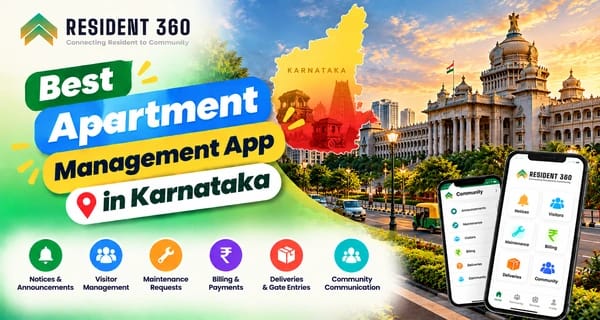
Managing an apartment community in Karnataka involves far more than collecting monthly dues. Resident Welfare Association (RWA) committees, facility managers, security teams, and residents must coordinate maintenance requests, visitors, staff, notices, shared facilities, and records every day. An Apartment Management App can bring these activities into a more organised process, reducing dependence on scattered messages, spreadsheets, paper registers, and repeated follow-ups. Whether the community is a compact apartment building in Bengaluru, a growing society in Mysuru, or a large gated community elsewhere in Karnataka, digital coordination can make routine administration easier to track and communicate.
The right system should support the way a community actually operates. It should be simple enough for residents to use, practical for committee members, and flexible enough to handle changing requirements as the property grows.
Why Karnataka Apartments Need an Apartment Management App
Apartment communities in Karnataka often have a mix of owners, tenants, domestic helpers, delivery personnel, vendors, security guards, and facility staff. Coordinating everyone through informal chat groups can make urgent information difficult to find and routine tasks difficult to monitor.
A digital platform can help create a common process for maintenance, visitor access, announcements, records, and follow-ups. It may also support clearer accountability, because residents and committee members can refer to updates and activity details instead of relying only on verbal communication.
For a committee that changes periodically, documented processes are especially useful. New members can understand pending work, recurring tasks, vendor coordination, and community records without starting from the beginning.
Common Problems Faced by Apartments and Societies in Karnataka
Different communities experience different operational pressures, but many apartment associations face similar challenges as the number of residents, staff, and facilities increases.
- Maintenance requests are shared in multiple groups and may be missed.
- Monthly dues, receipts, and payment follow-ups can take considerable manual effort.
- Visitor details may be recorded inconsistently at the security gate.
- Residents may not know whether a reported issue is pending, assigned, or resolved.
- Notices can get buried under unrelated conversations.
- Committee members may depend on separate spreadsheets and paper files.
- Staff duties and vendor visits may not be clearly assigned.
- Shared facilities can become difficult to schedule fairly.
- Important records may be spread across personal devices and email accounts.
- Handover between outgoing and incoming committee members may be incomplete.
These issues affect more than administration. Residents may experience delayed service, guards may receive unclear instructions, and committee members may spend time searching for information instead of resolving priorities. A structured process can help the community respond more consistently.
A Society Management App can bring several routine activities into one accessible workspace. For communities that focus strongly on recurring repairs and dues, a Society Maintenance App may also help create a clearer maintenance workflow.
How an Apartment Management App Solves These Problems
An Apartment Management App can connect activities that are often managed separately. Instead of asking residents to post a request in a group, call a committee member, and follow up with a staff person, the community can use a defined process for reporting, assigning, updating, and closing work.
For example, a resident may report a water leakage issue with a description and supporting details. The relevant staff member or committee representative can review it, assign the next action, update the status, and keep the resident informed. This does not remove the need for human judgement, but it can make the sequence easier to follow.
A digital process can also help with:
- Recording recurring maintenance activities and service requests.
- Sharing notices with the intended residents or community groups.
- Organising resident, tenant, vehicle, and staff information.
- Tracking follow-ups that require committee attention.
- Keeping operational information available during committee changes.
Communities reviewing a dedicated Apartment Management App can compare features against their own workflows rather than selecting software only because it has a long feature list.
Maintenance, Visitor, Security, and Complaint Management
Daily operations become easier to coordinate when maintenance, visitor handling, security communication, and resident issues follow clear processes. These areas are closely connected, so information should be easy for authorised people to locate.
Maintenance Management
Maintenance work can include plumbing, electrical repairs, lift coordination, housekeeping, common-area cleaning, landscaping, and preventive inspections. Without a consistent system, requests may be duplicated or forgotten after a verbal conversation.
A community can use maintenance management software to support activities such as:
- Registering a request with location and issue details.
- Assigning work to a staff member, vendor, or committee representative.
- Recording status changes and follow-up notes.
- Separating urgent repairs from routine requests.
- Reviewing recurring issues in particular areas of the property.
The aim is not only to record complaints but also to give the team a practical way to manage the work that follows.
Visitor Management
Visitor coordination is especially important in communities with frequent deliveries, domestic workers, drivers, guests, and service providers. A visitor management system can help the security team follow a more organised entry process while allowing residents to provide relevant visitor information in advance.
Useful practices may include:
- Recording visitor or vendor details at entry.
- Supporting resident confirmation where required.
- Maintaining a reviewable history of entries.
- Sharing instructions for deliveries and service personnel.
- Helping residents communicate temporary access information.
The exact process should reflect the community's security policy and should not make entry unnecessarily difficult for residents, guests, or essential service workers.
Security Management
Security teams need clear information about residents, vehicles, expected visitors, move-ins, move-outs, and vendor access. A digital process can support coordination between the gate, residents, facility staff, and the committee without requiring every instruction to be repeated verbally.
Communities should also define who can view or update sensitive records. Access permissions, clear escalation procedures, and regular communication with guards remain important even when software is used.
Complaint Management
A resident should have a clear route for reporting issues, whether the concern relates to noise, water supply, cleanliness, parking, repairs, or shared facilities. A structured complaint process can help distinguish new issues from repeated follow-ups and show which matters require committee review.
The management team can review open requests, add comments, communicate expected next steps, and close an issue after suitable action. This can make follow-up more transparent without promising that every issue will be resolved immediately.
Resident Communication, Staff, Facility, and Record Management
Strong administration depends on timely information. Residents need relevant updates, staff need clear instructions, and committee members need dependable records to make practical decisions.
Resident Communication
Important notices can be missed when they are mixed with informal messages. A Resident communication app can help communities organise announcements, reminders, event information, maintenance updates, and emergency communication in a more focused channel.
Communication should remain concise and purposeful. Committees can separate general notices from issue-specific conversations and provide residents with a clear place to ask questions or report concerns.
Staff Management
Apartment staff may handle housekeeping, security coordination, waste management, landscaping, equipment checks, and support for events or repairs. Clear task allocation can help supervisors understand what is pending and what has already been completed.
A digital record may support shift instructions, recurring duties, vendor visits, and escalation notes. It should complement regular supervision rather than replace conversations with staff or contractors.
Facility Management
Clubhouses, gyms, swimming pools, sports areas, party halls, visitor parking, and other common facilities often require schedules and usage rules. A community can use a defined booking or approval process to reduce confusion and help residents understand availability.
Facility records can also support cleaning schedules, inspection reminders, equipment servicing, and notices about temporary closures. These details are easier to manage when they are not scattered across separate files.
Record Management
A community may need to organise notices, resident details, tenant information, maintenance history, vendor records, payment updates, and committee documents. A Maintenance management system can support service records, while a broader rwa management software approach may bring administration and communication activities together.
Committees should also review permissions, backups, retention practices, and the accuracy of stored information. Good record management is useful only when records are maintained responsibly and remain accessible to authorised users.
Apartment Management App for Small Apartments and Gated Communities
A small apartment building and a large gated community may need the same basic categories of support, but their daily scale is different. A smaller property may need simple maintenance tracking, resident communication, payment follow-up, and a basic visitor process without complicated administration.
A larger community may coordinate multiple towers, several entry gates, more security personnel, numerous vendors, shared facilities, and a higher volume of service requests. It may need stronger role management, clearer escalation, separate facility workflows, and better coordination between the central office and individual blocks.
The right system should be proportionate to the community. Residents should not face unnecessary complexity, while larger associations should have enough structure to manage volume. Scalability can be assessed by considering resident numbers, staff roles, facilities, communication needs, and the likely growth of the property.
How Resident360app Simplifies Apartment Management
Resident360app can be considered as a central platform for communities that want to organise recurring apartment operations in one place. Its usefulness depends on how the association configures processes and encourages residents, committee members, staff, and security teams to use them consistently.
Depending on community requirements, a platform can help support:
- Resident and apartment information management.
- Maintenance requests, assignments, and status updates.
- Visitor and gate coordination.
- Notices and resident communication.
- Payment-related updates and administrative records.
- Facility information and recurring operational tasks.
- A clearer handover process for committee members.
For payments and related processes, committees should share accurate payment information and follow appropriate banking and security practices. Software can make information easier to organise, but associations should still define approval responsibilities, access controls, and financial procedures.
The value of a platform is usually determined by everyday adoption. A simple workflow that residents and staff actually use may be more helpful than a complex system that remains incomplete or inconsistent.
How to Choose the Right Apartment Management App
Before selecting an Apartment Management App, an association should map its existing work. List the most frequent maintenance requests, communication gaps, visitor procedures, facility schedules, payment tasks, and records that need better organisation.
Consider these practical questions:
- Usability: Can residents, guards, staff, and committee members understand the main actions without lengthy training?
- Management requirements: Does the platform match the community's size, facilities, staff structure, and approval processes?
- Resident adoption: Are there simple ways to encourage owners, tenants, and families to use the relevant features?
- Scalability: Can the system support additional blocks, residents, staff, or facilities as the community changes?
- Communication: Can notices, reminders, and operational updates reach the right audience clearly?
- Maintenance: Can requests be assigned, followed up, prioritised, and reviewed after completion?
- Record organisation: Can authorised users find resident, vendor, facility, and activity information without depending on one person's files?
The Apartment Management App guide can help a committee frame its evaluation around practical community needs. It is also useful to confirm onboarding expectations, user roles, data handling, support processes, and any configuration needed before rollout.
Conclusion
Apartment communities in Karnataka need practical systems that support maintenance, visitor handling, security coordination, communication, records, and resident follow-up without adding unnecessary complexity. An Apartment Management App can help an RWA create clearer workflows and improve visibility across daily tasks. By reviewing community needs, resident adoption, staff responsibilities, and record practices, committees can choose a more organised approach that supports both small apartments and large gated communities.
Get Started with Resident360 Today
Resident360app can be considered by apartment communities looking for a more organized approach to apartment management. To learn more, visit Resident360app.
Download the Resident360app Today