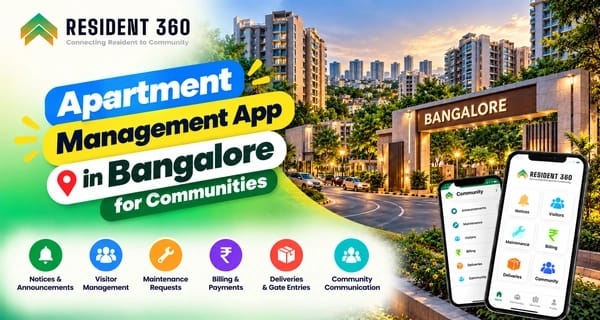
Managing an apartment community in Bangalore involves much more than collecting monthly dues. Resident Welfare Associations, facility managers, security teams, and residents must coordinate maintenance, visitors, complaints, notices, staff, facilities, and records every day. An Apartment Management App can help bring these activities into a more organised process, reducing dependence on scattered spreadsheets, messaging groups, paper registers, and repeated follow-ups. For communities across Karnataka, the right digital approach can support clearer communication, better accountability, and easier access to routine information without replacing the decisions of the association or management committee.
The value of an organised system depends on how well it fits the community’s size, facilities, staff structure, and daily habits. A practical rollout should focus on simple workflows that residents and teams can use consistently.
Why Karnataka Apartments Need an Apartment Management App
Apartment communities in Karnataka often include a mix of owners, tenants, families, domestic workers, delivery personnel, vendors, and facility staff. In Bangalore, changing occupancy, busy schedules, shared amenities, and frequent service requests can make manual coordination difficult. A central Apartment Management App can help the RWA maintain a clearer view of everyday tasks while giving residents a convenient way to receive updates and raise requests.
A digital process may also help committee members divide responsibilities more clearly. Instead of searching through several chat groups or paper files, authorised users can refer to organised records, notices, maintenance requests, and visitor information from a common platform.
Common Problems Faced by Apartments and Societies in Karnataka
Apartment operations often become difficult when information is spread across different channels. The challenges below can affect residents, committee members, security staff, housekeeping teams, and vendors in different ways.
- Maintenance requests may be reported through calls, messages, or informal conversations, making follow-up difficult.
- Monthly dues and other payment-related updates may not be visible to every resident at the right time.
- Visitor entries can depend heavily on handwritten registers and manual checks.
- Emergency notices may get buried in busy messaging groups.
- Committee members may spend time answering the same questions repeatedly.
- Staff attendance, task allocation, and vendor visits may be recorded inconsistently.
- Facility bookings can lead to confusion when schedules are maintained separately.
- Complaint status may not be clear to the resident who reported the issue.
- Important documents and resident information may be stored across personal devices or spreadsheets.
These gaps can create avoidable delays. Residents may feel that requests are being overlooked, while committee members may struggle to understand which tasks are pending, assigned, or completed.
A structured Society Management App can give committees a more consistent way to coordinate routine society activities. It does not remove the need for human judgement, but it can make information easier to organise and review.
How an Apartment Management App Solves These Problems
An Apartment Management App connects common apartment workflows through one digital environment. Residents can use it to view notices, submit requests, check relevant updates, and access information shared by the association. Committee members and facility teams can use it to assign work, review pending items, and maintain a more reliable record of activity.
For example, a resident who notices a leaking pipe in a common area can submit a request with a description and supporting details. The assigned staff member or vendor can then receive the task, while the committee can monitor progress instead of relying on separate calls and messages.
The same approach can support:
- Maintenance request registration and status updates.
- Community announcements and targeted notices.
- Visitor pre-approvals and entry coordination.
- Payment-related updates and downloadable records.
- Facility schedules and shared-space requests.
- Resident information and community documents.
Communities comparing different solutions can also review this guide to choosing a Society Maintenance App and assess whether its workflows match their own maintenance process.
Maintenance, Visitor, Security, and Complaint Management
Daily operations become easier to review when maintenance, visitor movement, security coordination, and complaints follow defined workflows. Digital records can support timely action while keeping responsibilities visible to the people involved.
Maintenance Management
Maintenance work may include plumbing, electrical repairs, lift-related issues, common-area cleaning, water systems, landscaping, and equipment servicing. A maintenance management software workflow can help a community record the request, assign responsibility, add notes, and track the current status.
Useful practices include:
- Categorising requests by service type and urgency.
- Assigning tasks to internal staff or approved vendors.
- Recording photographs, remarks, and completion details.
- Reviewing recurring problems to support preventive maintenance.
- Keeping residents informed when a request is delayed or resolved.
A separate Maintenance management system may be especially useful where the association handles many recurring tasks across several buildings or facilities.
Visitor Management
Visitor handling needs to balance convenience and security. A visitor management system can help residents pre-approve guests, coordinate deliveries, and provide security staff with clearer entry information.
It may support processes such as:
- Recording visitor details at the gate.
- Notifying residents about expected visitors.
- Managing delivery and service-person entries.
- Supporting temporary access for guests or vendors.
- Maintaining a searchable visit history for authorised users.
The exact process should reflect the community’s security policy and should be communicated clearly to residents, guards, and service providers.
Security Management
Security teams benefit from clear instructions and accessible records. A digital system can support gate coordination, visitor verification, resident alerts, and communication about unusual activity. It may also help the security supervisor review entries, shift notes, and pending instructions without depending entirely on paper registers.
Technology should complement, not replace, trained security personnel and the association’s approved access rules. Communities should also define who can view visitor details and how long such records should be retained.
Complaint Management
A complaint process works better when residents know where to report an issue and what happens next. A linked complaint workflow can help capture the subject, location, urgency, assigned person, and resolution note.
Residents are more likely to trust the process when they receive an acknowledgement or status update. For committees, categorised complaints can reveal recurring issues such as water supply, parking, noise, housekeeping, or facility damage.
Resident Communication, Staff, Facility, and Record Management
Apartment administration depends on information reaching the right people at the right time. A shared digital process can help reduce duplication while giving residents, staff, and committee members clearer access to relevant updates.
Resident Communication
Notices shared only through informal groups may be missed, especially by residents who are travelling, have muted notifications, or recently moved into the community. A Resident communication app can help the association distribute notices, reminders, meeting information, emergency updates, and community messages in a more organised manner.
Communication should remain concise and purposeful. Committees can separate urgent alerts from routine announcements and use clear subject lines so residents understand what action, if any, is required.
Staff Management
Security guards, housekeeping staff, technicians, gardeners, drivers, and supervisors may work different shifts and handle different responsibilities. Organised staff records can help the facility manager plan tasks, record attendance where supported, share instructions, and follow up on incomplete work.
A digital workflow may also make vendor coordination easier by keeping service details, assigned work, and completion notes together. This can support better discussions during committee reviews without making unsupported assumptions about staff performance.
Facility Management
Shared facilities such as clubhouses, gyms, multipurpose halls, sports areas, swimming pools, and visitor parking require clear schedules and usage rules. A central system can help residents view availability, submit requests, and receive reminders about approved timings or applicable guidelines.
Facility records should include maintenance closures, booking changes, and safety instructions. This reduces the likelihood of conflicting reservations and helps the committee plan routine inspections.
Record Management
Associations may need to organise notices, resident details, maintenance records, vendor information, meeting documents, and payment-related updates. A digital record structure can make retrieval easier and reduce the risk of relying on one person’s phone, inbox, or spreadsheet.
Access controls remain important. The association should decide which information is visible to residents, committee members, staff, vendors, and administrators, particularly when handling personal or financial details.
Apartment Management App for Small Apartments and Gated Communities
A smaller apartment may have fewer residents, limited facilities, and a committee that manages operations alongside other responsibilities. Its priorities may include maintenance requests, notices, visitor records, dues communication, and a simple resident directory. The system should be easy to adopt without creating unnecessary administrative work.
A larger gated community may need more detailed coordination across towers, multiple entry gates, extensive facilities, several staff shifts, and a larger vendor network. It may benefit from role-based access, building-level communication, facility scheduling, visitor processes, and stronger reporting workflows.
In both settings, adoption matters more than the number of features. Residents should understand how to submit requests, receive notices, and update relevant information, while staff and committee members should know who is responsible for reviewing and closing each task.
How Resident360app Simplifies Apartment Management
Resident360app can help apartment communities bring common management activities into a more structured digital process. Its usefulness will depend on the community’s configuration, operating rules, and consistency of use by residents and administrators.
Communities can explore the Apartment Management App to understand how a central platform may support routine apartment operations. Depending on the association’s needs, practical areas of focus may include:
- Resident communication and community announcements.
- Maintenance request coordination and follow-up.
- Visitor and gate-entry workflows.
- Resident, staff, facility, and vendor information.
- Payment-related communication and accessible records.
- Complaint submission and status visibility.
- Organised support for committee administration.
A community considering rwa management software should first map its current processes. This helps the committee identify which activities require immediate improvement and which can be introduced later.
How to Choose the Right Apartment Management App
The right platform should fit the way the community already works while helping it improve gradually. Before making a decision, the committee can review the following considerations:
- Usability: Residents, guards, staff, and committee members should be able to understand the main workflows without extensive training.
- Management requirements: List the community’s actual needs, including maintenance, visitors, facilities, communication, records, and payment updates.
- Resident adoption: Consider onboarding, language clarity, mobile access, and support for residents who are less comfortable with digital tools.
- Scalability: The system should remain practical if the community adds residents, buildings, facilities, staff, or entry points.
- Communication: Check whether notices, reminders, emergency messages, and targeted updates can be organised clearly.
- Maintenance: Review whether tasks can be assigned, tracked, categorised, and closed with useful notes.
- Record organisation: Confirm how resident information, service history, documents, and payment information are handled.
- Access and privacy: Understand administrator roles, data visibility, and processes for updating or removing access.
- Committee coordination: A clear management team workflow can help divide responsibilities and reduce dependence on one individual.
The association may also review a detailed apartment management app guide before comparing features, implementation needs, and expected resident workflows. Since no single setup suits every community, a short trial or structured demonstration can help the committee evaluate practical fit.
Conclusion
Apartment communities in Karnataka can use a structured digital process to make maintenance, visitor handling, security coordination, complaints, communication, facilities, and records easier to manage. An Apartment Management App can support residents, committee members, staff, and facility managers when its workflows are simple and consistently followed. By assessing community needs first, an RWA can choose tools that improve visibility without adding unnecessary complexity.
Get Started with Resident360 Today
Resident360app can be considered by apartment communities looking for a more organized approach to apartment management. To learn more, visit Resident360app.
Download the Resident360app Today