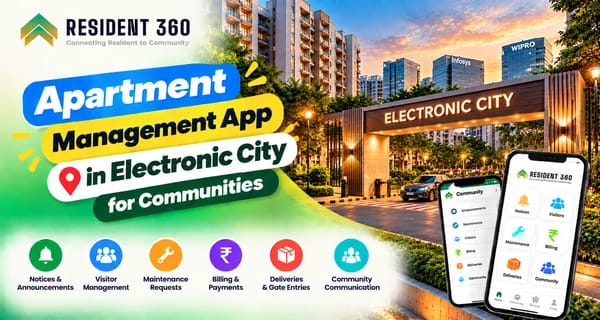
Managing an apartment community in Electronic City involves much more than collecting monthly dues or sending notices. Resident Welfare Associations, committee members, security teams, housekeeping staff, and facility managers must coordinate maintenance, visitors, complaints, communication, and records every day. An Apartment Management App can help bring these activities into a more organised process, reducing dependency on scattered messages, spreadsheets, paper registers, and repeated follow-ups. For communities in Karnataka, the right digital approach can support clearer responsibilities and smoother daily operations.
The aim is not to replace human coordination. It is to give residents and management teams a practical system for handling routine work with better visibility and consistency.
Why Electronic City Apartments Need an Apartment Management App
Electronic City has a wide mix of apartment complexes, gated communities, working professionals, families, tenants, and shared facilities. This diversity creates a steady flow of service requests, visitor movements, payments, notices, and operational decisions that need timely attention.
A central platform can help committees record requests, share updates, coordinate staff, and maintain useful information in one place. It may also make it easier for residents to follow the status of their requests instead of relying only on personal calls or group chats. Communities reviewing a digital approach can also refer to this detailed Apartment Management App resource to understand the typical areas such a platform may cover.
Common Problems Faced by Apartments and Societies in Electronic City
Apartment associations in Electronic City often deal with recurring operational issues, even when committee members and staff are actively involved. These challenges can affect response times, resident satisfaction, security coordination, and the accuracy of community records.
- Maintenance requests are shared through different WhatsApp groups, calls, or paper notes.
- Residents may not know whether an issue has been assigned or resolved.
- Visitor information can be difficult to retrieve when registers are maintained manually.
- Security guards may receive incomplete instructions about expected guests or deliveries.
- Monthly maintenance collections and payment follow-ups require repeated manual work.
- Notices can be missed when they are posted across multiple channels.
- Staff duties, attendance, and task completion may not be consistently recorded.
- Facility bookings can result in scheduling conflicts between residents.
- Committee members may spend too much time searching for old records and conversations.
- Complaints may be repeated because earlier actions and resolutions are not documented clearly.
These issues create extra work for residents, committee members, security personnel, and facility staff. A structured Society Management App can help bring routine activities into a common workflow, while a Society Maintenance App can support more focused handling of service requests and upkeep tasks.
How an Apartment Management App Solves These Problems
An Apartment Management App can connect activities that are often handled separately. Instead of using one tool for notices, another for maintenance records, and a paper register for visitors, the community can adopt a more coordinated process.
For example, a resident can submit a maintenance request with relevant details. The management team can review it, assign it to the appropriate staff member or vendor, add an update, and close it after completion. This creates a basic service trail that helps both the resident and the committee understand what happened.
A digital process can also help with:
- Recording resident requests in an organised manner.
- Sharing notices with selected groups or the wider community.
- Tracking maintenance charges and payment-related updates.
- Coordinating expected visitors, deliveries, and service personnel.
- Keeping facility bookings visible to avoid overlapping reservations.
- Preserving important records for future committee members.
The value comes from consistency. When information is recorded in a common system, the community may spend less time reconstructing events from separate chats, calls, and spreadsheets.
Maintenance, Visitor, Security, and Complaint Management
Daily apartment operations depend on quick coordination between residents, staff, security personnel, vendors, and committee members. A digital workflow can help each group understand what needs attention and what action has already been taken.
Maintenance Management
Maintenance issues can range from plumbing leaks and electrical faults to lift concerns, common-area cleaning, water supply problems, and equipment servicing. A maintenance management software solution can help organise these requests by recording the issue, location, priority, assigned person, and status.
Useful practices may include:
- Creating a separate record for each maintenance request.
- Assigning tasks to internal staff or an external vendor.
- Adding notes when an inspection or repair is completed.
- Keeping recurring maintenance activities visible to the team.
- Reviewing open requests before committee meetings.
A documented process can reduce the risk of requests being forgotten or handled more than once. It also gives residents a clearer way to follow up without repeatedly explaining the same problem.
Visitor Management
Security teams in Electronic City apartments may handle guests, domestic workers, delivery executives, cab drivers, technicians, and move-in or move-out activity. A visitor management system can help standardise how entries are requested, verified, recorded, and communicated.
Depending on the community’s process, it may support:
- Pre-approving expected guests.
- Recording visitor entry and exit details.
- Coordinating delivery and service personnel access.
- Sending relevant alerts to residents or security staff.
- Maintaining a searchable record for operational review.
The system should support the community’s security policy and not replace the judgement of trained security personnel.
Security Management
Security coordination becomes easier when guards, residents, and committee members receive consistent information. Clear instructions for expected visitors, vendor access, emergency contacts, and restricted areas can reduce confusion at the gate.
A digital record may also help the committee review unusual access patterns, verify whether a visitor was expected, and communicate updates to security staff. Access to information should be based on appropriate roles so that sensitive resident details are handled responsibly.
Complaint Management
Residents need a dependable way to report concerns involving common areas, noise, parking, housekeeping, water, repairs, or security. A structured complaint process can help separate genuine service requests from general announcements and ensure that each issue receives attention.
The management team can record the complaint, review its urgency, assign responsibility, and add a resolution note. This may make follow-up more transparent and help the committee identify repeated issues that require a longer-term solution.
Resident Communication, Staff, Facility, and Record Management
Good apartment management depends on more than issue tracking. Residents need timely information, staff need clear duties, facilities need planned usage, and committees need reliable records for everyday decisions.
Resident Communication
Apartment communities often share updates about water supply, lift maintenance, festive events, parking, association meetings, repairs, and emergency situations. A Resident communication app can help bring these updates into a more organised channel instead of depending entirely on informal groups.
Communication works better when notices are clear, relevant, and sent to the right audience. Communities may also use separate workflows for announcements, private service updates, payment reminders, and committee discussions.
Staff Management
Housekeeping, security, gardening, plumbing, electrical, and facility staff may work on different schedules. Clear task allocation can help supervisors understand attendance, assigned duties, pending work, and completed activities.
A digital record can also support smoother handovers between shifts. This is useful when a staff member is absent or when a new vendor takes responsibility for a service area. It may reduce dependence on verbal instructions that are easily missed.
Facility Management
Clubhouses, swimming pools, gyms, community halls, sports courts, and visitor parking areas require rules and scheduling. A central process can help residents view availability, request a slot, and understand any usage guidelines or charges.
Facility records can also help committees review recurring maintenance needs and plan inspections. Clear booking information may reduce disputes caused by overlapping reservations or last-minute changes.
Record Management
Apartment associations need to maintain notices, resident information, maintenance histories, vendor details, payment records, meeting notes, and community documents. Using rwa management software can help the Resident Welfare Association organise these records in a more structured way.
Good record management is especially helpful when committee members change. A documented history can help new members understand earlier decisions, ongoing contracts, recurring expenses, and unresolved matters without depending only on personal handovers.
Apartment Management App for Small Apartments and Gated Communities
The right setup may differ according to the size and structure of the community. A smaller apartment may need simple maintenance requests, notices, payment tracking, visitor records, and resident information without a complex administrative process.
A large gated community may need more detailed coordination across several towers, multiple entry gates, a larger security team, vendors, extensive facilities, and different resident groups. It may require role-based access, more structured work allocation, facility scheduling, and a clearer process for reviewing open issues.
In both cases, resident adoption matters. The platform should be easy enough for residents to use and practical enough for committee members and staff to manage. Communities looking at nearby Bengaluru areas can also compare the considerations in this guide to an Apartment Management App in Sarjapur Road, an Apartment Management App in Varthur, and an Apartment Management App in Marathahalli.
How Resident360app Simplifies Apartment Management
Resident360app can help apartment communities bring several routine activities into a more connected management process. Its usefulness depends on how the association configures workflows and how consistently residents, staff, and committee members use them.
A community may use it to support:
- Resident and household information management.
- Maintenance requests and follow-up activities.
- Visitor and security coordination.
- Notices and resident communication.
- Staff, vendor, and facility-related records.
- Payment updates and community administration.
- Organised access to information for authorised users.
The objective is practical organisation rather than adding more complexity. When common activities are recorded in one place, the committee can spend more time reviewing priorities and less time searching through disconnected messages. A Maintenance management system can also help communities create a clearer service process for repairs, inspections, and recurring work.
How to Choose the Right Apartment Management App
Before selecting an Apartment Management App, the association should first identify its actual needs. A smaller community may prioritise maintenance and communication, while a larger gated community may need stronger coordination for security, facilities, staff, vendors, and multiple towers.
Consider the following points:
- Usability: Residents, guards, staff, and committee members should be able to understand the main workflows without extensive training.
- Management requirements: Review whether the platform supports maintenance, visitor handling, complaints, notices, records, facilities, and payment-related administration.
- Resident adoption: A system is more useful when residents can submit requests, receive updates, and access relevant information conveniently.
- Scalability: The platform should be able to support changes in occupancy, facilities, staff, and management structure.
- Communication: Check whether the community can send targeted notices and maintain useful communication records.
- Maintenance: Look for request assignment, status tracking, follow-ups, recurring tasks, and vendor coordination.
- Record organisation: The association should be able to keep important information structured and accessible to authorised users.
- Payment clarity: Communities should provide residents with clear payment information and follow suitable processes for collecting and recording dues.
- Team coordination: A committee may benefit from clear roles and workflows supported by an organised management team.
It is also sensible to review data access, support processes, onboarding requirements, and the platform’s fit with the association’s existing rules. A short internal review with committee members, staff, and residents can help identify the features that will be used most often.
Conclusion
Electronic City apartment communities can face daily pressure from maintenance requests, visitor handling, security coordination, complaints, communication, facilities, and records. An Apartment Management App can help bring these activities into a clearer and more consistent process. By choosing tools that match community size, resident needs, staff workflows, and committee responsibilities, apartments in Karnataka can support more organised administration without losing the value of human oversight.
Get Started with Resident360 Today
Resident360app can be considered by apartment communities looking for a more organized approach to apartment management. To learn more, visit Resident360app.
Download the Resident360app Today