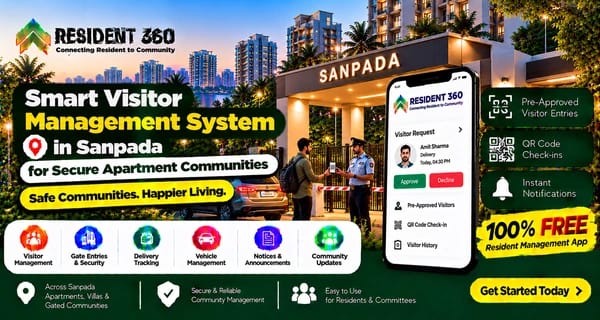
Visitor Management in Sanpada societies involves more than recording a name at the gate. Security teams need to verify visitors, residents need a clear way to approve expected guests, and committee members need reliable entry information when questions arise. In busy residential communities across Mumbai, deliveries, domestic staff, contractors, guests, and service personnel may arrive throughout the day. A visitor management system can help bring these activities into a more organized process without making gate operations unnecessarily complicated.
For a society management team, the objective is not only faster entry. It is also clearer communication, better coordination between residents and guards, and a usable record of who entered and left the premises.
Why Sanpada Societies Need More Organized Visitor Management
Sanpada includes apartment buildings and gated residential communities where security teams may handle a steady flow of guests, delivery agents, technicians, domestic workers, and drivers. Manual registers can become difficult to read, search, and maintain, particularly during busy hours or shift changes. Residents may also be unavailable to answer calls immediately, which can create delays at the entrance.
A structured visitor process can help societies define how expected and unexpected visitors are handled. It may support better coordination between the gate, residents, committee members, and facility staff while keeping the focus on practical day-to-day security operations. The right approach should be simple enough for regular use and clear enough to support consistent decisions.
Common Visitor Management Problems in Sanpada Residential Communities
Visitor-related difficulties often arise when information is spread across phone calls, paper registers, and informal messages. A digital process does not remove the need for security judgement, but it can make routine coordination more organized.
- Manual registers may be incomplete, difficult to read, or time-consuming to review.
- Guards may need to make repeated calls when a resident is not immediately reachable.
- Residents may not have a consistent process for approving expected guests.
- Delivery personnel can create congestion during peak arrival periods.
- Entry and exit details may not be recorded in a uniform format.
- Security staff may not receive clear information about recurring domestic staff or service personnel.
- Shift changes can make it harder to understand pending visitor-related matters.
- Committee members may struggle to review visitor records when investigating an incident or query.
- Residents may receive inconsistent communication about gate procedures.
- Contractors and technicians may arrive without enough information about the apartment or service request.
A can provide a broader operating environment in which visitor coordination sits alongside resident records, service requests, and community communication. This can be useful when a committee wants to reduce disconnected processes rather than manage every gate activity separately.
A society maintenance app is not primarily a visitor tool, but related resident and payment records can help a society maintain more complete administrative information. Similarly, an apartment management app may help bring resident details and apartment information into one organized environment, subject to the processes followed by the community.
How a Visitor Management System Can Improve Gate Coordination
A visitor management system can address common gate problems by creating a clearer sequence: identify the visitor, contact or confirm the resident, allow entry according to society policy, and record the relevant details. This sequence can help reduce repeated manual work while keeping security staff involved in the decision-making process.
For example, when a guest arrives for a resident in Sanpada, the gate team can follow the society’s defined verification process before allowing entry. For a delivery, the guard can coordinate with the resident and direct the visitor according to community rules. For a technician, the entry can be connected to the purpose of the visit and the apartment concerned. These steps may create more consistent handling without assuming that every visitor should be treated in exactly the same way.
Societies that already use maintenance management software may also benefit from considering how visitor information fits into wider facility workflows. A visitor record can be useful when a service professional is expected for a repair, inspection, or scheduled maintenance activity. The key is to keep the process practical, understandable, and aligned with the society’s operating policies.
Four Core Areas of Effective Visitor Management
Visitor Entry and Verification
The first stage is identifying who is arriving and why. Security staff can follow a consistent process for guests, delivery personnel, domestic staff, contractors, and service providers.
- Record relevant visitor details in an organized format.
- Distinguish between expected guests, deliveries, and service visits.
- Apply the society’s entry rules consistently across shifts.
Resident Approval
Resident confirmation can help the gate team decide whether a visitor should proceed. A clear approval process may reduce repeated calls and make it easier to handle visitors when residents are temporarily unavailable.
- Allow residents to communicate approval according to society procedures.
- Record whether entry was approved, declined, or still pending.
- Use clear escalation steps for unusual or disputed visits.
Security Coordination
Guards, supervisors, committee members, and facility staff need a shared understanding of gate activity. A visitor management system can support this coordination by keeping relevant information in an accessible format.
- Help security teams follow the same process across shifts.
- Make pending visitor matters easier to hand over.
- Support communication between the gate and residents when clarification is needed.
Visitor Records
A reliable record can help the society review past entries when a resident raises a question or when committee members need to understand what happened at a particular time. Records should be maintained according to the community’s policies and access practices.
- Organize entry and exit information.
- Make recurring visitor activity easier to review.
- Support fact-based follow-up instead of relying only on memory.
Related Society Operations That Support Visitor Management
Delivery Coordination
Deliveries are a regular part of apartment life and can increase pressure at the gate. Clear communication between residents and security staff may help reduce confusion, particularly when several delivery personnel arrive together.
- Separate delivery handling from guest and service visits.
- Share practical instructions with residents and guards.
- Reduce unnecessary waiting by using a consistent confirmation process.
Service Personnel Management
Domestic workers, drivers, technicians, and contractors may visit regularly or for a limited period. Recording the purpose and frequency of visits can help the society apply its rules more consistently.
- Maintain clearer information about recurring service personnel.
- Connect technician visits with the relevant apartment or work purpose.
- Make it easier for guards to identify unusual or unexpected visits.
Resident Communication
A Resident communication app can support notices about gate timings, delivery procedures, visitor rules, and temporary access restrictions. Clear updates may reduce misunderstandings between residents and the security team.
- Share approved visitor procedures with residents.
- Communicate changes before they affect gate operations.
- Provide a common channel for questions related to visitor handling.
Complaints and Follow-Up
Visitor issues may involve delayed entry, an unrecognized person, a delivery concern, or a disagreement about access. A structured complaint process can help the society record the concern, identify the responsible team, and follow up more clearly.
- Record the nature and time of a visitor-related complaint.
- Route the matter to the appropriate committee member or facility staff.
- Track follow-up so that recurring gate issues are not overlooked.
A society may also refer to a defined complaint system when designing how visitor concerns should be reported and reviewed. This keeps the process focused on resolution rather than informal conversations alone.
Visitor Management for Different Residential Communities
Small societies may have fewer daily visitors, but they still need a dependable way to handle guests, deliveries, and service providers. A simple process can help avoid reliance on one guard’s memory or a single paper register. The society can define which visitor categories need resident confirmation and which routine entries may follow pre-approved instructions.
Apartment communities with multiple buildings may need stronger coordination between building entrances, residents, and security supervisors. Clear records can help teams understand where a visitor is expected to go and whether the visit has been completed. Processes should remain easy enough for residents and guards to follow without creating unnecessary steps.
Larger gated communities may experience higher visitor volume, multiple gates, and more frequent deliveries. In such settings, the society may need clear rules for guest entry, contractor access, recurring staff, and exit recording. A visitor management system can provide a more organized approach, but the community still needs defined responsibilities and practical training for the people using it.
RWAs may also use visitor information as part of wider administrative coordination. An rwa management software approach can bring visitor procedures closer to resident records, maintenance activities, and committee communication. For communities comparing local practices, a visitor management system in Kopar Khairane may offer another location-focused reference point, while a second example from visitor management in Kopar Khairane can help committees compare how similar residential settings frame gate operations. A further guide to visitor management in Kopar Khairane may also be useful when discussing visitor volume, approval workflows, and security responsibilities with committee members.
How Resident360app Can Support Visitor Management in Sanpada
Resident360app can be considered by Sanpada societies looking for a more organized approach to resident and community operations. For a visitor-focused process, the most relevant areas are visitor and security coordination, resident communication, resident and apartment records, complaints, and staff or facility coordination. These areas can help connect gate activity with the people responsible for responding to it.
A society may use an organized resident record to reduce confusion about apartment details and contact responsibility. Communication tools can help share visitor procedures or clarify an access-related question. Complaint and service-request workflows may also support follow-up when a resident reports a repeated delivery issue, an unexpected visitor, or a concern about security coordination.
Resident360app can also be reviewed alongside a broader visitor management system guide when a committee is defining its requirements. The aim should be to understand which activities need records, which require resident confirmation, and which should be handled by security staff under society policy. The platform may provide a more connected way to coordinate these activities, but each community should decide its own operating rules.
A management team can use information from visitor records to identify recurring operational questions, such as unclear delivery instructions or inconsistent handovers between guards. The value comes from creating a shared process that residents, security personnel, and committee members can understand. It is not necessary to treat every visitor category identically; the process can reflect the society’s actual needs.
What to Evaluate Before Choosing a Visitor Management Solution
A committee evaluating visitor management should begin with the gate process rather than with a list of generic software features. The solution should be understandable for residents and practical for security staff who may need to use it during busy periods or shift changes.
Consider the following questions:
- Does the process support visitor entry and exit recording?
- Can the society define how resident approval should work?
- Can guards distinguish guests, deliveries, contractors, and recurring service personnel?
- Is visitor information organized enough for appropriate follow-up?
- Can the process support communication between residents and security teams?
- Will committee members understand how visitor-related concerns are handled?
- Can the society document procedures for different gates or buildings?
- Does the approach fit the community’s privacy, access, and record-handling policies?
- Is the process practical for small societies as well as larger communities?
- Can it sit alongside maintenance, complaints, and resident records without creating unnecessary duplication?
It is also useful to involve the people who will use the process daily. Security staff can explain where delays occur, residents can identify approval difficulties, and committee members can describe the records they need for follow-up. A short review of these requirements can make the selection process more grounded in actual gate operations.
Conclusion
A visitor management system can help Sanpada societies organize visitor entry, resident approval, security coordination, deliveries, service personnel, and entry records through a clearer process. The right approach should fit the community’s size, gate operations, and communication practices without adding unnecessary complexity. With defined responsibilities and organized information, residents, security teams, and committee members may find visitor-related coordination easier to manage.
Get Started with Resident360 Today
Resident360app can be considered by societies and residential communities looking for a more organized approach to society management. To learn more, visit Resident360app.
Download the Resident360app Today