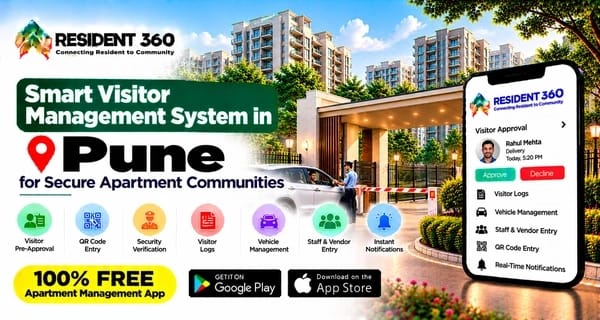
A visitor management system can help residential societies in Pune create a more organized process for handling guests, deliveries, domestic workers, service providers, and other visitors. In busy apartment communities, security teams often manage several entry requests at the same time while residents expect convenience and control. A structured approach can make it easier to verify visitors, seek resident approval, record entry and exit details, and coordinate activity at the gate. The need is especially relevant for societies where multiple buildings, entrances, parking areas, and service movements make manual registers difficult to maintain. Instead of depending only on handwritten notes or scattered phone calls, societies can bring visitor-related information into a clearer operational process.
For committee members, security personnel, facility managers, and residents, the goal is not to make entry unnecessarily complicated. It is to establish a practical balance between visitor convenience, resident awareness, and gate-level coordination.
Why Pune Societies Need Better Visitor Management
Pune has a wide mix of apartment complexes, gated communities, and residential societies with different visitor patterns. A society may receive office guests in the morning, delivery personnel throughout the day, domestic helpers during fixed time windows, and technicians or contractors for scheduled work. During weekends, festivals, move-ins, or community events, the volume and variety of visitors can increase further.
A clear visitor process can help security teams handle these situations with less confusion. It may also support residents who want to know who is requesting access before allowing entry. For committee members, organized records can make it easier to review recurring issues, clarify entry-related questions, and coordinate with guards and facility staff.
The requirements can differ between a small society and a large gated community. Some communities may have one entrance and a limited number of homes, while others may manage multiple gates, towers, parking areas, and service routes. A visitor management system should therefore support a process that is practical for the community rather than adding unnecessary steps.
Common Visitor Management Problems in Residential Societies
Many societies still manage visitors through paper registers, phone calls, and informal messages. These methods may work during quiet periods, but they can become difficult to manage when several visitors arrive together or when security staff change shifts.
Common challenges include:
- Handwritten visitor registers that are difficult to read or review later.
- Delays when security staff try to contact residents for approval.
- Unclear verification of guests, delivery personnel, and service providers.
- Missing or incomplete entry and exit records.
- Difficulty coordinating deliveries when residents are unavailable.
- Confusion when domestic workers or technicians visit several homes.
- Inconsistent communication between residents, guards, and committee members.
- Limited visibility into visitors who remain inside the community for extended periods.
- Challenges in managing multiple gates or different entry procedures.
- Time-consuming follow-up when residents raise questions about an entry.
These issues do not always result from poor security practices. They often arise because information is recorded in different places and decisions depend on manual coordination. A more organized process can help reduce avoidable confusion while allowing security teams to retain responsibility for gate operations.
How a Visitor Management System Can Organize Gate Operations
A visitor management system can connect the main steps involved in entry handling: visitor details, resident approval, security confirmation, and entry or exit recording. When a guest arrives, the security team can follow a defined process instead of relying on memory or separate paper notes. The resident can be contacted for confirmation, and the outcome can be recorded for future reference.
For example, if a delivery person arrives for a resident who is not immediately available, the security team can follow the society’s defined procedure for contact and access. Similarly, when a technician visits a particular apartment, the relevant resident or management contact can confirm the visit before entry is allowed. These processes can make gate operations more consistent without assuming that every community needs identical rules.
A structured visitor management system can also help societies distinguish between different visitor categories. Guests, delivery personnel, domestic workers, contractors, and emergency service providers may require different forms of coordination. Recording these details in an organized manner can support clearer communication between the gate and the resident.
For societies that are reviewing broader digital operations, a Society Management App may provide wider context around resident coordination, security communication, and community administration. Visitor handling can then be considered as one part of a larger operating process rather than an isolated gate activity.
Four Operational Areas That Define Effective Visitor Management
Visitor Entry and Verification
The first step is to identify who is requesting access and why they are visiting. Security staff may need to record the visitor category, destination apartment, and relevant details before proceeding with approval.
Useful process points include:
- Recording the purpose of the visit.
- Confirming the apartment or resident concerned.
- Following the society’s procedure for unknown or repeat visitors.
A defined verification process can help guards handle similar situations consistently across different shifts.
Resident Approval
Resident approval is central when a guest or service provider arrives without prior notice. The process should make it clear whether the resident has approved entry, declined it, or has not responded.
A society can define practical rules such as:
- Contacting the resident through the approved communication channel.
- Waiting for confirmation before allowing non-routine visitors inside.
- Escalating unresolved requests according to community guidelines.
This can give residents a clearer role in visitor decisions while helping security teams avoid uncertain verbal instructions.
Security Coordination
A visitor process is useful only when it supports the people managing the gate. Security staff need clear information about approved visitors, expected service personnel, and visitors who should not enter without additional confirmation.
Coordination may include:
- Sharing relevant approval details with the gate team.
- Maintaining consistent instructions across shifts.
- Recording exceptions or unusual entry situations for review.
The objective is to support security operations, not replace the judgment of trained personnel.
Visitor Records
Records can help a society review what happened at the gate when questions arise. Entry and exit information may be useful for checking the timing of a visit, understanding recurring service movement, or responding to resident queries.
A useful record process can support:
- More organized entry and exit information.
- Easier review of delivery and service visits.
- Better handover between security shifts.
The value of records depends on accurate use and on the society’s own rules for access, retention, and review.
Supporting Society Operations Around Visitor Handling
Delivery Coordination
Deliveries are a regular part of apartment life and can create frequent interruptions at the gate. A clear process can help security staff identify the destination resident and decide whether the delivery should be handed over at the gate or taken inside according to society rules.
This may help with:
- Separating routine deliveries from personal guests.
- Reducing repeated calls when delivery staff arrive.
- Keeping gate activity more orderly during busy periods.
Visitor handling should remain flexible enough for urgent or time-sensitive deliveries.
Service Personnel Management
Domestic workers, electricians, plumbers, cleaners, drivers, and maintenance technicians may visit a society regularly. Their entry patterns can differ from those of occasional guests, so the society may need defined procedures for recurring service personnel.
Useful considerations include:
- Identifying the resident or facility contact responsible for the visit.
- Recording scheduled or repeat service activity where appropriate.
- Communicating changes to the security team.
A structured process can reduce confusion when several apartments use the same service provider.
Resident Communication
Visitor approvals often depend on quick and clear communication between residents and the gate. A Resident communication app can be considered as part of a broader approach to sharing community updates, visitor information, and operational messages.
Resident communication may support:
- Approval-related messages.
- Notices about temporary entry procedures.
- Updates about maintenance work or restricted access.
The society should still define which messages require formal confirmation and which are general updates.
Complaints and Follow-Up
Visitor-related concerns may include delayed entry, unapproved access, delivery disputes, or questions about a service person’s movement. A clear complaint process can help the society record the issue, identify the relevant people, and determine the next step.
A follow-up process may include:
- Capturing the concern with sufficient context.
- Checking the related visitor or entry record.
- Communicating the outcome to the resident or committee.
This can make issue resolution more structured than relying on informal conversations alone.
Applying Visitor Management to Different Residential Communities
Visitor requirements vary according to the size, layout, and operating style of a community. A smaller society may have one gate and a small security team, while a larger apartment community may handle several towers, separate pedestrian and vehicle entrances, and more frequent deliveries.
In a small society, the priority may be a simple approval and record process that does not create extra work for guards or residents. Clear visitor categories and basic entry records can be more useful than a complex workflow.
Apartment communities with several buildings may need better coordination between the main gate, tower representatives, residents, and facility staff. The process can help identify the destination apartment accurately and reduce repeated calls when visitors move between common areas and buildings.
Large gated communities may need to consider visitor volume, multiple entry points, contractor movement, and delivery activity. In such settings, the society may benefit from clearly defined procedures for each gate and consistent communication between security shifts. This does not mean every community should follow the same model; the process should reflect local operating needs.
RWAs can also use organized visitor procedures to support committee oversight and resident communication. The RWA may define approval rules, service personnel practices, delivery handling, and escalation steps while allowing security teams to manage daily gate operations.
For readers comparing regional requirements, the topic may also be described as Visitor Management System in Maharastra. Regardless of the label used, societies should focus on practical visitor verification, resident approval, security coordination, and reliable records.
How Resident360app Can Support Visitor Coordination
Resident360app can be considered by residential communities looking for a more organized approach to visitor and security coordination. Based on the community’s requirements, it may help bring relevant resident information, visitor-related communication, and society operations into a more structured environment.
For a visitor-focused process, the most relevant areas may include:
- Supporting communication between residents and security teams.
- Helping organize visitor-related information and resident records.
- Coordinating service personnel and facility-related activity.
- Supporting complaints and service requests connected with community operations.
A broader apartment management app can also be useful when visitor operations need to work alongside maintenance, resident records, and other society processes. Similarly, rwa management software may be relevant for committees that want to review visitor coordination as part of wider RWA administration.
The platform can be assessed according to the society’s actual workflow. Committee members may wish to understand how resident information is maintained, how communication is organized, and how security teams would use the process during regular and high-volume periods. It is also useful to define responsibilities clearly so that technology supports, rather than replaces, gate staff and committee decisions.
What to Evaluate Before Choosing a Visitor Management Solution
A society should evaluate a visitor solution against its daily operating requirements instead of selecting one based only on a feature list. The following considerations can support a practical review.
- Visitor entry process: Check whether the workflow suits guests, deliveries, domestic workers, and service providers.
- Verification steps: Consider whether security staff can follow the process consistently during busy periods.
- Resident approval: Review how residents are contacted and how approval or rejection is recorded.
- Security coordination: Confirm whether the process gives guards clear information without creating unnecessary complexity.
- Entry and exit records: Consider whether records are organized enough for routine review and follow-up.
- Multiple gates: If the community has more than one entrance, assess how information will be coordinated.
- Resident adoption: A process is more useful when residents understand when and how to respond.
- Delivery handling: Review whether routine delivery activity can be handled without repeated confusion.
- Service personnel: Consider how recurring workers and contractors will be identified and coordinated.
- Communication and complaints: Check whether visitor-related questions can be directed to the right management team and followed up properly.
A society may also review related operational tools. For example, a society maintenance app may be relevant when visitor coordination needs to connect with facility work or maintenance requests. Communities comparing structured processes may also examine maintenance management software and a Maintenance management system for adjacent administrative needs. Clear payment information may matter when service visits relate to approved society work, although payment handling and visitor entry should remain separate processes.
The right evaluation should consider the people who will use the system every day. Security teams need clarity, residents need convenient communication, and committees need enough visibility to review recurring concerns. A solution that supports these needs may provide a more organized approach than disconnected registers and messages.
Conclusion
A visitor management system can help Pune societies organize visitor entry, resident approval, verification, delivery coordination, security communication, and entry records. The most suitable approach depends on the community’s size, gate structure, visitor volume, and operating rules. By reviewing these needs carefully and involving residents, security teams, facility staff, and committee members, a society can create a clearer and more consistent visitor-handling process.
Get Started with Resident360 Today
Resident360app can be considered by societies and residential communities looking for a more organized approach to society management. To learn more, visit Resident360app.
Download the Resident360app Today