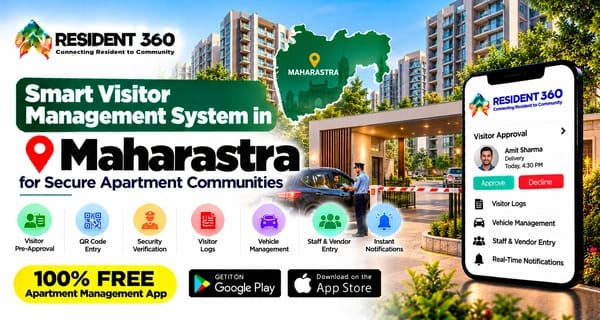
A visitor management system can help residential societies in Maharashtra create a more organized approach to visitor entry, verification, resident approval, and gate coordination. In busy apartment communities, security teams may handle residents, guests, delivery agents, domestic workers, contractors, and service personnel throughout the day. Manual registers and phone-based approvals can make it difficult to maintain clear records or communicate quickly with residents. A digital process can support more consistent gate operations while helping residents and security teams coordinate visitor access with greater clarity.
For societies in Maharashtra, the right approach should suit the community’s entry points, visitor volume, security routines, and resident communication needs. The goal is not to add unnecessary complexity, but to make everyday access management easier to follow and review.
Why Maharashtra Societies Need More Organized Visitor Management
Residential communities across Maharashtra range from compact apartment buildings to large gated developments with several entrances. Each community may deal with different visitor patterns, including family guests, food deliveries, courier personnel, domestic staff, technicians, and event visitors. A visitor management system can help bring these activities into a more structured process without relying entirely on paper registers or scattered phone calls.
Security teams need clear instructions at the gate, while residents need a convenient way to confirm whether a visitor should be allowed inside. Committee members and facility managers may also need access to organized visitor records when reviewing unusual activity, repeated entries, or service personnel access. A consistent process can support better coordination without replacing the judgment of the security team or residents.
Common Visitor Management Problems in Residential Societies
Visitor handling often becomes difficult when information is recorded differently by each guard or shared through multiple communication channels. The following issues are common in apartment communities:
- Handwritten visitor registers may be incomplete or difficult to review later.
- Security staff may struggle to verify a visitor’s purpose quickly.
- Residents may miss calls when approval is requested at the gate.
- Delivery agents may wait while security teams try to contact residents.
- Entry and exit details may not be recorded consistently.
- Domestic workers and service personnel may require repeated verification.
- Shift changes can result in important visitor information being missed.
- Residents may not know when a guest has arrived at the entrance.
- Committee members may lack an organized record for reviewing access activity.
- Multiple gates can make visitor coordination more difficult.
A clear visitor process can reduce avoidable confusion, but it should remain practical for both residents and guards. The system should support daily routines rather than create another disconnected task.
How a Visitor Management System Can Organize Gate Operations
A visitor management system can connect the main steps involved in receiving and approving visitors. When a guest arrives, security staff can record the relevant information, identify the apartment or resident being visited, and seek confirmation before allowing access where required. This creates a more defined flow than relying only on a paper entry book and informal calls.
For example, if a delivery agent arrives for an apartment while the resident is unavailable, the security team can follow the society’s stated process instead of making an individual decision without context. Similarly, a resident expecting a guest can help security staff identify the visitor more efficiently. These processes can make entry handling more consistent while leaving approval decisions with the appropriate resident or security authority.
Societies can also use the broader visitor management system approach to understand how visitor information, gate activity, and resident coordination fit together. A well-defined process may help reduce repeated questions and improve the availability of entry details for authorized society personnel.
Four Core Areas of Effective Visitor Management
Visitor Entry and Verification
The first step is recording who has arrived, whom they are visiting, and why access is being requested. A structured entry process can help guards ask consistent questions and reduce dependence on memory or informal notes.
- Record visitor details at the point of entry.
- Identify the concerned apartment or resident.
- Follow the society’s verification procedure before access.
Resident Approval
Resident confirmation is especially useful when guests, delivery personnel, or service providers arrive without prior notice. A clear approval process can help residents respond while giving security teams a documented instruction to follow.
- Send or communicate an approval request to the resident.
- Record whether access was approved, declined, or deferred.
- Avoid allowing entry solely because a visitor provides an apartment number.
Security Coordination
Security teams work more effectively when all guards follow the same visitor handling process. This becomes important during shift changes, busy hours, festivals, and periods when several visitors arrive together.
- Maintain a consistent process across entry gates.
- Share relevant instructions between security shifts.
- Coordinate visitor handling with delivery and service access.
Visitor Records
Organized records can help authorized committee members or facility managers review past entries when a question arises. Records may also help identify repeated service visits or clarify the timing of a guest’s arrival and departure.
- Track entry and exit information where applicable.
- Keep records organized by date, apartment, or visitor type.
- Review access information according to the society’s internal process.
Related Society Operations That Support Visitor Management
Resident Communication
Visitor approval depends on timely communication between the gate and the resident. A Resident communication app can support a more centralized way to share entry requests, society notices, and important access-related updates.
- Share visitor instructions with residents.
- Communicate temporary gate or access changes.
- Reduce dependence on scattered resident groups and individual calls.
Delivery Coordination
Deliveries can account for a large portion of daily gate activity. Societies may need a practical process for food, courier, grocery, and other delivery personnel that balances convenience with access control.
- Define where delivery personnel should wait or hand over items.
- Communicate delivery-related rules clearly to residents.
- Help guards distinguish routine deliveries from other visitor categories.
Service Personnel Management
Domestic workers, technicians, drivers, and maintenance contractors may visit regularly or occasionally. Consistent records can make it easier to follow the society’s access process without treating every visit as an entirely new situation.
- Record relevant service personnel details.
- Clarify recurring access requirements.
- Coordinate unusual or one-time service visits with residents.
Complaints and Incident Follow-Up
Visitor-related concerns may include unauthorized entry attempts, delayed approvals, delivery disputes, or confusion at the gate. A defined complaint process can help residents and committee members record concerns for review instead of relying only on verbal conversations.
- Record the issue and the relevant date or time.
- Identify whether the concern involved a visitor, delivery, or service provider.
- Share the outcome with the appropriate resident or management group.
Adapting Visitor Management to Different Residential Communities
A small society may have one entrance and a limited number of daily visitors, but it can still benefit from clear approval and record-keeping procedures. In such communities, the process should remain simple enough for residents and guards to use without creating unnecessary steps.
Apartment communities with higher visitor volumes may need clearer categories for guests, deliveries, domestic workers, and contractors. During peak hours, a consistent workflow can help security teams handle several requests while keeping residents informed. The community may also need clear instructions for visitors who arrive when the resident is unavailable.
Large gated communities may face additional coordination requirements because of multiple gates, separate blocks, and larger security teams. In these settings, the society can define how information moves between gates and how visitor records are reviewed by authorized staff. A society management app may provide broader context for coordinating visitor activity with other community operations.
RWAs may also need to align visitor procedures with resident communication, facility coordination, and committee oversight. The wider role of rwa management software can be considered when an association wants to organize several administrative activities alongside access management. Communities should select processes based on their actual gate layout, visitor volume, staffing, and resident expectations.
How Resident360app Can Support Visitor Coordination
Resident360app can be considered by societies looking for a more organized approach to visitor and security coordination. Based on the community’s requirements, it may help bring visitor-related communication, resident coordination, and other society activities into a more structured environment.
For visitor-focused operations, a society may use a defined process to coordinate entry requests, resident approvals, delivery access, and visitor records. This can make it easier for residents, guards, and committee members to understand what action is expected at each stage. Resident360app can also be considered alongside broader society management app needs when a community wants to connect visitor coordination with resident records or other society processes.
Related activities may include maintenance communication, service requests, and facility coordination. These should not distract from gate operations, but organizing them in a common management approach can help reduce fragmented communication. Societies reviewing maintenance management software may also find it useful to consider whether visitor coordination needs to work alongside maintenance staff and service personnel access.
The platform’s relevance should be assessed against the society’s own workflow. A committee can review how residents communicate with security teams, how visitor information is recorded, and how staff or facility-related access is handled. For broader context, a Maintenance management system may be relevant when technicians, contractors, or facility personnel regularly enter the community.
Practical Criteria for Choosing a Visitor Management Solution
Societies should evaluate a visitor solution based on everyday usability rather than selecting features in isolation. The process must work for residents who approve visitors, guards who manage the entrance, and committee members who oversee community operations.
Consider the following points before adopting a system:
- Visitor entry workflow: Check whether the process is clear from arrival through approval and exit.
- Verification steps: Review whether the society can define how guests, deliveries, and service personnel are handled.
- Resident approvals: Consider whether residents can receive and respond to requests without confusion.
- Security usability: The interface and process should be practical for guards working different shifts.
- Record organization: Confirm whether visitor information can be reviewed in an understandable format.
- Multiple access points: Larger communities should consider how different gates will coordinate.
- Delivery handling: Assess whether routine delivery activity can be managed without weakening access controls.
- Resident communication: Review how visitor instructions and temporary changes will be shared.
- Committee oversight: Consider whether authorized society personnel can review processes and address concerns.
- Related operations: If the society also needs resident records, payment information, or facility coordination, assess how these requirements fit together. Useful background on payment information can help committees understand why financial and operational information should be handled through clearly defined processes.
A society may also consult a broader apartment management app resource when comparing visitor operations with other community requirements. The most suitable approach is one that residents and security staff can understand, use consistently, and support through clear internal rules. A defined management team can help communicate those rules, review adoption, and address process gaps over time.
For communities developing internal documentation, a visitor policy should explain who may approve access, how unapproved visitors are handled, what information security staff should record, and when incidents should be escalated. Additional supporting guidance can be added through a [visitor access planning resource](), a [residential security coordination guide](), and a [community gate operations reference](). These resources should complement, not replace, the society’s own procedures.
Conclusion
A visitor management system can help Maharashtra societies organize entry, verification, resident approval, delivery handling, security coordination, and visitor records. The right approach depends on the community’s size, gates, visitor volume, and internal rules. By replacing scattered communication with a clearer process, societies can make daily gate operations easier to follow while supporting better coordination between residents, security teams, facility staff, and committee members.
Get Started with Resident360 Today
Resident360app can be considered by societies and residential communities looking for a more organized approach to society management. To learn more, visit Resident360app.
Download the Resident360app Today