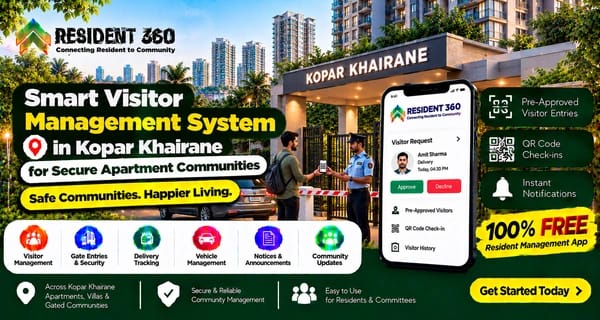
Managing visitors in a residential community requires more than recording a name at the gate. In Kopar Khairane, societies may need to coordinate residents, security personnel, delivery executives, domestic help, contractors, and service professionals throughout the day. A Visitor Management system can help create a more organized process for verifying visitors, seeking resident approval, recording entry and exit details, and communicating important updates. Instead of depending entirely on paper registers or scattered phone calls, communities can work towards a clearer gate-management process that supports both security teams and residents. The goal is not to make visitor handling complicated, but to make routine entry decisions easier to track and coordinate.
For committee members and facility teams, the right approach should fit the community’s daily visitor patterns. A practical process can improve visibility at the gate while keeping residents involved in approvals and exceptions.
Why Kopar Khairane Societies Need Better Visitor Management
Kopar Khairane has a mix of apartment buildings, gated communities, residential clusters, offices, and local services. This creates varied visitor movement during working hours, evenings, weekends, and festival periods. A society may receive residents’ guests, courier personnel, food deliveries, domestic workers, technicians, movers, and contractors within the same day.
When this activity is handled manually, security teams may have to search through registers, call residents repeatedly, or depend on incomplete information. A visitor management system can help societies introduce a more consistent process for entry, approval, and record keeping. It may also make it easier for committee members to understand how the gate is being managed without interrupting security staff during busy periods.
The objective is not to delay genuine visitors. It is to give the gate team a clearer way to confirm who is arriving, whom they are visiting, and whether entry has been approved.
Common Visitor Management Problems in Residential Societies
Visitor-related challenges often become more visible when a community has multiple buildings, more than one entrance, or a high volume of deliveries. Even smaller societies can face issues when visitor information is recorded inconsistently.
- Paper registers may contain incomplete, unclear, or difficult-to-read visitor details.
- Security staff may spend considerable time calling residents for routine approvals.
- Residents may miss approval calls when they are working, travelling, or unable to answer immediately.
- Delivery personnel may arrive at the gate without clear instructions about the building or flat.
- Entry and exit details may not be recorded consistently for visitors and service personnel.
- Temporary workers, technicians, and contractors may be difficult to track after entry.
- Shift changes can lead to gaps in information between security guards.
- Residents may not receive timely updates about visitor arrival or gate-related concerns.
- Committee members may lack a convenient way to review recurring visitor-management issues.
- Manual records can make it harder to check past entries when clarification is needed.
These problems do not always indicate poor security practices. They often show that the process depends too heavily on memory, phone calls, and paper records. A structured workflow can support the security team without replacing human judgment.
How a Visitor Management System Can Organize Gate Operations
A visitor management system can connect the main steps involved in a visitor’s arrival. The process may begin when a visitor reaches the gate, followed by identification, resident confirmation, entry recording, and exit tracking. Each step can be handled more consistently when the security team has clear information available at the right time.
For example, if a guest arrives for a resident in Building B, the security team can seek confirmation before allowing entry. Once the visit is approved, the entry can be recorded for future reference. A delivery executive may follow a different process from a personal guest, while a contractor may require additional attention because the visit could continue for several hours or days.
Societies exploring the broader role of a visitor management system can consider how digital visitor handling fits with their existing gate rules. The most useful process is one that security staff can follow comfortably and residents can understand without repeated explanations.
A visitor system may help with:
- Recording essential visitor information in a more organized manner.
- Supporting resident approval before entry.
- Making delivery and service-personnel coordination clearer.
- Maintaining entry and exit information for later reference.
- Reducing dependence on repeated manual calls and register searches.
The system should support the community’s operating rules rather than encourage a one-size-fits-all process. Each society can decide how guests, deliveries, domestic workers, and contractors should be handled.
Four Core Areas of Effective Visitor Management
A visitor process becomes easier to manage when its most important operational areas are clearly defined. The following four areas can help societies in Kopar Khairane review how visitor movement is handled from arrival to exit.
Visitor Entry and Verification
The gate team needs a practical way to identify the visitor and understand the purpose of the visit. Verification does not have to create unnecessary delays; it should provide enough information for a reasonable entry decision.
- Record the visitor’s basic details and purpose of visit.
- Distinguish between guests, deliveries, workers, and service personnel.
- Follow the society’s existing entry rules consistently.
Resident Approval
Residents are usually the most appropriate people to confirm whether an unexpected guest or service person should enter. A clear approval process can reduce confusion between the gate, visitor, and resident.
- Give residents a clear opportunity to approve or decline entry.
- Record approval status for accountability and future reference.
- Provide a defined approach for visitors arriving when the resident is unavailable.
Security Coordination
Security guards may work in shifts, and each shift needs access to consistent information. Better coordination can help reduce repeated questions and make handovers more reliable.
- Share relevant visitor information with the responsible gate team.
- Keep procedures clear for multiple entrances or buildings.
- Make exceptions visible to the appropriate security personnel.
Visitor Records
Records are useful when a committee needs to understand what happened at the gate or review a past entry. Organized information can be more useful than a register containing scattered notes.
- Maintain entry and exit details where appropriate.
- Review recurring patterns involving deliveries or service visits.
- Use records to identify process gaps without blaming individual staff members.
Related Society Operations That Support Visitor Management
Visitor handling does not operate separately from the rest of community administration. Communication, resident records, staff coordination, and complaints can all affect how smoothly the gate functions.
Resident Communication
Residents need clear information about visitor rules, approval expectations, restricted timings, and temporary arrangements. A Resident communication app can support a more centralized way to share these updates, provided the society uses it consistently.
- Share visitor guidelines and gate instructions.
- Notify residents about temporary access changes.
- Reduce dependence on multiple informal communication groups.
Resident and Apartment Records
Accurate flat and resident information can help the gate team identify the intended recipient of a visitor or delivery. It may also make it easier to manage changes when residents move in, move out, or update their contact details.
- Keep apartment and resident information organized.
- Clarify building, wing, and flat references for visitors.
- Review records when recurring delivery or access issues arise.
Staff Coordination
Security guards, housekeeping personnel, maintenance workers, and facility staff may all interact with visitors. Clear coordination can help them understand who is authorized to enter and which team member should handle a particular situation.
- Define responsibility for visitor-related questions.
- Share relevant instructions across shifts.
- Coordinate staff access with committee-approved society rules.
Complaint and Service Requests
Visitor-related concerns may lead to complaints, such as unauthorized entry attempts, delivery confusion, or delays at the gate. A structured complaint process can help the society record the issue, assign responsibility, and communicate a response.
- Record the concern with enough context to investigate it.
- Separate urgent gate issues from routine feedback.
- Track whether a process change is needed after repeated complaints.
Adapting Visitor Management to Different Communities
The right visitor process depends on the size, layout, and daily activity of a residential community. A small society in Kopar Khairane may have one gate and a familiar security team, but it can still benefit from consistent visitor records and resident approvals. The process should remain simple enough for residents and guards to use without adding unnecessary steps.
Apartment communities with several buildings may need clearer building and flat identification. Visitor volume can increase during evenings, weekends, holidays, or move-in periods, so the gate team may need a process that handles routine guests and high-traffic periods differently. Delivery coordination can also become more important when multiple courier and food-delivery personnel arrive close together.
Larger gated communities may have more than one gate, several security shifts, and different access rules for residents, visitors, domestic workers, contractors, and vendors. In such settings, consistent records and clear handovers can support better coordination. A community can review its visitor process through a broader society management app, especially when visitor operations need to work alongside communication and society administration.
RWAs may also need to coordinate visitor rules across buildings or blocks. They can define common procedures while allowing individual buildings to manage practical details. The focus should remain on a workable process that supports residents, security staff, and committee members rather than creating rules that are difficult to follow.
For communities comparing local approaches, a guide about Visitor Management System in Ghansoli may offer a useful neighbouring-area perspective. Another reference on visitor management for Ghansoli residential communities can help committees think through similar visitor, delivery, and gate-coordination questions. A further Ghansoli visitor management guide may also be relevant when comparing processes across nearby residential locations.
How Resident360app Can Support Visitor Coordination
Resident360app can be considered by societies that want a more organized approach to residential community operations. For a visitor-focused process, the relevant areas may include visitor and security coordination, resident communication, resident records, and complaints or service requests. Bringing related information into a more structured workflow can make it easier for the committee and facility staff to coordinate routine issues.
A society may use its visitor process alongside other operational areas rather than treating the gate as a completely separate function. For example, resident records can support clearer flat identification, communication can help share gate instructions, and service requests can provide a way to document recurring operational concerns.
Resident360app’s wider role can also be reviewed through an apartment management app approach when visitor coordination needs to connect with broader apartment administration. Societies that manage recurring payments or facilities may also review a Society Maintenance App as part of their wider digital-management planning, without making maintenance the centre of the visitor workflow.
The platform may support a more organized approach to related society information, but each community should define its own rules, approval practices, and staff responsibilities. The committee should also ensure that security personnel receive clear instructions and that residents understand how visitor approvals are expected to work.
Practical Factors for Choosing a Visitor Management System
Selecting a visitor management system should begin with the society’s actual gate operations. A feature list alone may not show whether the process will be practical for residents, security guards, committee members, and facility teams. Before making a decision, communities can map the visitor journey from arrival through exit and identify where delays or information gaps occur.
Entry and Verification Workflow
Check whether the process supports the types of visitors the society receives most often. It should be clear how guests, deliveries, domestic workers, technicians, and contractors are handled.
Resident Approval Process
Consider whether residents can understand and respond to approval requests without confusion. The process should also account for situations where a resident is unavailable or a visitor arrives unexpectedly.
Security Team Usability
Security staff should be able to follow the workflow during busy periods and across shift changes. Clear screens, simple instructions, and defined responsibilities may help reduce operational uncertainty.
Records and Review
Review how the system organizes visitor details, entry and exit information, and recurring issues. A society should be able to use records for clarification and process improvement without creating unnecessary administrative work.
The wider administrative context may also matter. Committees comparing tools can review maintenance management software, rwa management software, and a Maintenance management system when they want visitor coordination to sit alongside other community processes. Resident-facing payment information may also be handled through established channels such as payment information, while the society’s management team can decide which responsibilities should remain with security, facility staff, or the committee.
Conclusion
A well-planned Visitor Management process can help Kopar Khairane societies coordinate guests, deliveries, service personnel, resident approvals, and security records more consistently. By reducing dependence on paper registers and scattered calls, a visitor management system may give residents and security teams clearer responsibilities while helping committees review gate operations. The right approach should remain practical, easy to follow, and suited to the community’s daily visitor patterns.
Get Started with Resident360 Today
Resident360app can be considered by societies and residential communities looking for a more organized approach to society management. To learn more, visit Resident360app.
Download the Resident360app Today