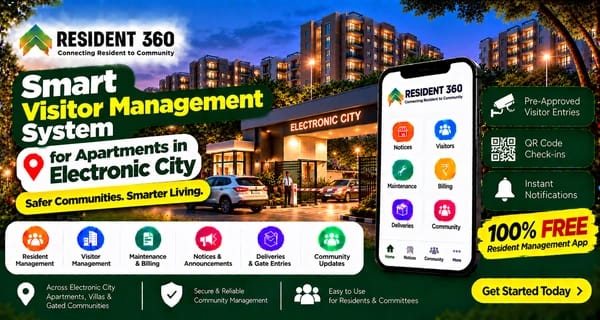
A visitor management system helps residential communities organize guest entries, verify visitors, coordinate with security teams, and maintain clear records. In Electronic City, where gated communities, apartment societies, and RWAs manage residents, deliveries, domestic staff, service providers, and guests every day, a structured process can reduce confusion at the gate. Instead of relying only on paper registers, phone calls, or informal messages, societies can create a clearer flow for visitor approval, entry, exit, and communication. The aim is not to make entry difficult. It is to ensure that residents, security personnel, facility staff, and society committees have the right visitor information at the right time.
A well-planned visitor process also helps communities respond more consistently to regular visitors, unexpected guests, delivery personnel, and service workers while keeping resident convenience in view.
Why Karnataka Societies Need Visitor Management
Residential communities in Electronic City often have a mix of high-rise buildings, gated layouts, shared amenities, multiple entry points, and busy service activity. A manual gate register may not provide enough clarity when several visitors arrive together or when a resident is unavailable to answer a call. Security teams may need to verify guests, contact residents, record vehicle details, and coordinate with delivery or maintenance staff at the same time.
An organized Visitor Management System can give societies a more consistent way to handle these activities. It can support visitor registration, resident confirmation, entry and exit tracking, and access to organized visitor information. The process can be especially useful for managing regular domestic workers, cab drivers, repair technicians, guests attending events, and unexpected visitors.
For committee members and facility managers, structured visitor management can also make security coordination easier. Clear records help teams understand what happened at the gate, communicate with residents, and address visitor-related concerns with better context. The right process should be practical for the size of the community and simple enough for security staff to use during busy periods.
Common Visitor Management Problems Faced by Societies in Karnataka
Societies in Electronic City may face different visitor challenges depending on their size, number of gates, security arrangements, and resident preferences. Common issues include:
- Manual visitor entry that takes time and can result in incomplete information.
- Long queues at security gates during office hours, weekends, or community events.
- Difficulty verifying a guest when the resident does not respond immediately.
- Delayed resident confirmation for unexpected visitors or service personnel.
- Visitor records that are difficult to search, review, or maintain consistently.
- Confusion while handling delivery personnel at busy residential entry points.
- Coordination gaps between security guards, residents, housekeeping teams, and facility staff.
- Difficulty tracking visitor entry and exit times across different gates.
- Visitor-related complaints that lack clear information about the incident.
- Problems managing recurring visitors such as domestic help, tutors, drivers, or technicians.
A Visitor Management System can help societies replace scattered visitor information with a more organized process. It should support practical gate operations rather than add unnecessary work for residents or security teams.
How Visitor Management Solves These Problems
A visitor management system can connect the main steps involved in residential entry management. A guest can be registered, the resident can be contacted for confirmation, and the security team can record the relevant entry details. This creates a more visible process for both planned and unexpected visits.
For example, a resident expecting a guest can share the required information in advance. When the visitor arrives, security personnel can check the available details and confirm the visit. For an unplanned guest, the security team can contact the resident before allowing entry. Entry and exit records can then provide a useful reference if the society needs to review a visit later.
The same approach can be adapted for delivery personnel and service providers. A community may define its own process for recording deliveries, directing visitors to the right block, or coordinating with facility staff. A linked apartment management app may be relevant where visitor coordination is part of wider residential operations, while maintenance management software can support related service requests without making visitor management the secondary focus.
Useful processes may include:
- Registering planned guests before arrival.
- Confirming unexpected visitors with residents.
- Recording visitor names, purpose, vehicle details, and timestamps where required.
- Notifying residents about relevant arrivals.
- Maintaining separate workflows for guests, deliveries, and service personnel.
- Coordinating with security and facility teams.
- Reviewing visitor information when a concern or complaint is raised.
Visitor Entry, Security, Delivery, and Complaint Management
Visitor Entry Management
Organized visitor entry begins with a clear process for identifying who is arriving, whom they are visiting, and whether entry has been approved. Security personnel can follow the same basic steps for guests, drivers, technicians, and event visitors. This reduces dependence on memory or loosely maintained notebooks. Societies can also define rules for recurring visitors and visitors who need access only to a specific block or facility.
The process should remain practical during peak hours. Clear visitor information, resident confirmation, and entry and exit records can help security teams manage the gate without creating avoidable delays.
Security Management
Security teams need timely and organized information to coordinate visitor movement. A visitor management system can give them a structured reference for expected guests, pending confirmations, and completed entries, depending on the process adopted by the society. This can improve communication between the main gate, secondary gates, residents, and facility staff.
Committees can also review whether visitor procedures are followed consistently. For a broader understanding of how a visitor management system fits into residential operations, societies can assess the process against their own gate structure, staffing, and resident communication needs.
Delivery Management
Delivery personnel often arrive throughout the day, making them different from invited guests. Societies can create a simple process for recording deliveries, notifying residents, directing personnel to the appropriate building, and managing access to common areas. Security teams may also need clear instructions for food, grocery, courier, and large-item deliveries.
The process should balance convenience and control. A society maintenance app or society management app may support related community communication, but delivery entry should still follow the visitor rules approved by the association. Clear information can reduce repeated calls and uncertainty at the security desk.
Complaint Management
Visitor-related concerns may involve unauthorized entry attempts, delayed deliveries, vehicle obstruction, noise, misuse of common areas, or disagreements at the gate. Organized visitor details can help the committee understand the time, visitor type, location, and people involved before responding. Residents can submit a complaint through the society’s chosen process, while security teams can provide the available entry information for review.
A consistent complaint process should focus on facts, respectful communication, and appropriate follow-up. Visitor records do not replace judgement, but they can help the society avoid relying only on incomplete verbal accounts.
Resident Communication, Staff, Facility, and Record Management
Resident Communication
Residents need clear information about visitors without receiving unnecessary notifications. A community can define how security teams contact residents, how approvals are recorded, and how residents communicate special instructions. A Resident communication app may be considered as part of this wider communication process, provided the society selects tools that fit its operating needs.
Good communication also helps residents understand visitor rules. Notices about gate timings, delivery procedures, event guests, and service access can reduce confusion and make security coordination more predictable.
Staff Management
Visitor coordination may involve security guards, housekeeping teams, facility managers, maintenance workers, drivers, and other residential staff. Each group may need different access instructions. For example, recurring service staff may require a defined verification process, while a one-time technician may need resident confirmation at the gate.
A society maintenance management software process can help teams document related work and coordinate responsibilities, but visitor entry rules should remain clear and easy to follow. The committee can assign responsibility for reviewing records, handling exceptions, and communicating changes to staff.
Facility Management
Visitors may use clubhouses, community halls, play areas, gyms, swimming pools, or other shared facilities when permitted by society rules. Facility managers can coordinate visitor access with resident bookings, event timings, and entry restrictions. This is useful when a guest is visiting a facility rather than a particular home.
A visitor process should clarify who approves access, how the visitor is identified, and whether entry is limited to a specific time or location. Such controls can help communities manage shared spaces without treating every visitor in the same way.
Record Management
Accurate visitor records help societies review entry and exit activity, understand recurring patterns, and respond to questions about a particular visit. Records should be organized, accessible to authorized personnel, and maintained according to the community’s policies. The society should also decide what information is necessary and avoid collecting irrelevant details.
A Maintenance management system may support wider operational records, while rwa management software can be evaluated for broader association coordination. The visitor process should remain clear about who can view records and how information is used.
Visitor Management System for Small Societies and Gated Communities
Visitor requirements vary according to the structure of a community. A small society with one gate and a limited number of homes may need a straightforward process for guest approval, delivery entry, and basic records. A large gated community may require clearer coordination between multiple gates, towers, security shifts, facility teams, and resident groups.
High-rise and multi-block communities may need visitor information to identify the right tower, block, floor, or facility. Communities with multiple security gates may also need a shared process so that residents and security personnel follow consistent rules at each entry point. The society can decide whether different gates handle different visitor types or whether all entries follow one central workflow.
The process can be adapted by considering:
- Number of homes, blocks, and entry gates.
- Volume of guests and delivery personnel.
- Number of security shifts and supervisory roles.
- Frequency of recurring service visits.
- Need for resident confirmation before entry.
- Access requirements for shared facilities.
- Record review and complaint-handling procedures.
The goal is not to use the same process everywhere. It is to create a visitor management approach that matches the community’s physical layout and daily operations.
How Resident360app Simplifies Visitor Management
Resident360app can be considered by societies, RWAs, and residential communities looking for a more organized approach to visitor management and related coordination. Its relevance should be assessed against the society’s visitor entry process, security workflow, resident communication needs, record requirements, and community structure.
A society may also review the wider Resident360app ecosystem when visitor activity connects with maintenance requests, resident communication, association coordination, or other routine community processes. For example, payment information may be relevant when a society separately communicates approved payment processes for community services, but payment handling should not be confused with visitor verification.
Society committees should evaluate how any selected tool fits their existing policies and responsibilities. Security staff need a process they can understand and follow, residents need useful communication, and management teams need organized information for review. Resident360app can therefore be considered as one option for communities seeking a more structured approach, without assuming that every society requires the same setup.
How to Choose the Right Visitor Management System
Before selecting a visitor management system, societies should map their current gate process and identify where delays, communication gaps, or record problems occur. A practical evaluation can include the following areas:
- Ease of use for residents, security guards, facility managers, and committee members.
- A clear process for planned guests, unexpected visitors, and recurring visitors.
- Simple resident confirmation and relevant visitor notifications.
- Usability for security teams during busy entry periods.
- Organized visitor records with suitable access controls.
- Procedures for delivery personnel and service providers.
- Coordination between security, housekeeping, maintenance, and facility staff.
- A defined method for reviewing visitor-related complaints.
- Support for the number of blocks, gates, and security shifts in the community.
- Accessibility of information when the society needs to review an entry or exit.
- Overall fit with the community’s rules, staffing, and daily routines.
A society management app or apartment management app may include functions beyond visitor activity, but the selection decision should begin with the visitor process itself. The committee should ask whether the system is understandable, practical at the gate, and suitable for the community’s actual requirements. It may also help to document responsibilities for the management team, security personnel, residents, and facility staff before implementation.
For location-specific research, committees can also review approaches described in Visitor Management System in Sarjapur Road, Visitor Management System in Varthur, and Visitor Management System in Marathahalli. These references can support comparison of local residential considerations without replacing the society’s own assessment.
Conclusion
A clear visitor management process helps Electronic City societies coordinate guests, deliveries, service personnel, security teams, and residents with less confusion. Digital visitor records, resident confirmation, entry and exit tracking, and defined complaint procedures can make daily gate operations more consistent. Before choosing a visitor management system, committees should review their community size, gate structure, staffing, communication needs, and record practices so the process remains practical for everyone.
Get Started with Resident360 Today
Resident360app can be considered by societies and residential communities looking for a more organized approach to visitor management. To learn more, visit Resident360app.
Download the Resident360app Today