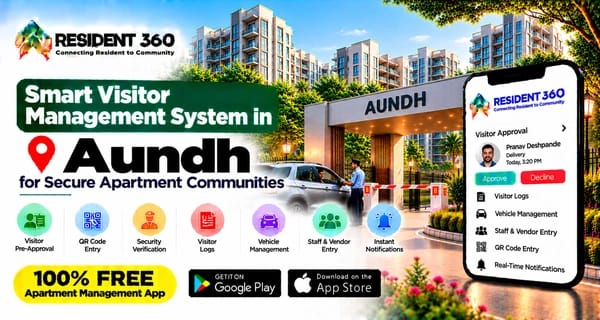
A visitor management system can help residential societies in Aundh organize visitor entry, verification, resident approval, and security coordination in a more structured way. In busy apartment communities, guards may need to manage guests, deliveries, domestic workers, service personnel, and cab pickups at the same time. A clear digital process can make it easier to record who enters and exits, share relevant information with residents, and reduce confusion at the gate. For committees and security teams, this approach can support better visibility without depending entirely on handwritten registers or scattered phone calls.
The right approach should fit the community’s gate operations, resident expectations, and daily visitor patterns. It should also support practical coordination between residents, security staff, facility teams, and the society management team.
Why Aundh Societies Need More Organized Visitor Management
Aundh includes a mix of apartment buildings, gated communities, and established residential societies where visitor movement may vary throughout the day. Residents may receive guests, food deliveries, courier personnel, domestic help, repair technicians, and facility workers. When these entries are handled through informal calls or paper records, security teams may find it difficult to verify details consistently.
A structured visitor process can help societies create clearer steps at the gate. It may support resident confirmation before entry, more complete visitor records, and better communication between security personnel and residents. Communities can also review their broader society management app requirements when visitor coordination is connected with other residential operations.
For Aundh communities, useful considerations include:
- Different visitor volumes during mornings, evenings, weekends, and holidays.
- Multiple entry points or separate gates for residents, visitors, and service personnel.
- Frequent deliveries from food, grocery, courier, and e-commerce providers.
- Regular movement of domestic workers, drivers, technicians, and contractors.
- Residents who may not be available to answer every gate call immediately.
- The need to maintain clear entry and exit information.
- Communication gaps between guards working across different shifts.
- Visitor approval processes for rented flats and owner-occupied apartments.
A visitor management system does not remove the need for security staff or resident judgment. Instead, it can provide a more organized way for people to follow the society’s visitor process.
Common Visitor Management Problems in Residential Societies
Many societies begin with a paper register and telephone-based confirmation. This can work for a small number of entries, but the process becomes harder to manage as visitor activity increases. The following issues are common when gate operations are handled manually:
- Handwritten visitor registers may contain incomplete or difficult-to-read information.
- Guards may need to make repeated calls before receiving resident approval.
- Residents may miss calls when they are working, travelling, or attending meetings.
- Delivery personnel may wait at the gate while security teams seek confirmation.
- Service workers may be recorded inconsistently across different shifts.
- Exit times may not be updated accurately in a busy gate environment.
- Committee members may have limited visibility into recurring entry patterns.
- Residents may not know whether a guest, technician, or delivery person has arrived.
- Shift changes can create gaps when one guard does not clearly brief another.
- Paper records can be difficult to search when the society needs to review an earlier entry.
These problems do not always indicate poor security. They often reflect a process that depends on several people remembering and communicating the same information at the right time. A more structured workflow can reduce avoidable confusion while keeping approval decisions with residents and society representatives.
How a Visitor Management System Can Organize Gate Operations
A visitor management system can connect the main steps of a gate process: recording visitor details, requesting resident confirmation, communicating the decision to security staff, and maintaining an entry or exit record. The exact process can differ from one society to another, but the objective is to make responsibilities clearer.
For example, when a guest arrives at an Aundh apartment community, security staff can record the relevant details and contact the resident through the society’s chosen process. Once the resident confirms or declines the visit, the security team can act accordingly. Similar steps may be used for deliveries, technicians, and domestic workers, depending on the community’s rules.
A society can also define separate handling for pre-approved visitors, regular service personnel, and unexpected guests. This can help security staff avoid treating every entry in the same way. A visitor management system can support a consistent process, while the society retains control over its own visitor policies.
Some communities may also review the differences between a Society Maintenance App and a visitor-focused process when planning broader digital operations. These are related but serve different daily needs.
Four Core Areas of Effective Visitor Management
Visitor Entry and Verification
The gate team needs a practical way to capture who has arrived and why they are visiting. Clear information can help guards handle guests, deliveries, and service personnel without relying on memory alone.
- Record visitor type and basic entry details.
- Follow the same verification steps across shifts.
- Keep the process simple enough for busy gate periods.
Resident Approval
Resident confirmation is central to visitor handling. A structured approval process can make it easier to communicate whether a visitor should be allowed in, asked to wait, or directed to another contact.
- Send approval requests through an organized channel.
- Allow residents to respond without repeated informal calls.
- Keep security staff informed of the resident’s decision.
Security Coordination
Security teams often manage several tasks at once, especially during peak arrival and delivery hours. A shared process can support better coordination between guards, residents, and facility staff.
- Use consistent instructions for entry and exit.
- Support clearer shift handovers.
- Help distinguish guests from service personnel and deliveries.
Visitor Records
Records can be useful when a society needs to review a previous entry or understand recurring visitor activity. Digital records may be easier to organize than multiple paper registers, provided the community follows a suitable process.
- Maintain entry and exit information in one organized workflow.
- Make it easier to locate relevant records when required.
- Support committee discussions about recurring gate issues.
Communities evaluating a broader Society Management App may consider whether visitor coordination can work alongside other apartment operations. The visitor process should remain clear rather than becoming buried under unrelated functions.
Related Society Operations That Support Safer Gate Coordination
Delivery Coordination
Food, grocery, courier, and e-commerce deliveries can create frequent gate activity. A defined process can help security teams communicate with residents while keeping delivery movement orderly.
- Separate delivery handling from guest entry where practical.
- Reduce confusion during busy meal and evening periods.
- Provide residents with clearer arrival information.
Service Personnel Management
Domestic workers, electricians, plumbers, drivers, and appliance technicians may visit regularly. Societies can establish suitable approval and record-keeping steps for recurring and one-time service personnel.
- Identify the purpose of the visit.
- Apply the society’s entry rules consistently.
- Coordinate with residents or facility staff when needed.
Resident Communication
Visitor management depends on timely information sharing. A Resident communication app can support clearer updates about gate procedures, temporary restrictions, maintenance work affecting access, or changes in entry instructions.
- Share society-wide visitor instructions.
- Inform residents about gate changes or service disruptions.
- Reduce dependence on scattered messages and informal groups.
Complaints and Service Requests
Residents may report concerns about delayed approvals, missing records, or difficulties at the gate. A defined complaint process can help the committee review these issues and coordinate follow-up instead of losing them in conversations.
- Record the concern and the relevant date or visitor type.
- Assign follow-up to the appropriate facility or security contact.
- Keep residents informed about the status where appropriate.
A visitor process may also connect with a wider maintenance management software approach when service personnel are visiting to handle repairs or facility work. The two processes should remain distinct but can support better coordination across the community.
Applying Visitor Management to Different Residential Communities
A visitor management system may need to be adapted to the size, layout, and operating style of a community. A small society in Aundh may have one gate and a limited security team, while a larger apartment community may manage several buildings, multiple entry points, and higher visitor activity. The workflow should be practical for the people expected to use it.
In a small society, the priority may be replacing an inconsistent paper register with a simple approval and record process. Residents may know many regular workers, but the community can still benefit from recording unusual or one-time entries.
In a large apartment community, the process may need clearer separation between guest entry, deliveries, domestic workers, and contractor access. Security staff may also need a consistent method for coordinating across gates and shifts. A gated community with several access points should consider how information is shared so that one gate does not operate with different instructions from another.
RWAs managing several buildings may need to define who is responsible for visitor rules, resident communication, and security review. A broader rwa management software evaluation can help committees consider visitor coordination alongside records, complaints, payments, and other community operations. The suitable process will depend on the RWA’s internal responsibilities and the needs of its residents.
How Resident360app Can Support Visitor Coordination
Resident360app can be considered by societies that want a more organized approach to coordinating residents, security teams, and related community operations. For a visitor-focused workflow, relevant capabilities may include visitor and security coordination, resident communication, resident or apartment records, and support for complaints or service requests.
The platform may help societies bring related information into a more structured environment instead of relying only on separate registers, calls, and informal messages. For example, resident communication can support timely updates, while organized records may make it easier for committee members or facility teams to review recurring concerns.
Visitor operations may also overlap with maintenance work. A technician arriving for a repair, a contractor entering for facility work, or a staff member visiting a building may require coordination between the gate and the relevant resident or facility contact. A Maintenance management system can address maintenance records and service workflows, while visitor coordination can help manage the person’s movement at the gate.
Societies may also need to share or review payment information when managing broader apartment operations, but payment processes should not be confused with visitor approval. Each function should have a clear purpose so residents and staff know how to use it.
The value of a digital platform depends on how consistently the society defines its process and communicates it to residents and staff. Resident360app can provide a more organized approach, but the committee still needs to establish appropriate visitor rules, responsibilities, and escalation steps.
What to Evaluate Before Choosing a Visitor Management Solution
Societies comparing visitor management options should begin with their actual gate challenges rather than selecting features in isolation. A practical review can help the committee understand whether the solution fits residents, guards, facility teams, and the community’s daily routines.
Consider the following questions:
- Does the process make visitor entry clear for security staff?
- Can residents respond to approval requests without unnecessary confusion?
- Can the society handle guests, deliveries, and service personnel differently where needed?
- Are entry and exit records organized for later review?
- Can the workflow support more than one gate or building if the community expands its operations?
- Is the process understandable for residents with different levels of digital familiarity?
- Can the committee communicate visitor rules and temporary gate changes effectively?
- How will complaints about visitor handling be recorded and followed up?
- Can the society define responsibilities for guards, residents, facility teams, and committee members?
- Does the solution support a broader management team workflow without making gate operations unnecessarily complicated?
It is also useful to test common scenarios before adoption. The committee can review how the process handles an unexpected guest, a delivery during a busy period, a regular domestic worker, a technician visiting an unoccupied flat, and a resident who does not respond immediately. These examples can reveal whether the proposed workflow is practical in real conditions.
A society may also compare a dedicated Maintenance management system requirement with visitor operations if it wants one broader platform for community administration. The final decision should reflect the society’s priorities, staff capacity, communication habits, and operational rules rather than a generic feature checklist.
Conclusion
A visitor management system can help Aundh societies create a clearer process for visitor entry, resident approval, security coordination, deliveries, service personnel, and entry records. By reducing dependence on manual registers and scattered communication, communities may find it easier to organize daily gate operations. Resident360app can be considered as part of a broader effort to support more structured residential management while keeping visitor rules aligned with each society’s needs.
Get Started with Resident360 Today
Resident360app can be considered by societies and residential communities looking for a more organized approach to society management. To learn more, visit Resident360app.
Download the Resident360app Today