
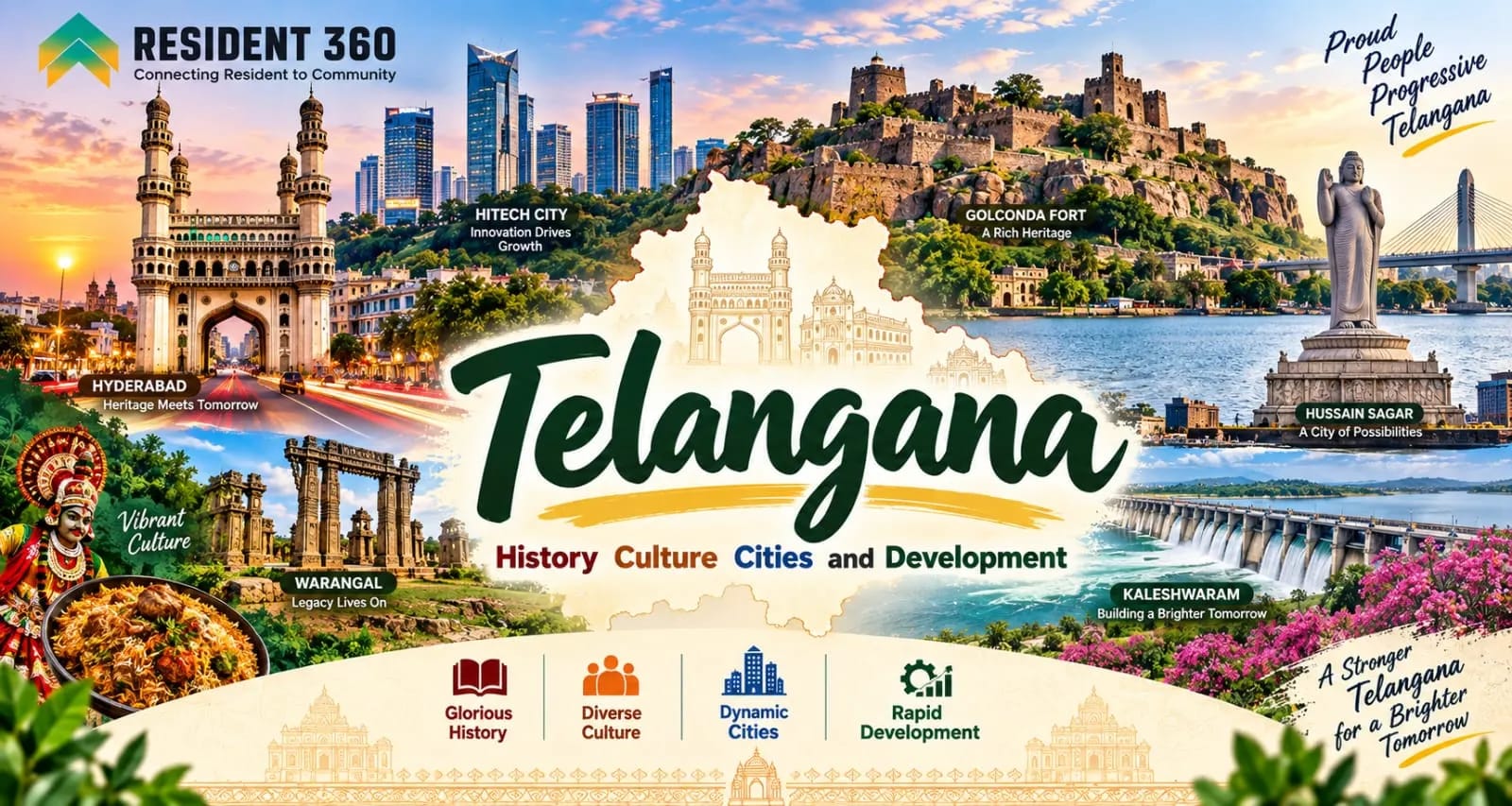
Telangana is a state where ancient Deccan history, living traditions, fast-growing cities, and distinctive regional identity come together. From the historic lanes of Hyderabad and the grand monuments of Warangal to the forests, reservoirs, temples, and village communities beyond the major urban centres, Telangana offers far more than a single travel destination. Its story includes powerful dynasties, the cultural influence of the Deccan, the evolution of Telugu language and literature, and the creation of a modern state with Hyderabad as a major technology and business hub. This guide to Telangana explores its history, geography, cities, heritage, festivals, food, lifestyle, and development so readers can understand how the state’s past continues to shape its present. Whether you are planning a visit, studying the region, or simply seeking a clearer picture of Telangana, these connected themes provide a useful starting point.
The state’s character is best understood by looking at both its celebrated landmarks and its everyday life, where old customs and new opportunities continue to exist side by side.
The Historical Journey of Telangana
Telangana’s history reflects the wider story of the Deccan plateau, shaped by powerful kingdoms, changing trade routes, religious movements, and the interaction of several languages and communities. The region was influenced by the Satavahanas, Chalukyas, Kakatiyas, Bahmani rulers, the Qutb Shahi dynasty, and the Asaf Jahi Nizams. Each period left behind architecture, administrative traditions, artistic practices, and cultural memories that remain visible today.
From the Kakatiyas to the Qutb Shahis
The Kakatiya period is especially important in Telangana’s regional identity. Warangal served as a major centre, and the dynasty is remembered for its forts, temples, tanks, and contributions to irrigation and administration. The Thousand Pillar Temple and the Warangal Fort area reflect the architectural ambition of that era, while the historic Ramappa Temple shows the refinement of Kakatiya craftsmanship.
The Qutb Shahi rulers later developed Golconda and founded Hyderabad in the sixteenth century. Their rule strengthened the region’s connections with Persianate court culture, local Telugu traditions, architecture, trade, and diamond commerce associated with the wider Golconda area. Hyderabad’s monuments and neighbourhoods still reveal this layered past.
The Nizams and the Formation of the State
The Asaf Jahi dynasty, commonly associated with the Nizams of Hyderabad, influenced the region’s politics, education, architecture, cuisine, and urban development for several centuries. The legacy can be seen in palaces, public buildings, museums, language communities, and culinary traditions.
Telangana became a separate state on 2 June 2014 after a long political and social movement. State formation gave renewed attention to regional history, festivals, language, irrigation, public administration, and local development priorities. Modern Telangana therefore carries both the heritage of the former Hyderabad State and a strong contemporary identity shaped by its people.
Geography, Rivers, and Natural Landscapes
Telangana lies on the Deccan Plateau and has a landscape of rocky terrain, fertile plains, dry deciduous forests, lakes, reservoirs, and river valleys. The Godavari and Krishna are its principal river systems, supporting agriculture, drinking water needs, irrigation projects, and settlements across different districts.
The state’s geography changes noticeably from one area to another. Around Hyderabad, granite formations and urban development define the landscape. Northern districts include forested areas and agricultural belts, while eastern and southern parts feature river valleys, dryland farming regions, and historic water bodies. Seasonal rainfall plays an important role in farming and water management, making tanks and reservoirs a notable part of Telangana’s rural environment.
Forests and Wildlife
Telangana’s forests provide habitat for species such as deer, wild boar, peafowl, sloth bears, and, in suitable protected landscapes, tigers and other wildlife. Places such as the Kawal Tiger Reserve and the Amrabad Tiger Reserve are associated with the state’s broader conservation landscape. Forests also support communities through traditional livelihoods and the collection of minor forest produce.
Visitors exploring natural areas should follow local rules, avoid disturbing wildlife, and respect forest-dependent communities. The best experience often comes from treating these landscapes as living ecological systems rather than simply as sightseeing locations.
Hyderabad: The State’s Historic and Modern Centre
Hyderabad is the most widely recognised city in Telangana and one of the country’s best examples of old and new urban life existing together. Founded by the Qutb Shahi rulers, the city grew around historic neighbourhoods, markets, palaces, mosques, tombs, lakes, and later institutions linked to education, government, technology, and commerce.
Charminar remains the city’s defining landmark, while the surrounding bazaars provide a lively view of Hyderabad’s traditional commercial culture. Golconda Fort offers insight into the region’s military and architectural history, and the Qutb Shahi tombs show the artistic language of the dynasty. Other notable places include Chowmahalla Palace, the Salar Jung Museum, Hussain Sagar, and the historic areas of the old city.
A City of Technology and Enterprise
Modern Hyderabad has expanded through areas such as HITEC City, Madhapur, Gachibowli, and the Financial District. Information technology, pharmaceuticals, biotechnology, education, healthcare, financial services, and start-ups contribute to the city’s economic profile. This growth has created employment and investment opportunities while also increasing pressure on transport, housing, water systems, and urban planning.
The city’s appeal comes from this combination: a visitor can experience historic architecture, Deccani cuisine, and traditional markets in one part of Hyderabad, then encounter research institutions, corporate campuses, modern residential districts, and contemporary cultural spaces in another.
Major Cities and Places Beyond Hyderabad
Although Hyderabad receives the greatest attention, Telangana’s other cities and towns help explain the state’s wider identity. Each has a different relationship with history, agriculture, industry, religion, education, or regional trade.
Warangal and Hanamkonda
Warangal and nearby Hanamkonda form one of Telangana’s most important historic urban areas. The region is associated with the Kakatiya dynasty and includes the Warangal Fort, Thousand Pillar Temple, and Ramappa Temple in the broader cultural landscape. The large Ramappa Lake and surrounding rural areas also show how historic water management and settlement patterns shaped the region.
Nizamabad, Karimnagar, and Khammam
Nizamabad is known for its agricultural surroundings, temples, historic sites, and links with northern Telangana. Karimnagar has developed as an important commercial and educational centre and is connected with craft traditions and regional trade. Khammam serves as a gateway to areas with forests, rivers, temples, and the wider eastern landscape.
Nalgonda, Mahbubnagar, and Adilabad
Nalgonda is associated with historic Buddhist and fort-related sites, as well as important irrigation landscapes. Mahbubnagar, also known as Palamuru, reflects the culture and challenges of a largely dry region while participating in changing agricultural and infrastructure patterns. Adilabad is recognised for its forest environment, tribal cultural influences, waterfalls, and connection to northern Telangana.
Together, these places show that Telangana is not defined only by its capital. Its identity is distributed across historic towns, district centres, rural settlements, and natural regions.
Culture, Communities, and Living Traditions
Telangana culture is expressed through language, music, dance, festivals, clothing, crafts, oral traditions, and community celebrations. Telugu is central to public and literary life, while Urdu, Marathi, Kannada, Lambadi, Gondi, and other languages are also spoken by communities across the state. This linguistic variety reflects Telangana’s position at a cultural crossroads in the Deccan.
Festivals and Folk Expressions
Bathukamma is one of Telangana’s most distinctive festivals. Women arrange seasonal flowers into colourful stacks and gather for songs and circular dances before immersing the floral arrangements in water. The festival connects nature, community, feminine traditions, and regional identity.
Bonalu is another major Telangana festival, particularly associated with Hyderabad and Secunderabad. It involves devotional offerings to local forms of the goddess, processions, music, and community participation. Sammakka Saralamma Jatara, held in the tribal region of Medaram, is among the most significant religious gatherings associated with Telangana’s indigenous cultural traditions.
Folk forms such as Oggu Katha combine storytelling, music, and performance to preserve narratives about local deities and heroes. Perini dance, linked to the Kakatiya period, is remembered as a vigorous martial dance tradition. These forms demonstrate that Telangana’s heritage is not limited to monuments; it also lives through performance and collective memory.
Heritage Sites, Temples, and Architecture
Telangana’s built heritage spans Hindu temple architecture, Islamic monuments, palace complexes, forts, Buddhist sites, stepwells, and traditional urban neighbourhoods. The state’s monuments often reveal how regional stonework, engineering, religious practice, and political power influenced one another.
The Ramappa Temple is particularly notable for its sculptural detail and Kakatiya design. Warangal Fort reflects the defensive and ceremonial importance of the medieval capital. In Hyderabad, Charminar and the surrounding old city represent the Qutb Shahi foundation of the metropolis, while the Qutb Shahi tombs and Chowmahalla Palace illustrate later royal traditions.
Buddhist heritage can be explored at sites such as Phanigiri and Dhulikatta, which point to the region’s links with ancient religious and trading networks. Jain and Hindu sites across the state add further layers to its religious history.
Responsible Heritage Visits
A respectful visit means following monument rules, avoiding damage to carvings, dressing appropriately at religious sites, and learning the local significance of a place rather than treating it only as a photo opportunity. Travellers should also allow time for smaller museums, local guides, village surroundings, and traditional markets, where the historical context often becomes easier to understand.
Telangana Cuisine and Everyday Lifestyle
Telangana food is known for bold flavours, chilli, tamarind, sesame, millets, pulses, and locally available vegetables. The cuisine varies between urban households, rural communities, festival kitchens, and food traditions influenced by the Deccan and Hyderabad.
Popular dishes and preparations include sarva pindi, sakinalu, jonna roti, pachi pulusu, kodi pulusu, and a range of lentil- and vegetable-based curries. Hyderabadi biryani, haleem, kebabs, and desserts such as double ka meetha are closely associated with the capital’s composite culinary culture, although Hyderabad’s food identity is only one part of Telangana cuisine.
Daily life differs between the state’s cities and villages. Urban Telangana includes professionals, students, entrepreneurs, migrants, artists, and service workers living in rapidly changing neighbourhoods. Rural communities remain connected to agriculture, livestock, seasonal festivals, local markets, and tank-based landscapes. Handloom weaving, metal crafts, pottery, woodwork, and tribal arts also contribute to the state’s cultural economy.
Development, Economy, and Emerging Opportunities
Telangana’s development has been strongly influenced by Hyderabad, but economic activity is gradually becoming more distributed across districts. Information technology, pharmaceuticals, biotechnology, aerospace, education, healthcare, agriculture, food processing, textiles, logistics, and renewable energy are important areas of opportunity.
Hyderabad’s technology and life-sciences sectors have attracted institutions, skilled workers, and supporting businesses. At the same time, irrigation projects, roads, digital services, industrial parks, agricultural programmes, and improved connectivity have shaped development beyond the capital. District centres are gaining importance as places for education, healthcare, retail, administration, and small-scale enterprise.
Balancing Growth with Sustainability
Rapid expansion brings challenges. Traffic congestion, loss of lakes, water stress, waste management, uneven access to opportunities, and pressure on land require careful planning. Protecting forests, restoring traditional tanks, supporting sustainable agriculture, and conserving heritage sites are essential to ensuring that growth does not weaken the resources and cultural character that make Telangana distinctive.
The state’s future will depend on how effectively it combines technology and infrastructure with inclusive public services, environmental care, local employment, and the protection of community traditions.
Conclusion
Telangana is a state of layered identity, where Kakatiya temples, Qutb Shahi monuments, Nizam-era architecture, Bathukamma celebrations, regional food, forest landscapes, and Hyderabad’s modern economy form one connected story. Its major cities reveal different sides of the region, while villages, heritage sites, rivers, and communities add depth beyond the capital. Understanding Telangana means appreciating both its history and its continuing transformation. From its cultural traditions to its development opportunities, Telangana remains a distinctive part of India’s Deccan landscape and a region with a dynamic future.