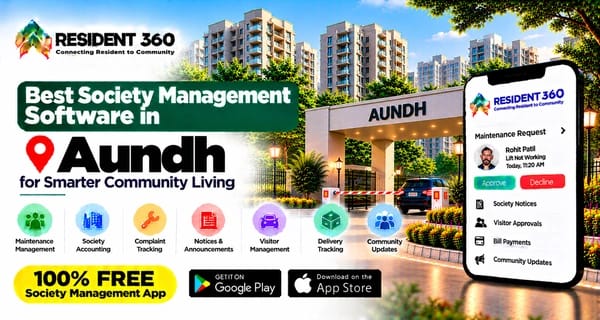
Society Management Software can help residential communities in Aundh bring everyday operations into one more organized process. As apartments, gated communities, and Resident Welfare Associations (RWAs) coordinate maintenance payments, resident requests, visitor entries, staff activities, and announcements, manual registers and scattered messages can become difficult to manage. A structured digital approach may help committee members, facility managers, security teams, and residents access relevant information more easily. The right solution should support practical community needs rather than add unnecessary complexity. For societies in Maharashtra, this can mean clearer coordination between residents and the people responsible for keeping the community running.
A useful platform should connect daily tasks with better records, timely communication, and simple follow-up. It can support both committee-level visibility and a more convenient experience for residents without replacing the judgment of the people managing the community.
Why Aundh Societies Need More Organized Community Management
Aundh includes a wide range of residential communities, from established apartment buildings to larger gated developments. Each community may have different committee structures, staff arrangements, facility needs, and resident expectations. Yet most societies still need to coordinate similar activities: maintenance collection, repairs, visitor movement, complaints, notices, and shared facilities.
When these activities are handled through paper registers, spreadsheets, phone calls, and multiple chat groups, information can become difficult to trace. A committee member may not know whether a payment concern was resolved, while a resident may miss an important notice among unrelated messages. Society Management Software can provide a more organized way to record, communicate, and follow up on these tasks.
The value is not only in digitizing information. It is also in creating a clearer working process for the committee, facility staff, security personnel, and residents. Aundh societies can use such an approach to reduce avoidable confusion while keeping community operations practical and transparent.
Common Problems in Aundh Society Operations
The challenges faced by a residential community often grow as the number of residents, staff, vehicles, visitors, and daily requests increases. Without a shared process, small gaps can lead to repeated calls, delayed follow-ups, or uncertainty about the latest status.
- Maintenance payments may be tracked across different spreadsheets or notebooks.
- Pending dues may require repeated manual follow-up with residents.
- Resident records may not be updated consistently after occupancy changes.
- Visitor information may remain in paper registers that are difficult to review later.
- Security teams may not have a clear process for resident approval and entry updates.
- Complaints about repairs or common facilities may be sent to different people.
- Important society announcements may be missed in busy messaging groups.
- Committee members may lack a shared view of open requests and completed work.
- Staff attendance, responsibilities, or service-related information may be difficult to coordinate.
- Documents and operational details may be spread across personal devices and email accounts.
These issues do not necessarily indicate poor management. They often reflect the difficulty of coordinating many routine tasks with limited time and fragmented information. A digital platform can help create a repeatable process that is easier to maintain.
How Society Management Software Can Address These Challenges
Society Management Software can connect resident information, society communication, maintenance follow-up, complaints, visitor coordination, and operational records in a more structured environment. Instead of treating each activity as an isolated task, the committee can use a shared process for receiving information, assigning responsibility, and checking progress.
For example, a resident may raise a request related to a common facility. The committee or facility team can review the details, coordinate the required action, and retain a record of the status. Similarly, maintenance information can be organized so that residents have a clearer reference point and committee members can focus on follow-up instead of searching through multiple files.
A Society Management App may be useful when a community wants to bring several administrative activities into one accessible workflow. A Society Maintenance App can support the maintenance-specific side of that process, including payment information, dues follow-up, and related communication. The objective should be a practical system that helps people complete their responsibilities with fewer avoidable gaps.
Four Core Areas for Better Society Management in Aundh
Resident and Apartment Records
Accurate resident and apartment records support several other society activities. When basic information is organized, committee members can communicate with the appropriate residents and maintain a clearer understanding of occupancy, units, and community requirements.
- Keep resident and apartment information easier to reference.
- Support updates when residents, tenants, or contact details change.
- Reduce dependence on separate personal records maintained by different committee members.
A centralized Society Management App can make it easier to connect resident information with maintenance, communication, and service-related activities.
Maintenance and Payment Tracking
Maintenance collection is a recurring responsibility for most societies. A structured process may help the committee monitor dues, share reminders, and maintain a consistent record of payment-related information without relying entirely on manual reconciliation.
- Review outstanding maintenance amounts more systematically.
- Share relevant payment information with residents through an organized communication process.
- Keep recurring maintenance activities connected to resident and apartment records.
This can help reduce uncertainty for both residents who need payment clarity and committee members responsible for follow-up.
Visitor and Security Coordination
Security teams manage frequent interactions involving residents, guests, delivery personnel, domestic workers, and service providers. A clear process can help the gate team and residents coordinate entry-related information without depending only on handwritten registers or repeated calls.
- Support a more consistent visitor entry and approval process.
- Maintain useful visitor records for later reference.
- Improve communication between security personnel and residents when clarification is needed.
A visitor management system can be considered as part of a wider society-management approach, especially where a community has busy gates or several entry points.
Complaints and Service Requests
Repairs, housekeeping concerns, lift-related issues, and common-area requests need timely attention and clear ownership. A structured request process can help the committee understand what has been reported, who is handling it, and whether the matter remains open.
- Record a complaint with enough context for review.
- Separate new requests from those already being handled.
- Give the committee and facility team a clearer basis for follow-up.
This does not guarantee immediate resolution, but it can make responsibilities and status easier to organize.
Supporting Operations That Complete the Digital Workflow
Resident Communication
Announcements about maintenance schedules, repairs, meetings, water interruptions, and community activities need to reach the right residents at the right time. A Resident communication app can help place important updates in a more central channel instead of spreading them across informal groups.
- Share notices and operational updates in an organized manner.
- Reduce dependence on repeated one-to-one messages.
- Give residents a clearer reference for information shared by the committee.
Facility Coordination
Common facilities such as parking areas, community halls, play spaces, and other shared assets require regular coordination. A digital process may help the facility team and committee maintain clearer information about requests, schedules, and follow-up responsibilities.
- Organize facility-related requests and updates.
- Support coordination between residents, staff, and committee members.
- Make recurring operational tasks easier to review.
The exact process will depend on the community’s rules and staffing model, but centralizing information can reduce unnecessary back-and-forth.
Staff and Vendor Follow-Up
Security guards, housekeeping personnel, technicians, and other service staff contribute to daily society operations. Their work often involves multiple instructions and recurring tasks, so a shared record can help the committee coordinate more consistently.
- Keep service-related requests connected to the responsible team.
- Improve visibility into open operational tasks.
- Support follow-up when a resident raises a concern about common services.
A management team can use organized information to divide responsibilities more clearly, while still making decisions based on the community’s actual needs.
Society Activities and Notices
Meetings, cultural activities, safety notices, and community initiatives also require timely communication. These activities may not be as frequent as maintenance collection, but they still benefit from a clear way to share updates and coordinate participation.
- Publish activity-related information in one accessible place.
- Help residents stay aware of meetings and community notices.
- Reduce the chance that important updates are lost among unrelated conversations.
A consistent communication process can support stronger participation without requiring the committee to repeat the same announcement across several channels.
How Different Aundh Communities Can Use the Software
A smaller society may mainly need organized resident records, maintenance follow-up, complaint tracking, and notices. For such a community, the value may come from replacing scattered spreadsheets and informal coordination with a simpler shared process. The committee can decide which activities need to be digitized first instead of attempting to change every workflow at once.
Apartment communities with several buildings may have more complex requirements. They may need clearer coordination between building representatives, security teams, facility staff, and the central committee. In this setting, a solution should help people find relevant information without creating additional confusion between building-level and society-level responsibilities.
Large gated communities may handle higher visitor movement, more service requests, multiple facilities, and a larger volume of recurring maintenance information. They can benefit from clearer separation between visitor operations, resident communication, payments, complaints, and facility coordination. The process should remain understandable for residents as well as staff members who may have different levels of comfort with digital tools.
RWAs can also use an organized platform to coordinate committee work and maintain community records. A rwa management software approach may be relevant when the association wants to connect administrative activities, resident communication, maintenance follow-up, visitor coordination, and service requests without treating each function as a separate system. The appropriate setup depends on the association’s working model and priorities.
How Resident360app Can Support Society Operations
Resident360app can be considered by Aundh societies looking for a more organized way to coordinate routine community activities. Depending on the needs of the community, it may support maintenance and payment tracking, pending dues, resident communication, complaints and service requests, visitor and security coordination, resident records, and staff or facility coordination.
For a committee, having these activities connected can make it easier to review open responsibilities and communicate with residents. For residents, a central process may provide a clearer way to receive updates, share requests, and find relevant society information. For security and facility teams, organized records can support day-to-day coordination without requiring every detail to be remembered or passed through multiple people.
The platform should be introduced according to the society’s actual workflow. A committee may begin with maintenance communication and resident records, then expand its use for visitor coordination, complaints, or facility activities as residents and staff become familiar with the process. This measured approach can help the community focus on useful adoption rather than adding digital steps without a clear purpose.
Societies evaluating broader options can also review the maintenance management software perspective when recurring dues, requests, and operational follow-up are central concerns. A related Maintenance management system may help organize information, but the final choice should reflect the society’s responsibilities, team capacity, and communication habits.
For wider context, committees researching the category can review this guide to society management software in Hyderabad. Although communities differ by location and structure, the operational principles can help committees frame their own requirements. A local comparison of Society Management Software in Bavdhan may also help teams think about how similar residential communities approach digital administration.
What to Evaluate Before Choosing a Society Management Solution
A society should evaluate software against its real operating problems rather than selecting a platform only because it has a long feature list. The committee can begin by documenting how maintenance, resident communication, visitor entry, complaints, and staff coordination currently work. This makes it easier to identify where delays or repeated manual effort occur.
Consider the following points during evaluation:
- Whether residents can understand and use the main workflows without extensive assistance.
- Whether maintenance payments, dues, and related records can be organized clearly.
- Whether important announcements can be shared without adding more communication confusion.
- Whether visitor and security coordination fits the community’s gate process.
- Whether complaints and service requests can be recorded and followed up.
- Whether resident and apartment information can be kept current.
- Whether committee members and facility teams can access the information relevant to their responsibilities.
- Whether the system can be introduced gradually according to the society’s readiness.
The committee should also discuss ownership. Someone needs to maintain records, review requests, communicate updates, and guide residents when questions arise. Software can support the process, but clear responsibilities and regular follow-up remain essential for effective society administration.
Conclusion
Society Management Software can help Aundh societies organize maintenance, resident records, payments, visitor coordination, complaints, communication, and facility-related work through a more consistent process. The most suitable approach depends on the community’s size, workflow, committee structure, and adoption readiness. By evaluating practical needs first, societies can use Resident360app to support clearer coordination without losing the human oversight required for daily community management.
Get Started with Resident360 Today
Resident360app can be considered by societies and residential communities looking for a more organized approach to society management. To learn more, visit Resident360app.
Download the Resident360app Today