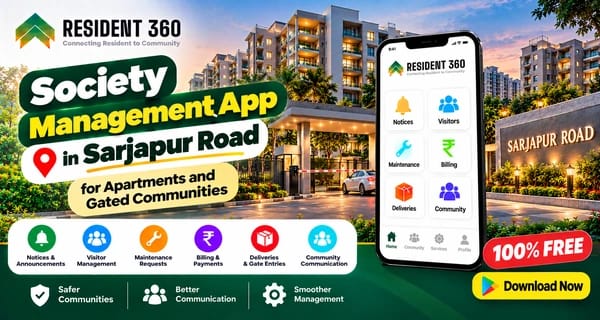
Sarjapur Road has a wide mix of residential societies, gated communities, and growing housing developments, each with daily responsibilities that require clear coordination. A society management app can help committees, facility managers, security teams, and residents manage maintenance, visitor entries, complaints, communication, records, and shared facilities in a more organized way. Instead of depending on scattered messages, paper registers, and manual follow-ups, communities can create clearer processes that support smoother society management and better visibility for everyone involved.
For a Resident Welfare Association (RWA), the goal is not simply to adopt software. It is to make everyday responsibilities easier to coordinate while keeping residents informed and records accessible.
Why Sarjapur Road Societies Need a Society Management App
Residential communities in Sarjapur Road often coordinate residents, domestic help, delivery personnel, security staff, vendors, maintenance teams, and committee members at the same time. As the number of homes and shared facilities grows, informal communication can make it difficult to know whether a request was received, who is handling it, or what action is still pending.
A Society Management App can help bring these activities into a more structured process. It may support resident coordination, maintenance tracking, visitor management, complaint handling, staff communication, facility scheduling, and record organization without requiring every update to pass through one committee member.
For communities in Sarjapur Road, organized society management can help with:
- Sharing notices and important updates with residents
- Recording maintenance requests and follow-ups
- Coordinating visitor entry with residents and security personnel
- Keeping payment-related records easier to review
- Managing complaints and service requests in a more visible manner
- Organizing staff responsibilities and facility-related activities
Common Problems Faced by Societies in Sarjapur Road
Society committees and management teams may face different operational pressures depending on the size, layout, and facilities of the community. Even routine tasks can become difficult when information is spread across messaging groups, spreadsheets, registers, and individual conversations.
Common challenges include:
- Tracking monthly maintenance collections and pending dues
- Responding to visitor and delivery coordination requests
- Sharing urgent security updates with the right residents
- Recording complaints and checking their follow-up status
- Coordinating housekeeping, security, and maintenance staff
- Managing bookings or upkeep for shared facilities
- Maintaining updated resident and unit records
- Organizing notices, circulars, and community announcements
- Finding earlier payment, complaint, or maintenance information
These gaps can affect residents who are waiting for a response, committee members who are handling multiple requests, security personnel who need clear instructions, and facility managers who must coordinate daily work. A more consistent process can reduce avoidable confusion, even when the underlying task remains manual.
For communities comparing options, a Society Maintenance App may be useful when maintenance collection, requests, and follow-up are central requirements.
How a Society Management App Solves These Problems
A society management app can bring separate activities into one organized workflow. Residents may have a clearer way to submit information, while committee members and facility managers can review requests, communicate updates, and maintain records with less dependence on scattered conversations.
For example, a resident may report a water leakage issue, the management team may assign or communicate the next step, and the resident can receive an update through the same society management process. Similarly, a notice about planned maintenance can be shared with the affected community instead of being passed through several informal groups.
The Society Management App approach can support:
- Centralized resident and unit information
- More organized maintenance and payment follow-up
- Clearer communication between residents and committees
- Structured visitor and delivery coordination
- Easier recording of complaints and service requests
- Better visibility into recurring society activities
The value depends on how consistently the community uses the process. A digital tool can support coordination, but clear responsibilities and timely human follow-up remain essential.
Maintenance, Visitor, Security, and Complaint Management
Maintenance, security, visitor handling, and complaints are closely connected to the daily experience of residents. A practical society management process should help people record information clearly and communicate the next step without creating unnecessary complexity.
Maintenance Management
Maintenance work can involve monthly dues, repair requests, vendor follow-up, common-area upkeep, and resident queries. A maintenance management software solution can help organize these activities so committee members and facility managers have a clearer view of what has been raised and what still needs attention.
Useful practices may include:
- Recording maintenance requests with relevant details
- Tracking pending dues and payment-related follow-up
- Sharing maintenance notices with affected residents
- Keeping a history of service requests and actions taken
- Separating routine upkeep from urgent repair requirements
Societies should also keep payment communication clear. Residents can be directed to official payment information when they need general guidance about digital payment systems, while the RWA should communicate its own approved payment process separately.
Visitor Management
A visitor management system can help societies create a more organized approach to visitor entry and resident confirmation. This is useful when security personnel handle guests, delivery partners, domestic staff, service providers, and temporary workers throughout the day.
Practical visitor processes may cover:
- Confirming expected visitors with residents
- Coordinating delivery and service entries
- Recording relevant visitor details
- Sharing entry-related updates with security staff
- Following the community’s access rules consistently
Security Management
Security coordination depends on timely communication between residents, guards, committee members, and facility managers. Organized visitor records and clear access instructions can make it easier to handle routine entry requests, unusual situations, and communication about maintenance work or service personnel.
A society management team should also review who is responsible for approving access, updating instructions, and responding to resident concerns. The software supports the process, but the community’s security policy and staff training remain important.
Complaint Management
Residents need a clear way to report issues involving common areas, water supply, cleanliness, noise, security, repairs, or facilities. A structured complaint process can help record the concern, communicate it to the appropriate person, and preserve follow-up information.
Complaints should include enough detail for the responsible person to understand the issue. Management committees can review open requests periodically and communicate realistic updates rather than allowing reports to disappear in busy group conversations.
Resident Communication, Staff, Facility, and Record Management
Society management involves more than collecting maintenance or approving visitors. It also includes keeping residents informed, coordinating staff, maintaining shared facilities, and organizing records that may be needed later.
Resident Communication
A Resident communication app can help communities share notices, announcements, planned work updates, and other relevant information in a more organized channel. This may reduce dependence on repeated forwards and make important messages easier for residents to find.
Communication should remain purposeful. Communities may use it for:
- Maintenance and water-supply notices
- Facility closure or repair updates
- Security advisories
- Meeting announcements and community information
- Responses to common resident queries
Staff Management
Housekeeping staff, security personnel, maintenance workers, and other service teams often work on different schedules. Clear task communication can help the management committee or facility manager explain daily responsibilities, report issues, and coordinate follow-up.
The community should define responsibilities clearly instead of assuming that a digital system alone will manage staff work. A simple record of assigned tasks and updates may make daily coordination easier for the responsible people.
Facility Management
Shared facilities such as clubhouses, halls, play areas, gyms, and parking-related spaces require rules, upkeep, and communication. Societies can organize facility schedules, maintenance notices, and usage-related information so residents understand availability and responsibilities.
Facility management also includes reporting damaged equipment, coordinating cleaning, and communicating temporary closures. Keeping these activities visible can help avoid conflicting expectations among residents.
Record Management
Resident details, unit information, notices, maintenance records, payment-related records, complaints, and community decisions may need to be referred to over time. A structured record approach can help committee members locate relevant information and support smoother handovers when committee responsibilities change.
Records should be kept accurate, access should be handled responsibly, and sensitive information should only be shared with people who need it for society management duties.
Society Management App for Small Societies and Gated Communities
Small societies and larger gated communities may need different levels of coordination. A smaller community may have fewer facilities and a smaller staff, while a larger development may manage multiple entry points, more amenities, more service providers, and a wider range of resident requests.
A society management app should be considered against the community’s actual requirements, including:
- Number of residents and units
- Maintenance collection and request volumes
- Visitor entry and security arrangements
- Number of staff members and service teams
- Facilities that require scheduling or upkeep
- Communication needs across blocks or towers
- Administrative and record-keeping responsibilities
An RWA may begin by identifying its most frequent problems rather than selecting software based only on a long feature list. This broader guide to RWA management software can help committee members think through the responsibilities and workflows that need support.
The same evaluation is useful for nearby communities. Committees comparing local requirements can also review guidance on a society management app in Varthur, a society management app in Marathahalli, and a society management app in Whitefield to understand how similar residential environments may approach digital society management.
How Resident360app Simplifies Society Management
Resident360app can be considered by societies that want a more organized way to coordinate routine management activities. Its usefulness should be assessed against the community’s processes, resident expectations, committee responsibilities, and the level of adoption the RWA can support.
Depending on the society’s requirements, a digital approach may help with:
- Maintenance and payment tracking
- Visibility into pending dues and follow-up
- Visitor and security coordination
- Complaints and service requests
- Resident communication and notices
- Resident and unit records
- Staff and facility coordination
- Recording recurring society activities
A Maintenance management system may be especially relevant for communities that need a clearer way to organize maintenance requests and related communication. Resident360app can support a more consistent process, but committees still need to define responsibilities, review requests, and communicate decisions appropriately.
Before adopting any system, the RWA can map its current process, identify gaps, and decide which activities should be introduced first. This approach may make implementation easier for residents, security staff, committee members, and facility managers.
How to Choose the Right Society Management App
The right society management app should fit the community’s real working style rather than add unnecessary complexity. Committee members and management teams can compare the following areas before making a decision:
- Usability: Residents, security personnel, and committee members should be able to understand the basic process without extensive guidance.
- Society requirements: The system should match the community’s needs for maintenance, communication, visitors, complaints, facilities, and records.
- Resident adoption: The RWA should consider how notices, requests, and updates will be introduced to residents and how support questions will be handled.
- Scalability: The process should remain practical if the community adds residents, facilities, staff, or additional administrative responsibilities.
- Communication: Check whether the approach can support notices, announcements, queries, and important updates in an organized manner.
- Maintenance: Review how requests, dues, payment-related records, and follow-up will be handled.
- Visitor management: Consider resident confirmation, delivery coordination, access rules, and security communication.
- Complaint management: Look for a practical way to record, assign, communicate, and review open issues.
- Record organization: Confirm how resident, unit, maintenance, and community information will be maintained and accessed.
- Staff and facility coordination: Assess whether the process can support daily responsibilities and shared facility activities.
Committees looking for a broader starting point can review this guide to society management apps for small apartments. The final choice should be based on clarity, suitability, responsible information handling, and the community’s ability to use the process consistently.
Conclusion
For societies in Sarjapur Road, organized society management can make daily coordination easier for residents, committee members, security personnel, facility managers, and service teams. A society management app may help bring maintenance, visitor handling, complaints, communication, records, and facility activities into a clearer process. Resident360app can be considered by RWAs seeking practical digital support while keeping responsibilities and community decisions clearly defined.
Get Started with Resident360 Today
Resident360app can be considered by societies and residential communities looking for a more organized approach to society management. To learn more, visit Resident360app.
Download the Resident360app Today