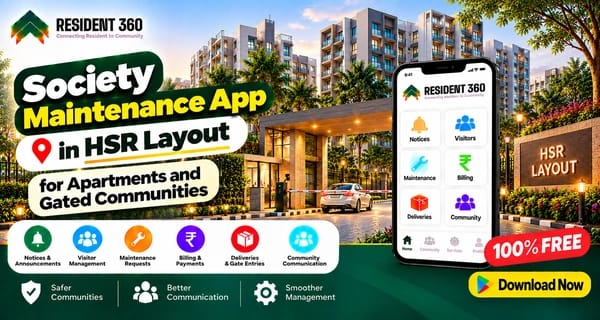
HSR Layout has a wide mix of residential societies, gated communities, and housing associations with different maintenance routines, security processes, and resident expectations. A Society Maintenance App can help bring these activities into one more organized process, making it easier to track dues, share notices, record complaints, coordinate visitors, and maintain community information. For Resident Welfare Association (RWA) committees and facility teams, a structured digital approach may reduce dependence on scattered spreadsheets, paper registers, and informal messaging groups. The goal is not to replace people or established procedures, but to support clearer coordination between residents, committee members, security personnel, vendors, and staff.
A practical society management process can also make everyday responsibilities easier to review. With the right approach, committee members can spend less time searching for updates and more time addressing the needs of the community.
Why HSR Layout Societies Need a Society Maintenance App
Societies in HSR Layout often manage several activities at the same time. Monthly maintenance, visitor entry, resident communication, parking concerns, facility bookings, staff coordination, and complaints may all involve different people and records. When information is spread across registers, spreadsheets, and messaging groups, follow-up can become difficult.
A Society Maintenance App can support a more consistent way to manage these responsibilities. It may help committees and facility managers keep important updates accessible while giving residents a clearer channel for requests and information. This is especially useful when a community has multiple blocks, shared facilities, security shifts, or a large number of daily visitors.
A structured system can help with:
- Coordinating residents and committee members around routine updates.
- Recording maintenance requests and tracking their status.
- Organizing visitor information and security communication.
- Sharing notices, announcements, and community updates.
- Assigning or communicating staff responsibilities.
- Managing complaints and service-related follow-up.
- Supporting facility scheduling and common-area maintenance.
- Keeping resident, payment-related, and society records more organized.
Common Problems Faced by Societies in HSR Layout
A society management team may face recurring administrative challenges even when individual staff members and committee volunteers are working diligently. The difficulty often comes from keeping information current, ensuring that the right person receives it, and following up consistently.
- Maintenance collection may be recorded in different formats, making monthly reconciliation harder.
- Pending dues may require repeated reminders and manual follow-up with residents.
- Visitor coordination can become difficult during busy hours, deliveries, events, or move-ins.
- Security staff may not always have quick access to the latest resident instructions.
- Notices and updates can get lost among unrelated messages in resident groups.
- Complaints may be reported verbally or in chat messages without a clear record of ownership.
- Housekeeping, security, and maintenance staff may need better coordination of daily responsibilities.
- Common facilities may require clearer schedules, usage rules, and maintenance updates.
- Resident records and contact information may become outdated when managed manually.
- Committee members may spend significant time searching for previous notices, payment records, or service updates.
Using a dedicated Society Management App can give committees a more defined place to organize these activities. It does not remove the need for human decision-making, but it can make information easier to review and share.
How a Society Maintenance App Solves These Problems
A Society Maintenance App can bring several routine society-management activities into a more connected workflow. Instead of treating maintenance, communication, visitors, and complaints as separate tasks, the committee can establish clearer processes for recording information, sharing updates, and reviewing pending work.
For example, a maintenance request can be recorded with relevant details, communicated to the responsible person, and reviewed later for follow-up. A community notice can be shared through a consistent channel instead of relying only on individual forwards. Similarly, resident-related information can be organized so that authorized committee members or staff can refer to it when needed.
A society management app may help by:
- Giving residents a more structured way to submit requests.
- Helping committees review pending maintenance or service matters.
- Supporting clearer communication between residents, staff, and security teams.
- Keeping routine records in a more accessible format.
- Reducing the need to search across multiple informal channels.
- Making recurring society-management activities easier to monitor.
The right system should support the way a community already operates rather than force every society into an unsuitable process. Committees can evaluate their requirements first and then select tools that match their communication, maintenance, security, and record-management needs.
For a broader reference point, committees can review this guide to the Society Maintenance App and compare the types of functions commonly considered in digital society management.
Maintenance, Visitor, Security, and Complaint Management
Maintenance, visitor handling, security coordination, and complaints are closely connected to the daily experience of residents. A clear process for each area can help the society management team communicate responsibilities and review pending matters more consistently.
Maintenance Management
Maintenance work may include common-area repairs, service requests, recurring upkeep, and monthly dues. Without a central process, residents may not know where to report an issue, while committee members may find it difficult to identify which requests are pending.
A maintenance management software approach can help societies organize activities such as:
- Recording maintenance requests with relevant details.
- Tracking whether a request is new, assigned, in progress, or awaiting follow-up.
- Reviewing pending dues and payment-related records.
- Sharing maintenance notices and reminders with residents.
- Maintaining a clearer history of follow-up and communication.
Payment records should be handled carefully, with access limited according to the society's administrative practices. Residents should also be given clear instructions about approved payment processes and related payment information.
Visitor Management
Visitor movement can vary significantly during weekdays, weekends, festivals, deliveries, and resident events. An organized visitor management system may help security personnel and residents coordinate entry-related activities more clearly.
Useful processes may include:
- Recording visitor or delivery details at the gate.
- Seeking resident confirmation where required by society rules.
- Sharing relevant visitor information with the concerned resident.
- Maintaining a record for review when an access-related question arises.
- Coordinating service providers, guests, and move-in or move-out activity.
The exact process should follow the community's security policy and applicable privacy expectations. Technology can support the process, but security staff and residents still play an important role in making access decisions.
Security Management
Security coordination involves more than recording visitors. It may also include shift communication, access instructions, delivery handling, emergency contacts, and updates from the committee. A society management team can use organized records and communication channels to reduce confusion between residents, guards, and facility staff.
Clear instructions are particularly useful when security personnel change shifts or when a temporary process is introduced. Committees should review what information is necessary, who can access it, and how long records should be retained.
Complaint Management
Residents may report concerns about plumbing, lighting, housekeeping, noise, parking, elevators, or shared facilities. A documented complaint process can help the committee capture the issue, communicate with the relevant person, and review follow-up without depending only on verbal conversations.
A complaint workflow may include the issue description, location, date, responsible staff member or vendor, status, and follow-up note. This does not guarantee immediate resolution, but it can make ownership and communication clearer for both residents and the committee.
Resident Communication, Staff, Facility, and Record Management
Society management depends on regular communication and reliable records. A practical digital process can help committees share important information while keeping routine staff, facility, and resident activities easier to organize.
Resident Communication
Residents need timely information about maintenance schedules, water supply, repairs, meetings, facility rules, security instructions, and community events. A Resident communication app can support a more consistent channel for notices, announcements, queries, and community updates.
Committees should keep messages clear and relevant. Important notices can include the date, affected area, expected duration, contact person, and any action residents need to take. This helps reduce confusion and unnecessary repeated questions.
Staff Management
Housekeeping, security, maintenance personnel, and other staff members may have different responsibilities and work schedules. Society management can be easier when daily tasks, instructions, and follow-up points are communicated in an organized manner.
A committee may use a Maintenance management system to support clearer coordination of maintenance-related work and service requests. Staff responsibilities should remain practical and aligned with the society's existing procedures rather than being documented in ways that create unnecessary complexity.
Facility Management
Shared facilities such as clubhouses, gyms, play areas, swimming pools, halls, and sports spaces require scheduling, usage guidelines, cleaning, and periodic maintenance. A digital process can help the committee communicate availability, record relevant requests, and share temporary closures or repair updates.
Facility management also requires clear rules. Societies should define booking limits, cancellation practices, maintenance responsibilities, and escalation points so that residents understand how shared spaces are administered.
Record Management
Resident information, maintenance records, notices, payment-related records, service requests, and community documents should be organized with suitable access controls. Accurate records can help committee members review past communication and understand the status of ongoing matters.
A record-management process should also include periodic updates. Residents may change contact details, tenants may move in or out, and committee responsibilities may change after elections or annual transitions.
Society Management App for Small Societies and Gated Communities
A smaller society may have fewer residents and facilities, but committee members may still need to manage maintenance, communication, visitors, staff, and records. In some cases, a small team handles several responsibilities at once, making simple access and clear workflows especially useful.
Larger gated communities may have multiple towers, entrances, security shifts, vendors, shared facilities, and different communication requirements. Their society management process may need more structured coordination across blocks, staff groups, facilities, and resident records.
The right society management app should be assessed against the community's actual needs, including:
- Number of residents and units.
- Type and number of shared facilities.
- Maintenance and payment processes.
- Staff and vendor coordination.
- Visitor handling and security procedures.
- Communication needs across blocks or phases.
- Committee administration and record organization.
Societies near Kudlu Gate, Electronic City, and Sarjapur Road may face similar administrative themes while having different layouts and operational routines. Committees can compare local considerations through this overview of the Society Maintenance App in Kudlu Gate, the guide to a Society Maintenance App in Electronic City, and the article on a Society Maintenance App in Sarjapur Road.
How Resident360app Simplifies Society Management
Resident360app can be considered as a digital platform for communities that want a more organized approach to routine society management. Its usefulness should be assessed according to the society's requirements, committee processes, and resident expectations rather than assumed without evaluation.
It can help bring attention to areas such as:
- Maintenance and payment tracking.
- Pending dues and related follow-up.
- Visitor and security coordination.
- Complaints and service requests.
- Resident communication and notices.
- Resident and apartment records.
- Staff and facility coordination.
- Activity management across routine society operations.
A platform that brings these areas into a more connected process may make it easier for a management team to review responsibilities and communicate updates. Committees can begin by identifying their most frequent administrative issues, checking how residents currently report them, and deciding which processes would benefit from better organization.
Resident360app should be reviewed in the context of the community's own policies. Clear roles, responsible access to information, and regular committee oversight remain important even when digital tools are introduced.
How to Choose the Right Society Management App
Choosing a society management app requires more than comparing a list of features. Committee members should consider whether the platform is easy for residents, security personnel, staff, and administrators to use in their daily routines.
Before selecting a solution, societies can review:
- Usability: Can different users understand the basic actions without extensive assistance?
- Society management requirements: Does the process match the community's maintenance, communication, and administration needs?
- Resident adoption: Can the committee explain the purpose clearly and support a gradual transition?
- Scalability: Can the approach remain useful if the society adds residents, facilities, or operational responsibilities?
- Communication: Are notices, updates, queries, and important instructions organized clearly?
- Maintenance: Can requests, dues, records, and follow-up be handled in a consistent manner?
- Visitor management: Does the process support the society's entry and security procedures?
- Complaint management: Can issues be recorded, assigned, communicated, and reviewed?
- Record organization: Are resident, payment-related, notice, and service records handled responsibly?
- Staff coordination: Can relevant work instructions and responsibilities be communicated clearly?
- Facility management: Can shared spaces, schedules, closures, and maintenance updates be organized?
Committees should also ask how access is managed, how information is updated, and what support is available during adoption. Reviewing a broader Society Management App resource may help decision-makers understand the wider role of digital society management before making a choice.
Conclusion
For societies in HSR Layout, a Society Maintenance App can support a more organized approach to maintenance, visitor coordination, complaints, communication, staff responsibilities, facilities, and records. The most suitable solution will depend on the community’s size, processes, and resident expectations. With clear responsibilities and thoughtful adoption, digital society management can help committees and residents coordinate everyday activities with greater clarity.
Get Started with Resident360 Today
Resident360app can be considered by societies and residential communities looking for a more organized approach to society management. To learn more, visit Resident360app.
Download the Resident360app Today