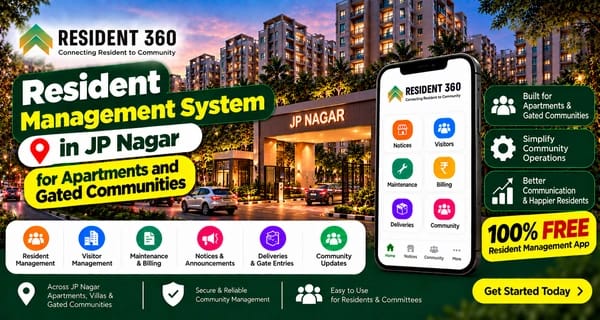
JP Nagar communities manage a wide range of daily responsibilities, from maintenance requests and visitor entries to resident communication, complaints, staff coordination, and facility upkeep. A Resident Management App can help bring these activities into a clearer, more organized process for residents, Resident Welfare Associations (RWAs), committee members, security teams, and facility managers. Instead of depending on scattered messages, spreadsheets, registers, and repeated follow-ups, communities can work with structured information that supports better coordination and more consistent administration.
For a community in Karnataka, the right resident management approach should fit its size, facilities, staffing, and communication habits. It should make routine work easier without creating unnecessary complexity for residents or committee members.
Why JP Nagar Societies Need a Resident Management App
JP Nagar includes residential societies, apartment communities, and gated developments with different management needs. Residents may need timely updates, clear maintenance information, visitor coordination, and a convenient way to raise issues, while RWAs and committees need organized records and visibility into pending tasks.
A resident management system can help communities bring several activities into one coordinated process. It may support:
- Resident and household record organization
- Maintenance requests, dues, and payment-related follow-up
- Visitor entry coordination with security staff
- Notices, announcements, and community communication
- Complaint recording and status-based follow-up
- Housekeeping, security, and maintenance staff coordination
- Common-area and facility scheduling
- Better access to day-to-day community information
For committee members, this can reduce dependence on informal conversations. For residents, it can make it easier to understand where to find updates, submit requests, and follow community-related matters.
Common Problems Faced by Residents and Societies in Karnataka
Residential communities in Karnataka may face similar operational challenges even when their size and facilities differ. The following issues can affect residents, committee members, security personnel, facility managers, and the wider management team:
- Maintenance collections may be recorded across spreadsheets, bank messages, and manual registers.
- Pending dues can require repeated individual follow-ups and reconciliation.
- Visitor details may be difficult to review when records are maintained only in physical registers.
- Security staff may not receive resident updates or delivery instructions quickly enough.
- Important notices can be missed when communication is spread across several chat groups.
- Complaints may not have a clear owner, status, or follow-up trail.
- Staff responsibilities may be communicated informally, making daily coordination harder.
- Shared facilities may require clearer booking, usage, and upkeep coordination.
- Resident records can become outdated when changes are not captured consistently.
- Committee members may spend too much time answering repeated questions and locating old information.
A structured Resident Management System can help create a common process for these activities. It does not remove the need for human decisions, but it may give residents and administrators a clearer way to share information and follow up on routine work.
How a Resident Management App Solves These Problems
A Resident Management App can help replace fragmented processes with a more organized resident-management workflow. For example, a resident may submit a maintenance request through a defined channel, while the committee or relevant staff member can review the information and coordinate the next step.
The same approach can support several daily activities:
- Community notices can be shared through a central communication channel.
- Maintenance-related information can be reviewed without searching through multiple conversations.
- Visitor and delivery coordination can follow a clearer process between residents and security.
- Complaints can be recorded with relevant details for assignment and follow-up.
- Resident information can be kept more organized for administrative use.
- Committee members can refer to activity records while reviewing recurring issues.
Communities comparing digital options can also review this Resident Management App resource to understand the broader role of technology in routine resident management. The objective should be practical coordination rather than adding software for its own sake.
Maintenance, Visitor, Security, and Complaint Management
Maintenance, access coordination, security communication, and complaints are closely connected to the daily resident experience. A resident management system can help create clearer processes for each area while leaving decisions and approvals with the appropriate community representatives.
Maintenance Management
Maintenance work often includes recurring dues, repair requests, vendor follow-up, and communication with residents. A digital process can make it easier to separate routine requests from pending payment matters and to keep relevant records together.
Useful practices may include:
- Recording maintenance requests with clear descriptions
- Reviewing pending dues and payment-related information
- Sharing maintenance notices with affected residents
- Tracking follow-up needs with staff or service providers
- Keeping residents informed when work affects shared areas
Communities may also evaluate maintenance management software when they need a more structured way to organize maintenance-related work. Payment records should be handled carefully, with access limited according to the community’s administrative practices. Residents can refer to reliable payment information when digital payment processes or transaction awareness are relevant.
Visitor Management
Visitor handling involves residents, guests, delivery personnel, security staff, and sometimes facility managers. A defined process can help reduce confusion at entry points and make it easier to confirm whether a visitor is expected.
A visitor management system may support organized handling of situations such as:
- Guest entry and resident confirmation
- Delivery coordination at the gate
- Recording visitor-related details
- Sharing access instructions with security personnel
- Reviewing entries when clarification is needed
The exact process should reflect community rules and the practical working conditions at the property. Security teams still need clear instructions, training, and resident cooperation.
Security Management
Security coordination is not limited to visitor records. It can also involve delivery movement, staff entry, vehicle access, emergency communication, and communication between the gate and residents. A resident management system can help keep relevant instructions and records easier to locate.
The resident management team and security personnel should agree on who can approve access, how exceptions are handled, and how information is updated. Clear responsibility can be as important as the digital tool itself.
Complaint Management
Residents need a dependable way to report concerns involving repairs, cleanliness, noise, common areas, or services. A complaint process can record the issue, communicate it to the appropriate person, and support follow-up without relying entirely on a busy group chat.
Communities can use a simple complaint handling approach with categories, dates, responsible persons, and status notes. This helps committee members distinguish new issues from matters already under review and gives residents a clearer basis for follow-up.
Resident Communication, Staff, Facility, and Record Management
Good resident management depends on more than maintenance and access control. Communication, staff coordination, shared facilities, and records all influence how smoothly a residential community operates.
Resident Communication
Residents may need notices about maintenance work, water supply, meetings, facility usage, safety instructions, and community events. A central Resident communication app can help communities share important information in a more organized manner.
Communication practices should be clear about who can issue official notices and how urgent updates are circulated. Residents may also benefit from having a consistent place to raise queries instead of sending the same question to several individuals.
Staff Management
Housekeeping, security, maintenance, and other support staff often work across different areas of a property. A resident management process can help committees communicate daily responsibilities, service requests, and relevant updates more clearly.
For example, a facility manager may need to coordinate a repair request with maintenance staff, while security personnel need separate instructions for access-related matters. Defining responsibilities and maintaining useful activity records can reduce avoidable confusion.
Facility Management
Shared facilities such as clubhouses, gyms, play areas, parking zones, and community halls require agreed usage rules and regular upkeep. Communities can organize scheduling, maintenance communication, and resident updates around those rules.
Facility coordination should consider availability, resident convenience, cleaning requirements, and any approval process established by the RWA. A clear record of requests and usage can help committee members review recurring concerns.
Record Management
Resident information, notices, maintenance records, payment-related entries, complaints, and facility details should be organized according to the community’s administrative needs. A digital system can make it easier to refer to current information rather than searching through disconnected files.
Access permissions and record accuracy remain important. Communities should review outdated information periodically and ensure that sensitive details are handled responsibly.
Resident Management System for Small Societies and Gated Communities
A smaller society may have fewer residents, facilities, and staff, but committee members may still handle many responsibilities directly. A larger gated community may need more structured coordination because it has more households, entry activity, service staff, shared facilities, and communication requirements.
The differences may involve:
- The number of residents and households to be recorded
- The volume of maintenance requests and dues
- The number of security personnel and entry points
- The range of facilities requiring coordination
- The frequency of resident notices and updates
- The need to coordinate several staff or service teams
- The level of visitor and delivery activity
- The complexity of administration and record review
A suitable resident management system should be adaptable to the community’s actual requirements. Committees can compare their needs with the broader resident management system in Hyderabad discussion and then assess which processes matter most for their own property.
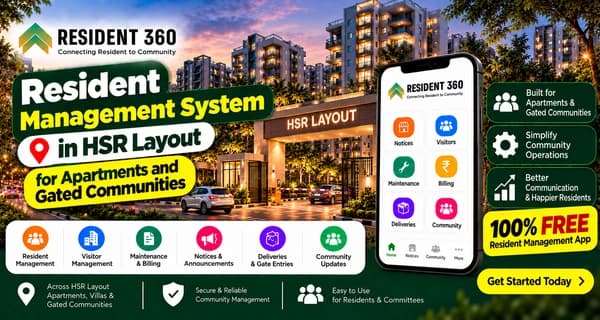
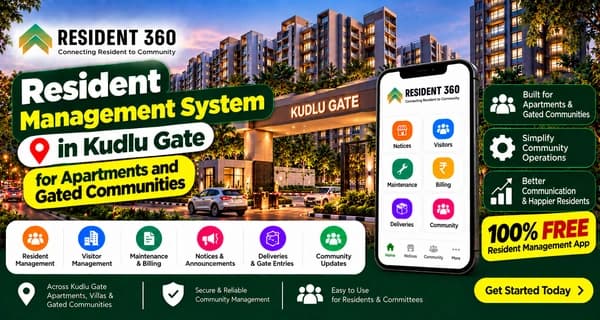
Communities in different parts of Bengaluru may also have distinct operational priorities. The approaches discussed in a Resident Management System in Bannerghatta Road, Resident Management System in HSR Layout, and Resident Management System in Kudlu Gate guide can provide useful location-based context without replacing a community-specific assessment.
How Resident360app Simplifies Resident Management
Resident360app can be considered by communities that want a more organized approach to routine resident management. Its usefulness should be assessed against the actual needs of the RWA, residents, committee members, facility managers, and staff.
Depending on the community’s process and usage, a resident management platform may help with:
- Organizing maintenance information and payment-related follow-up
- Reviewing pending dues and resident requests
- Supporting visitor and security coordination
- Recording complaints and service requests
- Sharing notices and resident communication
- Keeping resident and apartment records more organized
- Coordinating staff-related information and facility activities
- Providing a common place to review relevant community activity
A Resident Management System can make it easier for stakeholders to work from shared information, but successful use still depends on clear community rules, accurate records, resident participation, and responsible administration. The Maintenance management system area may be particularly relevant for communities seeking more structured handling of requests, dues, and follow-up.
How to Choose the Right Resident Management System
Before selecting a resident management system, committee members should first map the community’s current process. This includes how residents receive notices, how maintenance is recorded, how visitors are handled, how complaints are assigned, and how staff and facilities are coordinated.
Useful considerations include:
- Usability: Residents, committee members, and staff should be able to understand the basic workflow.
- Resident adoption: The process should be simple enough for regular participation across different user groups.
- Scalability: The system should suit current needs while allowing the community to review future requirements.
- Communication: Notices, queries, and important updates should have a consistent channel.
- Maintenance: Requests, dues, payment-related records, and follow-up should be organized.
- Visitor management: Entry coordination should match the community’s security procedures.
- Complaint management: Issues should be recordable, assignable, and available for follow-up.
- Record organization: Resident, facility, notice, and activity information should be easy to review.
- Staff coordination: Responsibilities should be communicated without creating unnecessary confusion.
- Facility management: Shared spaces should have practical scheduling and upkeep processes.
The committee should also consider data access, internal responsibilities, resident training, and how the system will be reviewed after implementation. Comparing a platform’s workflow with real daily tasks is more useful than choosing based only on a feature list.
Conclusion
For communities in JP Nagar, organized resident management can make everyday coordination more consistent across maintenance, visitors, security, complaints, communication, staff, facilities, and records. A Resident Management App may help RWAs and committees reduce fragmented processes while giving residents clearer ways to access information and raise requests. Resident360app can be considered as communities evaluate a practical resident management system suited to their own administrative needs.
Get Started with Resident360 Today
Resident360app can be considered by societies and residential communities looking for a more organized approach to resident management. To learn more, visit Resident360app.
Download the Resident360app Today