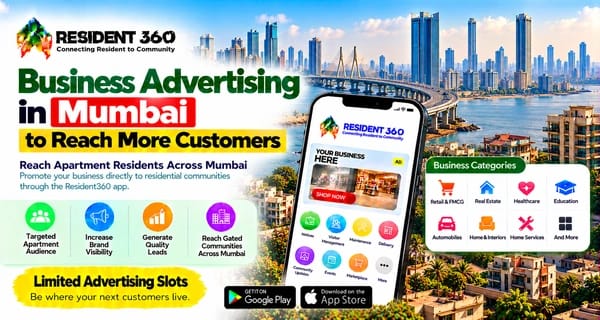
Business advertising in Mumbai requires more than placing an advertisement and waiting for enquiries. The city has a wide mix of apartment communities, gated societies, local businesses, service providers, retailers, and residential associations, each with different needs and buying habits. A useful advertising plan should identify the right audience, choose suitable channels, communicate clearly, and make it easy for interested people to respond. For businesses serving residential communities, this may include promoting services to residents, committees, facility managers, security teams, and society management teams. Local relevance, consistent messaging, and an organized follow-up process can make advertising more practical and measurable without relying on exaggerated claims or one-size-fits-all campaigns. Whether the goal is to create awareness, generate enquiries, or build stronger connections with communities, Mumbai businesses can benefit from treating advertising as an ongoing communication process rather than a single promotional activity.
For companies that serve housing societies, advertising can also support better discovery among the people who influence purchasing decisions, including committee members, residents, and facility teams.
Why Mumbai Businesses Need a More Focused Advertising Approach
Mumbai is a dense and diverse market where businesses often serve customers across different neighbourhoods, residential formats, and professional segments. A message that works for a large gated community may not be suitable for a smaller apartment society or a Resident Welfare Association (RWA). Business advertising in Mumbai therefore benefits from clear audience definition and local context.
Businesses offering maintenance services, security support, home services, community products, or society-focused technology need to explain their value in practical terms. Residents may care about convenience, while committee members may focus on coordination, records, and service responsiveness. Facility managers may look for easier workflows, and security teams may need reliable communication around daily operations.
A focused approach can help businesses:
- Identify the residential communities and customer groups they want to reach.
- Match advertising messages to the needs of residents, committees, or facility teams.
- Use local digital channels without repeating the same message everywhere.
- Explain service benefits in language that customers can understand quickly.
- Build trust through useful information rather than unsupported promises.
- Create a clear route from advertisement to enquiry or consultation.
- Follow up with interested prospects in an organized way.
Businesses can also use the advertising services and resources available through Resident360app as part of a broader approach to reaching residential communities. Supporting information should complement, not replace, a clear understanding of the target audience.
Common Advertising Challenges for Businesses in Mumbai
A business may have a good service but still struggle to reach the right audience. Mumbai’s competitive environment makes it easy for promotional messages to become broad, repetitive, or disconnected from the actual concerns of residential communities.
Common challenges include:
- Choosing a broad audience instead of defining a specific customer segment.
- Using the same advertisement for residents, committee members, and facility managers.
- Failing to explain how the service solves a practical society-related problem.
- Depending only on offline promotion or only on digital advertising.
- Losing enquiries because contact details or next steps are unclear.
- Finding it difficult to maintain consistent local visibility.
- Measuring attention without understanding the quality of enquiries.
- Communicating features without explaining the everyday value of the service.
- Reaching a society but not addressing the people involved in its decisions.
- Following up inconsistently after an initial response.
A business serving residential communities may also need to educate the market. For example, a company promoting a Society Management App should explain how digital coordination may support residents and committee members instead of simply listing product features. Clear education can make an advertisement more useful and improve the quality of later conversations.
How Business Advertising in Mumbai Can Build Better Local Connections
Business advertising in Mumbai can become more effective when each campaign follows a simple path: identify the audience, understand its concern, present a relevant solution, and provide a clear next step. This approach is especially useful for businesses serving societies, apartments, and RWAs because several groups may influence the final decision.
For example, a service provider may first create an educational advertisement about reducing manual maintenance follow-ups. A second message can explain how a Society Maintenance App may help organize recurring dues, payment records, and resident communication. A later interaction can invite a committee member or facility manager to discuss the society’s current process.
A practical advertising flow may include:
- Define whether the campaign is aimed at residents, committees, managers, or businesses serving societies.
- Identify one specific problem instead of combining every possible benefit in one message.
- Use a clear headline that reflects the customer’s situation.
- Explain the service through a short example or use case.
- Add a simple enquiry route, such as a contact form or consultation request.
- Review responses and improve the message based on the questions prospects ask.
This process helps separate awareness-building from direct promotion. It also gives a business a better chance of creating relevant conversations with Mumbai’s residential communities.
Four Core Areas for Effective Local Advertising
Audience Segmentation
Advertising becomes easier to manage when a business knows exactly who it wants to reach. A provider serving apartment associations may need separate messages for residents, committee members, security teams, and facility managers.
- Define the decision-maker and the daily user.
- Separate residential, commercial, and service-provider audiences.
- Adapt language to the audience’s practical priorities.
Clear Service Positioning
A customer should understand what a business offers and why it may be relevant. Positioning should connect the service to a real operational need rather than rely on broad claims.
- Explain the problem addressed by the service.
- Use examples related to societies or apartment communities.
- Avoid unsupported guarantees or vague superlatives.
Local Content and Visibility
Local advertising can be supported by content that reflects Mumbai’s varied residential environment. Useful content may cover community coordination, resident services, security communication, or society administration.
- Use Mumbai naturally where local relevance matters.
- Create content for specific community-management situations.
- Keep information practical and easy to share.
Enquiry and Follow-Up Management
An advertisement is only one part of the customer journey. A business should also decide how it will record enquiries, respond to questions, and maintain consistent communication after someone shows interest.
- Keep contact details and enquiry context organized.
- Clarify the next step after an initial response.
- Review recurring questions to improve future campaigns.
Businesses that want to speak to apartment communities can also explain how an Apartment Management App may support resident records, maintenance coordination, communication, and related operations. The advertisement should focus on the audience’s need instead of presenting every possible capability at once.
Society Operations That Can Support Advertising Relevance
Maintenance and Service Needs
Maintenance is a familiar concern across many residential communities, making it a useful context for relevant advertising. A business can create educational content around recurring dues, service requests, records, or communication without overstating the outcome.
- Explain how the service relates to routine society work.
- Use maintenance examples that residents and committees recognize.
- Connect the advertisement to a specific operational issue.
Payments and Records
Businesses serving societies may need to communicate how their offering can support organized records or clearer payment-related information. Content should remain factual and avoid claims about financial outcomes.
- Describe how records may be easier to organize.
- Clarify who can use the information.
- Refer to payment information responsibly when discussing payment awareness or digital payment context.
Complaints and Service Requests
Residents and committees often need a clear way to raise concerns and follow up on service matters. Advertising content can show how a service may support a more structured process for handling a complaint, while recognizing that each community may use its own procedures.
- Use realistic examples of resident queries.
- Explain how requests may be recorded or communicated.
- Avoid promising resolution times that have not been established.
Security and Visitor Coordination
Security and visitor operations are relevant to many apartment communities. A business can create targeted content around visitor communication, delivery coordination, or entry records when those topics match its offering.
- Speak separately to residents and security teams.
- Explain the value of organized communication.
- Use a visitor management system as a relevant example only when visitor operations are part of the service message.
Additional educational resources can be connected through [local advertising guidance for residential communities](), [society-focused campaign planning](), and [community outreach ideas for Mumbai businesses](). These references should be used as supporting content around the campaign, not as substitutes for audience research.
Adapting Advertising for Different Residential Communities
The same advertising message may not suit every community in Mumbai. A small society may value simple coordination and clear communication, while a larger gated community may have multiple buildings, gates, staff groups, and recurring service requirements. A campaign should reflect the operational setting in which the audience will use the advertised service.
For small societies, concise messages and direct explanations may be more useful than broad campaign language. The advertisement can focus on one concern, such as maintenance follow-up or resident updates, and show how the service may fit into existing routines.
Apartment communities may respond to content that connects resident needs with committee responsibilities. A business can explain how its service relates to records, complaints, payments, security, or day-to-day communication, depending on the offering.
Larger communities and gated developments may require more segmented communication. Different messages can be prepared for residents, security personnel, facility managers, and committee members. This does not mean making unsupported assumptions about the community; it means recognizing that different users may ask different questions.
RWAs may also need advertising that speaks to administration and coordination. Content should use the term Resident Welfare Association correctly and avoid inventing legal obligations or regulatory requirements. A practical campaign can focus on how a service may support RWA operations, records, resident communication, or committee workflows.
How Resident360app Can Support Relevant Business Messaging
Resident360app can be discussed in advertising content when the campaign is aimed at societies and residential communities that need a more organized approach to daily coordination. Depending on the audience, relevant topics may include maintenance and payment tracking, pending dues, resident communication, complaints and service requests, visitor and security coordination, resident records, and staff or facility coordination.
For example, a business advertisement aimed at committee members may refer to maintenance management software when explaining how maintenance processes and records can be structured. A campaign aimed at RWA administrators may mention rwa management software as a way to introduce organized approaches to society operations without claiming that one solution suits every community.
Resident communication is another useful advertising theme. Businesses can explain how a Resident communication app may help centralize announcements, updates, service-related messages, and resident queries. The message should remain focused on the problem being discussed and should not imply features or integrations that have not been confirmed.
A business can also use Resident360app-related topics to create educational content for different audiences:
- Residents may want clearer updates and easier access to relevant information.
- Committee members may look for better coordination across recurring tasks.
- Facility managers may value organized service requests and operational records.
- Security teams may need clearer communication around visitors and daily activity.
This kind of content can support advertising by helping prospects understand the practical context before they begin an enquiry.
How to Evaluate an Advertising Approach for Mumbai
Choosing an advertising approach should involve more than selecting a channel or designing a visual. Businesses should assess whether the campaign is relevant to the intended audience, understandable to people unfamiliar with the service, and practical to maintain over time.
Consider the following questions:
- Does the message clearly identify the audience it is addressing?
- Is the main problem specific enough to understand quickly?
- Does the advertisement explain the service in practical language?
- Can residents, committee members, or facility managers see its relevance?
- Is there a clear enquiry or response path?
- Can the business distinguish awareness from genuine interest?
- Are follow-up responsibilities assigned to an appropriate management team?
- Can the campaign be adapted for small societies, apartments, or gated communities?
- Does the content avoid unsupported claims, guarantees, or exaggerated comparisons?
- Is the campaign consistent with the business’s broader local communication?
It is also useful to review the questions received after a campaign begins. If prospects repeatedly ask about records, payments, communication, or visitor coordination, those questions can guide future content. Advertising then becomes a learning process that improves through clearer audience understanding.
Conclusion
Business advertising in Mumbai can be more useful when it connects a specific audience with a clearly explained need. For businesses serving societies, apartments, and RWAs, relevant messaging may focus on communication, maintenance, records, security, payments, or service coordination. By combining local context with practical content and organized follow-up, companies can create more meaningful conversations without relying on exaggerated promises or generic promotion.
Get Started with Resident360 Today
Resident360app can be considered by societies and residential communities looking for a more organized approach to society management. To learn more, visit Resident360app.
Download the Resident360app Today