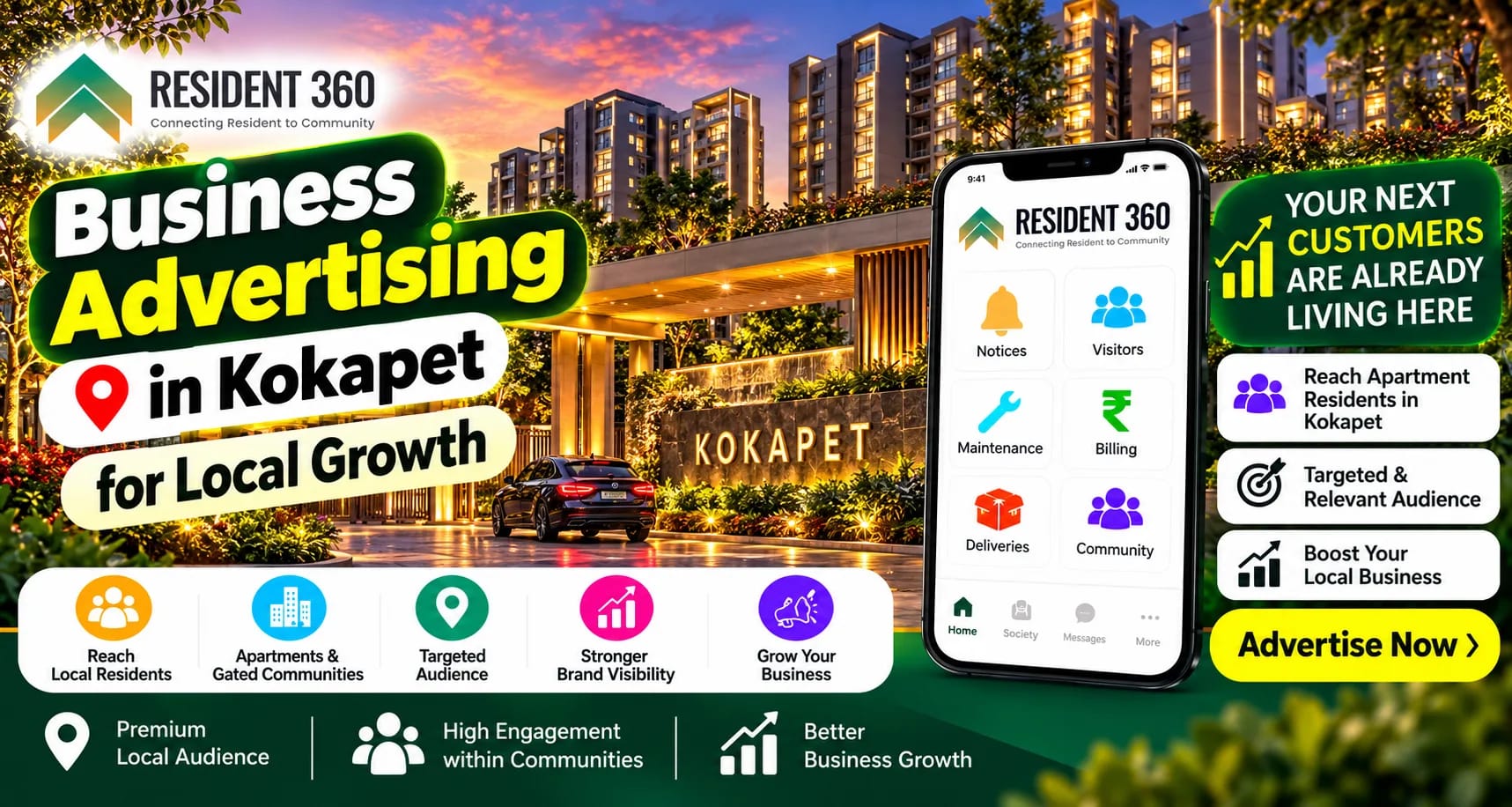
Business advertising in Kokapet can help local brands reach a growing audience of residents, professionals, families, and community decision-makers. For businesses serving homes and apartments, visibility is more valuable when it appears in places where people already discuss maintenance, security, services, events, and everyday needs. A focused local strategy can connect a brand with relevant residential communities without relying on broad, untargeted promotion. The right message, timing, and channel can make advertising more useful for both businesses and residents.
Kokapet businesses can benefit from understanding how residential communities make decisions, share information, and evaluate local services. Advertising becomes more meaningful when it answers a real need instead of interrupting communication.
Why Kokapet Businesses Need More Focused Local Advertising
Kokapet has a mix of apartment communities, gated developments, offices, retail outlets, service providers, and newly established residential areas. A business may serve people within a small radius, but reaching them consistently can still be difficult. Residents may need home services, education providers, healthcare options, food outlets, fitness services, repairs, moving assistance, or local professional support, yet they may not know which businesses are available nearby.
For this reason, business advertising in Kokapet should be planned around relevance and community context. A local campaign can focus on the audiences most likely to need the product or service, such as residents, facility managers, Resident Welfare Association (RWA) committee members, security teams, and apartment management teams.
Businesses should consider:
- Whether the offer is relevant to residential communities
- Which apartment or gated-community audience may need the service
- How residents usually receive local information
- Whether the message is easy to understand and act on
- How often the business should remain visible
- Whether the campaign supports a genuine community need
A useful starting point is the wider advertising solutions for residential communities, where businesses can consider how local promotion fits into everyday society communication and operations.
Common Challenges in Advertising to Kokapet Communities
Local advertising can appear simple, but residential audiences are not a single, uniform group. A message that works for a restaurant may not work for a home repair provider, educational service, clinic, or professional consultant. Businesses also need to approach community communication carefully so that promotions do not become intrusive.
Common challenges include:
- Reaching the right residential audience instead of a broad local population
- Finding suitable communication channels within apartment communities
- Presenting an offer without overwhelming residents with promotional messages
- Explaining the service clearly in a short format
- Coordinating with committee members or community administrators
- Maintaining consistent visibility after an initial campaign
- Measuring whether enquiries come from the intended local audience
- Addressing different needs across small and large communities
- Building trust when the business is not yet familiar to residents
- Keeping promotional content separate from urgent society communication
A business may also need to understand the digital environment used by a community. Societies increasingly use tools such as a Society Management App, a society maintenance app, or an apartment management app to organize resident communication and daily operations. Advertising should respect that structure and be presented in an appropriate, useful way.
How Business Advertising in Kokapet Can Reach the Right Audience
Business advertising in Kokapet becomes more effective when it is built around audience fit rather than simple visibility. A local brand can begin by identifying the type of community it wants to reach, the problem it solves, and the action it wants residents to take. The message should then be adapted to the setting in which it appears.
For example, a home cleaning service can communicate convenience, service coverage, and booking details. A coaching centre may focus on location, age group, and enquiry options. A local restaurant can highlight delivery areas, timings, and a clear menu category. In each case, the promotion should provide enough information for residents to decide whether it is relevant.
A structured approach may include:
- Define the local audience and service area.
- Identify the residential communities or neighbourhood segments that fit the offer.
- Prepare a short message with one clear benefit and call to action.
- Select suitable community-facing advertising opportunities.
- Coordinate timing with the relevant society or management contact.
- Review enquiries and refine the message based on genuine response.
Community software can provide useful context for this process. For instance, a Society Maintenance App may be used by residents and committee members for maintenance-related communication, while an Apartment Management App can support broader apartment operations. These environments should not be treated as spaces for unrestricted promotion. They require clear permissions, suitable content, and respect for resident communication priorities.
Four Operational Areas That Shape Local Advertising
Advertising in a residential setting works better when businesses understand how communities operate. The following areas can help a local brand plan a more relevant and responsible campaign.
Audience and Community Mapping
Businesses should define whether they want to reach residents, tenants, homeowners, committee members, facility managers, or service teams. This prevents a generic message from being shown to people who are unlikely to need the offer.
- Identify the service area and community type
- Match the offer to a clear resident need
- Separate consumer messaging from committee-level communication
Message Development
A good local advertisement should explain what the business does, who it helps, and how a resident can respond. Long descriptions and vague claims can reduce clarity, especially when residents are reviewing several updates at once.
- Use a direct headline and simple language
- Include relevant service details
- Provide one practical next step
Timing and Frequency
Community communication may already include notices about maintenance, security, repairs, events, and facility use. Advertising should be scheduled thoughtfully so it does not compete with urgent information or appear too frequently.
- Avoid periods reserved for important society notices
- Use a frequency that supports familiarity without repetition
- Coordinate timing with the appropriate community contact
Enquiry and Follow-Up Handling
A campaign does not end when an advertisement is published. Businesses should be ready to respond to questions, clarify service areas, and handle enquiries professionally. A slow or unclear response can weaken the value of otherwise relevant advertising.
- Record enquiries from different communities
- Respond with accurate service information
- Review recurring questions to improve future messages
Society Operations That Support Better Local Promotion
Residential advertising is connected to the way information and services move through a community. Businesses that understand these operational areas can create campaigns that are more considerate and useful.
Resident Communication
Residents may receive updates through a Resident communication app, notices, meetings, or other approved channels. A business message should fit the communication format and offer information that residents can quickly understand.
- Keep the message short and relevant
- Distinguish promotional content from society notices
- Use language suitable for a broad resident audience
Maintenance and Facility Needs
Maintenance concerns often reveal opportunities for local services. Plumbing, electrical work, cleaning, pest control, appliance repair, landscaping, and similar businesses may be relevant to apartment communities, provided the promotion is appropriate and transparent.
- Explain the service scope clearly
- Mention coverage only when it is accurate
- Avoid implying endorsement without permission
Payments and Service Information
Residents may look for clear payment information when a service involves bookings, subscriptions, or recurring charges. Advertising should not create confusion about payment steps, refunds, or the party responsible for the transaction.
- State the commercial terms clearly where needed
- Direct residents to the business’s approved contact method
- Avoid unclear payment requests in community communication
Complaints and Resident Feedback
A local brand should have a clear process for handling a complaint or service issue. This is especially important when the business serves several communities and residents may share feedback with committee members or neighbours.
- Provide a direct support contact
- Record and resolve service concerns responsibly
- Use feedback to improve future community outreach
Advertising Approaches for Different Residential Communities
The right approach can vary according to the community’s size, structure, and communication process. A small society may prefer a limited number of highly relevant local offers, while a larger gated community may have more varied resident needs and several internal communication groups.
For small societies, businesses can focus on a narrow service category and a concise message. A nearby pharmacy, repair service, tutor, or home maintenance provider may be more relevant than a broad brand campaign. The business should coordinate with the appropriate resident or committee contact before sharing promotional material.
Apartment communities with multiple towers may require clearer segmentation. A service provider could organize information around delivery coverage, appointment availability, or different service requirements. The message should remain consistent while allowing practical details to reflect the community’s needs.
Large gated communities may have several entry points, facilities, staff teams, and resident groups. In such settings, businesses should understand who can approve communication and how promotional content should be shared. Gate operations and security communication should not be disrupted by advertising activity.
RWAs and society committees may also evaluate whether a promotion is useful for residents, whether it is appropriate for the community, and whether it creates additional administrative work. Businesses that provide clear information and respect the community’s process are more likely to build a professional relationship.
Local campaign planning can also consider nearby markets. Businesses comparing audiences may review [business advertising in Tellapur](business advertising in Tellapur), [business advertising in Financial District](business advertising in Financial District), and [business advertising in HITEC City](business advertising in HITEC City) while keeping the message specific to each area.
How Resident360app Can Support the Community Advertising Context
Resident360app is designed around organized society and residential community management. Its relevant capabilities may help communities coordinate resident information, maintenance matters, payments, complaints, visitor and security communication, records, staff coordination, and facility-related activities. These functions can create a clearer operational environment in which approved community information is easier to organize.
For businesses, the important point is not to treat a society management platform as an unrestricted advertising channel. Instead, it can help clarify how communities manage communication and who may be involved in reviewing local promotions. A committee member or management contact can consider whether a business message is relevant before deciding how it should be shared.
A more organized approach can support:
- Clear separation between operational notices and promotional messages
- Better understanding of resident communication workflows
- Easier coordination with the management team
- More structured handling of service-related questions
- Improved context for businesses serving apartment communities
A maintenance management software approach may help communities organize recurring maintenance processes and related information. Similarly, a visitor management system can support visitor and gate coordination. These are operational examples, not substitutes for an advertising strategy, but they show why local businesses should understand the systems communities already use.
For RWA-focused administration, rwa management software may support records, committee coordination, communication, and society operations. Businesses seeking to reach RWAs should approach the relevant management team with an offer that is specific, transparent, and suitable for residents.
How to Evaluate a Local Advertising Opportunity in Kokapet
Before investing time or budget in a community-focused campaign, a business should assess whether the opportunity matches its goals and operating capacity. The decision should not be based only on audience size. Relevance, permission, message quality, and follow-up ability are equally important.
Consider the following questions:
- Does the community include the people the business actually serves?
- Is the product or service useful for residents, staff, or facility operations?
- Who is authorized to review or approve the promotional communication?
- Will the message be separate from urgent society notices?
- Can the business respond promptly to enquiries?
- Are service areas, timings, and commercial details accurate?
- Is the campaign suitable for the community’s communication style?
- Can enquiries be tracked without collecting unnecessary personal information?
- Does the business have a clear process for complaints or service issues?
- Can the campaign be adjusted based on relevant feedback?
Businesses should also compare the cost of reaching a smaller, highly relevant audience with the cost of broad local promotion. A focused campaign may be useful when the service depends on proximity, trust, repeat use, or community recommendations. However, every campaign should be reviewed on its actual objectives rather than assumed outcomes.
Conclusion
Business advertising in Kokapet can help local brands connect with residents and residential communities when the message is relevant, respectful, and easy to act on. Understanding society operations, communication preferences, community size, and committee coordination can improve campaign planning. With a focused local approach and organized follow-up, businesses can build more meaningful visibility without disrupting the information residents rely on.
Get Started with Resident360 Today
Resident360app can be considered by societies and residential communities looking for a more organized approach to society management. To learn more, visit Resident360app.
Download the Resident360app Today