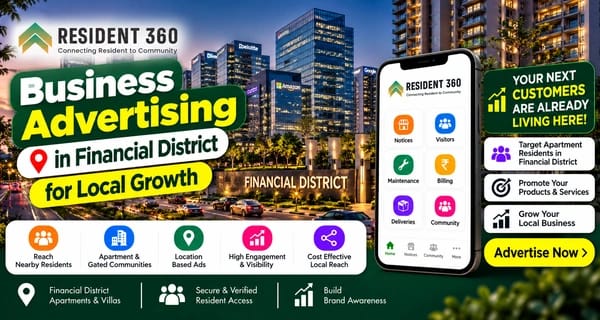
Business advertising in Financial District requires more than placing a message in front of a large audience. The area brings together offices, apartment communities, retail spaces, service providers, and residents with different needs and daily routines. For a local business, effective promotion depends on understanding these audiences and choosing channels that fit how they discover, compare, and use services. A restaurant may focus on nearby employees, while a home service provider may want visibility among residential communities. Clear positioning, useful offers, consistent communication, and location-focused campaigns can help businesses build recognition without wasting effort on audiences outside their service area. In Hyderabad, the Financial District offers a strong setting for locally relevant advertising because business activity and residential life exist close to one another. The goal is not simply to be visible, but to become easier to notice and remember when a relevant need arises.
A practical local advertising plan should connect digital visibility with the places where people already work, live, and make purchasing decisions. Community communication channels, office-focused outreach, search presence, and local partnerships can work together when the message remains clear and useful.
Why Financial District Businesses Need More Focused Local Advertising
Financial District is a mixed local market rather than a single customer group. Employees may search for food, transport, fitness, healthcare, convenience services, and professional support during the week, while residents may look for household services, education, wellness, repairs, and community-focused offers. This makes audience selection central to business advertising in Financial District.
A broad campaign may create visibility but still fail to bring relevant enquiries. Local businesses can make their advertising more useful by identifying the community, time of day, need, and decision-making context connected to their offer. A business serving apartment residents, for example, may need a different message from one targeting office administrators or retail visitors.
Local advertising can help businesses:
- Reach customers who are physically close to the service area
- Build familiarity among residents and office communities
- Promote offers that match local routines and requirements
- Reduce communication that reaches unrelated audiences
- Create repeat visibility instead of relying on one-time promotions
- Support referrals within apartments, offices, and neighbourhood networks
- Explain service coverage, timings, and contact options clearly
- Connect online discovery with an offline service experience
Common Challenges in Business Advertising in Financial District
Businesses operating in and around Financial District often compete for attention across search engines, social platforms, community groups, signage, and word-of-mouth channels. The challenge is not only creating an advertisement. It is making sure the message reaches the right people, at the right time, with enough information to encourage a next step.
Common challenges include:
- Reaching office-goers without overlooking nearby residents
- Communicating service areas and delivery coverage accurately
- Differentiating a local offer from similar businesses
- Maintaining consistent visibility across several channels
- Choosing between broad promotion and targeted community outreach
- Turning awareness into calls, enquiries, visits, or bookings
- Avoiding messages that are too general for a local audience
- Coordinating promotions with apartment or office communication rules
- Tracking which campaign or channel generated an enquiry
- Keeping local offers updated as timings and services change
A business may also struggle when its advertising is disconnected from its customer experience. If an advertisement promises quick communication but enquiries are missed, the campaign may create attention without building trust. Local promotion works better when the message, response process, and service delivery support one another.
How Business Advertising in Financial District Can Become More Organized
Business advertising in Financial District can become more organized when a business starts with a clear audience and a defined action. Instead of promoting every service to everyone, the business can create separate messages for office communities, apartment residents, facility teams, or nearby retail visitors. Each message should explain the relevant benefit, service area, contact route, and reason to respond.
For example, a cleaning service could promote recurring support to apartment communities while presenting office cleaning as a separate business solution. A restaurant could communicate lunch options to nearby employees and family-oriented offers to residents. The same business may use different content while maintaining one consistent brand identity.
A structured approach may include:
- Identify the most relevant local audience.
- Define the specific problem or need being addressed.
- Select channels where that audience already receives information.
- Create a short and clear message with a useful next step.
- Record enquiries and review which messages attract relevant interest.
- Improve the campaign based on questions, responses, and service capacity.
Businesses can also study how Society Management App content reaches committee members and residents. This does not mean every business should advertise inside a community platform. It shows why audience context matters: a message is more useful when it fits the information needs of the people receiving it.
Four Advertising Areas That Matter for Local Growth
Audience and Area Segmentation
A local campaign should separate audiences according to their relationship with Financial District. Office workers, residents, facility teams, and nearby businesses may all respond to different benefits and communication styles.
- Define primary and secondary customer groups
- Adjust messages for workday and residential needs
- Mention service boundaries clearly
Search and Local Discovery
Customers often begin with a search when they need a nearby service. A clear business profile, useful location information, service descriptions, and consistent contact details can make discovery easier. Advertising should support this basic information rather than replace it.
- Use location-specific service descriptions
- Answer common customer questions directly
- Keep business information consistent across channels
Businesses exploring local promotion can also review broader advertising strategies for Hyderabad communities to understand how residential audiences may fit into a wider local plan.
Community-Relevant Messaging
Residential communities can be useful audiences for services that solve recurring household or lifestyle needs. Messages should be relevant, respectful, and suitable for the communication setting. A short service introduction may work better than a long promotional message.
- Highlight a practical local benefit
- Avoid sending unrelated promotions
- Use clear contact and service details
Enquiry and Response Management
Advertising creates value only when interested people can receive a timely and accurate response. Businesses should decide who handles enquiries, what information is recorded, and how follow-ups are managed. This is especially useful when campaigns reach several communities or customer groups.
- Record enquiry source and customer requirement
- Set a simple follow-up process
- Keep service availability and pricing communication accurate
Supporting Operations for Effective Local Advertising
Resident Communication
For businesses serving apartment communities, communication can be more effective when it respects how residents receive updates. A Resident communication app is one example of a structured communication environment where important community information may be organized. Businesses should approach such channels carefully and share only relevant, permitted information.
- Match the message to resident needs
- Keep announcements brief and useful
- Avoid repeated or unrelated promotions
Service Requests and Complaints
Customer feedback can reveal whether an advertisement is creating the right expectations. Businesses should record each complaint and service request, identify recurring issues, and use those insights to improve campaign wording or delivery processes.
- Separate genuine service issues from general enquiries
- Review repeated questions about the advertised offer
- Use feedback to improve clarity
Payments and Customer Information
A campaign may lead to an enquiry, booking, or payment conversation. Businesses should handle customer details carefully and explain the next step clearly. Where residents or community teams need to verify payment information, communication should remain accurate and limited to the purpose of the transaction.
- Explain payment expectations before service delivery
- Maintain clear records of customer requests
- Avoid making claims that the business cannot support
Staff and Facility Coordination
Local campaigns can create demand across several service teams. A clear internal process helps staff understand which area is covered, which offer was advertised, and who should respond. Coordination with a community’s management team may also be necessary when advertising involves shared spaces or resident communication.
- Assign responsibility for enquiries
- Confirm access and scheduling requirements
- Keep operational teams informed about active campaigns
Related Digital Touchpoints for Community-Focused Promotion
Society Maintenance Communication
Businesses serving residential communities may find that maintenance-related communication creates practical opportunities for relevant services. For example, repair, cleaning, pest control, or facility support providers can position their offering around recurring needs rather than generic brand promotion. A Society Maintenance App represents the type of community context where residents and committee members may already be discussing property-related requirements.
Apartment Service Discovery
Apartment communities include residents with varied household needs. A service provider can create separate messages for move-ins, recurring maintenance, family services, wellness, education, or convenience. An Apartment Management App is another relevant touchpoint to understand when considering how apartment operations organize resident-facing information.
Visitor and Access-Related Services
Some businesses depend on scheduled visits, deliveries, installation work, or service personnel entering a community. Understanding the role of a visitor management system can help advertisers communicate practical details such as appointment timing, identification requirements, and contact responsibility without creating confusion at the gate.
RWA and Committee Outreach
Businesses that serve communities may need to communicate with committee members or Resident Welfare Associations before reaching residents. A rwa management software resource can provide context about the administrative environment in which community decisions, records, and resident communication are organized. Advertising should support that process rather than bypass it.
Advertising Approaches for Different Residential Communities
Small Societies
Small societies may depend heavily on personal recommendations and direct communication. A local business can use simple, focused messaging that explains the service, coverage, availability, and contact route. Relevance is usually more valuable than frequent promotion.
Apartment Communities
Apartment communities may include several resident groups, facilities, and daily routines. Businesses can organize campaigns around specific needs, such as home services, food, education, wellness, or repairs. Messages should be easy to understand and appropriate for the community channel being used.
Large and Gated Communities
Larger gated communities may have more structured access, multiple buildings, and greater communication volume. Businesses should plan for clear service scheduling, delivery instructions, and enquiry handling. If the campaign produces visits, coordination with security and facility staff may be necessary.
Resident Welfare Associations
Resident Welfare Associations may evaluate whether an offer is useful, appropriate, and manageable for residents. Businesses can prepare a concise proposal that explains the service, audience benefit, communication format, and operational requirements. A respectful approach can make community-level outreach more practical.
How Resident360app Can Support Community-Aware Advertising
Resident360app can be considered by societies and residential communities that want a more organized approach to resident-facing operations. Its relevant capabilities may include resident communication, maintenance and payment tracking, complaints and service requests, visitor and security coordination, resident and apartment records, and staff or facility coordination.
For a business advertising in Financial District, understanding these operational areas can improve campaign planning. A resident-facing message should not interfere with urgent notices, maintenance updates, or security communication. It should be relevant to the community and shared through an appropriate process when permission is required.
A community management environment may help societies keep important information more organized, while businesses remain responsible for the accuracy and usefulness of their own advertising. This separation supports clearer expectations between residents, committees, facility teams, and service providers.
Businesses can use this understanding to:
- Prepare messages that fit residential communication needs
- Coordinate service visits with the appropriate community contact
- Explain how enquiries and follow-ups will be handled
- Avoid promoting services that are not relevant to residents
- Align advertising with operational capacity and service coverage
For maintenance-focused providers, maintenance management software is another useful context because it highlights how communities organize recurring work and service-related information. Advertising that reflects these processes may be easier for committee members and facility teams to evaluate.
How to Evaluate a Local Advertising Approach
A suitable advertising approach should be evaluated by relevance, clarity, response quality, and operational fit rather than by visibility alone. Before launching a campaign, a business can ask whether the audience is clearly defined, whether the message explains a real local benefit, and whether the team can respond to enquiries accurately.
Consider the following factors:
- Audience fit: Does the campaign reach people who can use the service?
- Location clarity: Is Financial District, Hyderabad, or the exact service area stated where useful?
- Message quality: Can the audience understand the offer quickly?
- Channel suitability: Is the message being shared where the audience expects relevant information?
- Response process: Who handles calls, messages, bookings, and follow-ups?
- Community suitability: Does the promotion respect resident, committee, and facility processes?
- Measurement: Can the business identify useful enquiries without relying on unsupported assumptions?
- Service capacity: Can the business fulfil the demand created by the campaign?
Businesses may also compare different local content themes, such as [business advertising in HITEC City](business advertising in HITEC City), [business advertising in Jubilee Hills](business advertising in Jubilee Hills), and [business advertising in Puppalaguda](business advertising in Puppalaguda). These comparisons should be used to understand audience and locality differences, not to copy one campaign without adjustment.
A practical review can happen after each campaign cycle. Look at the questions customers asked, the services they requested, the locations they came from, and the points where communication slowed down. This information can help refine the next message while keeping the campaign grounded in actual business capacity.
Conclusion
Business advertising in Financial District works best when it is local, relevant, and connected to a clear customer need. Businesses can improve their approach by separating office and residential audiences, using suitable community communication channels, coordinating service operations, and reviewing enquiry quality. With thoughtful planning, local advertising can support stronger awareness among residents, employees, committees, and nearby customers without relying on broad or unsupported claims.
Get Started with Resident360 Today
Resident360app can be considered by societies and residential communities looking for a more organized approach to society management. To learn more, visit Resident360app.
Download the Resident360app Today