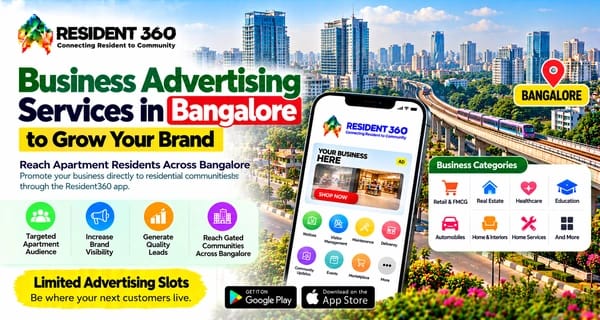
Business advertising in Bangalore is becoming more community-focused as local brands look for relevant ways to reach residents, families, professionals, and apartment decision-makers. Residential societies can offer a useful environment for businesses such as education providers, home-service professionals, healthcare practices, fitness centres, retailers, and local food brands to present their offerings. However, effective promotion requires more than placing an advertisement. It depends on permission, clear communication, suitable timing, organised records, and respect for residents' preferences. A society management platform can help communities coordinate advertising requests while giving businesses a more structured way to connect with the right audience.
For residential communities, the goal is to balance commercial opportunities with resident comfort. A clear advertising process can help committees review proposals, communicate relevant offers, and avoid unapproved or repetitive promotions.
Why Bangalore Businesses Need More Focused Community Advertising
Bangalore has a wide mix of apartment communities, gated developments, independent residential clusters, and neighbourhoods with distinct needs. A business may serve a particular locality well, but broad advertising can make it difficult to reach residents who are most likely to need its products or services. Community-based promotion can provide a more relevant context when it is planned with the association and shared responsibly.
Society committees also need a practical way to manage advertising requests. They may receive proposals through email, messaging groups, phone calls, or personal references. Without an organised process, useful opportunities can be missed while residents may receive unclear or repeated messages. Advertising through a structured community channel can make it easier to separate relevant information from unwanted promotion.
Businesses should also understand that residential communities are not simply advertising spaces. They are shared environments with their own communication norms, operating procedures, and resident expectations. A thoughtful campaign should explain the value of the offer, identify the intended audience, and give the community a clear choice about how the message is presented.
Common Challenges in Business Advertising in Bangalore
Local advertising can be effective, but both businesses and societies often face avoidable coordination problems. These issues can affect trust, response rates, and the overall resident experience.
- Advertising requests may arrive through scattered channels without a consistent review process.
- Society committees may find it difficult to verify the business or understand the offer clearly.
- Residents may receive promotions that are unrelated to their interests or community needs.
- Businesses may not know whether an announcement reached the intended audience.
- Repeated messages can create communication fatigue inside resident groups.
- Posters, flyers, and digital announcements may not follow a common approval process.
- A society may lack a clear record of who requested an advertisement and when it was shared.
- Businesses may struggle to explain their service without making unsupported claims.
- Follow-up questions can become difficult to manage when responses are spread across multiple channels.
- Committees may not have an organised way to compare advertising requests or schedule campaigns.
A responsible approach begins by defining what type of advertising is acceptable, who can approve it, and how residents should receive it. This creates a more predictable experience for all parties.
How Business Advertising in Bangalore Can Become More Organised
Business advertising in Bangalore can become more effective when it follows a simple community workflow. A business can submit a clear proposal describing its service, target audience, offer period, contact details, and preferred communication format. The society committee can then review whether the message is relevant and suitable for the community.
The next step is choosing the right channel. Some offers may be appropriate for a community announcement, while others may work better through a noticeboard, event collaboration, or a limited campaign. A digital society platform can help keep the discussion and approval process more organised instead of relying only on individual conversations.
Businesses can also improve results by understanding the needs of residents. For example, a home cleaning service may be more relevant during a seasonal maintenance period, while a local tutor may be useful before a school term begins. Timing and relevance often matter more than simply increasing the number of messages.
A society management app can support this broader coordination by helping committees manage resident communication, records, requests, and operational information in one place. Businesses should still avoid assuming that access to a community channel guarantees responses. The platform supports organisation; the quality and relevance of the offer remain the responsibility of the advertiser.
Four Operational Areas That Shape Community Advertising
Advertising Request Review
A clear review process can help the committee understand what a business wants to promote before the message reaches residents. It also gives the association an opportunity to check whether the content is suitable for the community.
- Record the business name, service category, and contact person.
- Review the proposed message, offer period, and intended audience.
- Confirm who is responsible for final approval.
Resident Communication
Once an advertisement is approved, the message should be written in a concise and transparent way. A Resident communication app can help societies share community updates and relevant information through a more centralised communication process.
- State what the business offers and where it operates.
- Avoid excessive repetition across different resident channels.
- Provide a clear way for residents to ask questions or opt out of future promotional messages.
Business and Community Records
Keeping basic records can help a committee understand which campaigns were submitted, approved, shared, or closed. This is useful when several businesses approach the society over time.
- Maintain the request date and approval status.
- Note the communication format and campaign period.
- Keep business contact details available for follow-up.
Resident Feedback
Feedback can help the committee decide whether a campaign was useful, disruptive, or unclear. Feedback does not need to become a complicated survey; even a structured record of common questions can guide future decisions.
- Track repeated resident concerns.
- Record whether the message was relevant to the community.
- Use feedback to improve future advertising guidelines.
Related Society Operations That Support Local Promotion
Resident and Apartment Records
Advertising becomes more responsible when communities understand their own communication structure without exposing unnecessary personal information. Resident and apartment records can help the committee identify suitable communication channels while keeping sensitive details protected and limited to legitimate operational use. An Apartment Management App may support broader apartment administration alongside communication and record-keeping needs.
- Keep resident information organised and access-controlled.
- Use community-level information rather than sharing private data with advertisers.
- Ensure that promotional communication does not reveal confidential resident details.
Maintenance and Payment Communication
Society operations often include recurring maintenance notices, payment reminders, and facility updates. These should not be mixed carelessly with advertisements. A community can use a Society Maintenance App to keep maintenance-related information distinct from optional business promotions.
- Separate essential society notices from commercial messages.
- Avoid placing advertisements alongside urgent payment or facility information.
- Schedule promotional content so it does not obscure operational updates.
Complaints and Service Requests
Residents may raise questions about an advertisement, a product experience, or the way a message was distributed. A defined complaint process can help the committee record concerns and decide whether a campaign should continue, change, or stop.
- Record the subject and date of the concern.
- Direct product or service disputes to the business where appropriate.
- Use community feedback to improve advertising rules.
Staff and Facility Coordination
Some businesses may request access to common areas for a stall, demonstration, or scheduled interaction. Staff members and facility teams may need advance information so that the activity does not interfere with security, cleaning, parking, or resident events.
- Share approved activity details with relevant staff.
- Confirm location, timing, and visitor expectations.
- Keep commercial activities separate from restricted or private areas.
Adapting Advertising to Different Residential Communities
Business advertising in Bangalore should be adjusted to the type and size of the residential community. A smaller society may prefer a short announcement or a noticeboard message because the committee can review requests directly. A larger apartment community may need a more structured submission, approval, scheduling, and feedback process because more residents and businesses may be involved.
Gated communities may have additional coordination requirements when an advertiser wants to visit the premises. The committee may need to confirm the purpose of the visit, expected time, location, and whether resident approval is necessary. A visitor management system can support visitor and security coordination for approved activities, but it should not be treated as permission to enter without the community's approval process.
RWAs may also work with nearby businesses on resident-focused initiatives, such as local service directories, community events, or seasonal information. In these cases, rwa management software can help support broader RWA administration, resident records, communication, and committee coordination. The exact process should still be set by the association.
For businesses, community size should influence the campaign format. A concise message may be suitable for a smaller society, while a larger community may benefit from a segmented announcement, scheduled event, or dedicated information page. Businesses should not assume that a larger audience automatically produces better results; relevance, clarity, and trust remain central.
How Resident360app Can Support Advertising Coordination
Resident360app can be considered by societies and residential communities that want a more organised approach to communication and day-to-day coordination. For advertising-related activity, its relevant role may be helping the community keep resident communication, records, service requests, maintenance information, and other operational updates in a more structured environment.
A society may use a Society Management App as part of a wider approach to managing resident coordination and community information. This does not replace the committee's responsibility to review advertising content or decide whether a promotion is suitable. It can, however, support a clearer process for sharing approved information.
Advertising should also remain separate from essential financial communication. If a society shares payment information or maintenance reminders, promotional content should not make those notices difficult to find. Clear categorisation can help residents distinguish operational messages from optional offers.
For societies that coordinate several vendors, facilities, and resident requests, a management team may benefit from having a consistent way to record responsibilities and follow-ups. Resident360app can support an organised approach to such coordination when the relevant community processes are defined by the association.
The platform should be evaluated according to the actual needs of the community. A society looking for broader administration may review a maintenance management system for related records and workflows, while advertising coordination remains one part of the larger operational picture. The purpose is not to add more messages, but to make useful information easier to manage.
What to Evaluate Before Choosing an Advertising Approach
A society should evaluate both its communication process and the suitability of the advertising opportunity. The right approach may differ depending on community size, committee availability, resident preferences, and the type of business involved.
Relevance to Residents
Ask whether the product or service is genuinely useful to a meaningful part of the community. A narrowly targeted offer may be more appropriate than a broad promotion that adds little value.
Approval and Content Control
Define who reviews advertising requests and what information must be included. The committee may request business details, contact information, campaign duration, and a final copy of the message before approval.
Communication Frequency
Set reasonable limits on how often commercial messages can be shared. Residents should continue to receive essential notices without promotional content creating confusion or fatigue.
Privacy and Information Use
Do not provide resident phone numbers, email addresses, apartment details, or other personal information to advertisers without a legitimate and appropriate basis. Businesses should communicate through approved community channels rather than collecting private data informally.
Follow-Up and Accountability
Decide how questions, complaints, and campaign closures will be handled. A record of approvals and resident feedback can make future decisions more consistent.
Communities may also review broader guidance on [business advertising in Karnataka](business advertising in Karnataka) when planning regional campaigns. For a wider perspective on how Resident360app relates to advertising and community operations, societies can explore the Resident360app advertising page. Additional planning resources for [Bangalore community advertising]() and [residential promotion practices]() can be used only after confirming that the content and destination are appropriate for the intended audience.
Conclusion
Business advertising in Bangalore can work well when it is relevant, permission-based, clearly communicated, and managed with resident comfort in mind. Societies can create a practical process for reviewing requests, protecting privacy, coordinating approved activities, and recording feedback. With organised communication and suitable digital support, local businesses and residential communities can connect more responsibly without allowing promotions to interfere with essential society operations.
Get Started with Resident360 Today
Resident360app can be considered by societies and residential communities looking for a more organized approach to society management. To learn more, visit Resident360app.
Download the Resident360app Today