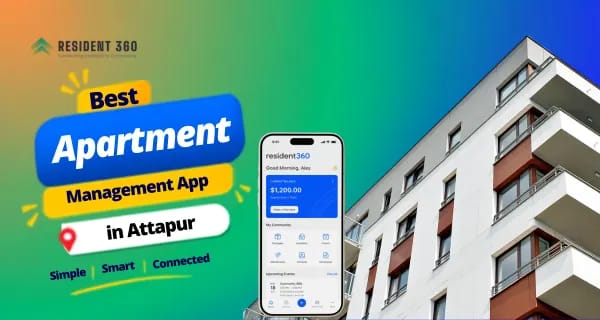
Attapur’s apartment communities manage a steady flow of maintenance requests, visitor entries, resident notices, staff duties, payments, and shared facilities every day. An Apartment Management App can help Resident Welfare Associations (RWAs) bring these activities into a more organized process instead of relying on scattered messages, registers, spreadsheets, and calls. For committee members and facility managers, this can make follow-up easier while giving residents clearer ways to raise requests and receive updates.
A practical digital system does not replace the people who run a community. It supports their work by making information easier to record, find, share, and act on.
Why Attapur Apartments Need an Apartment Management App
Attapur has a mix of apartment buildings, residential enclaves, and gated communities with different sizes, facilities, and operating arrangements. Even a smaller community may need to coordinate security guards, housekeeping teams, electricians, plumbers, vendors, parking concerns, notices, and monthly maintenance collections.
As the number of residents and daily requests grows, informal processes can become difficult to track. An Apartment Management App can help an RWA create consistent workflows for maintenance, communication, visitor coordination, and records without making every task dependent on one committee member.
For example, a resident may report a water leakage in the morning, while another asks about a clubhouse booking and a third needs approval for a delivery visitor. A shared digital process gives the committee a clearer view of these requests and their status.
Common Problems Faced by Apartments and Societies in Attapur
Apartment communities in Attapur often face operational issues that are manageable individually but difficult when handled together through disconnected channels.
- Maintenance requests may be shared in resident groups and get buried under unrelated messages.
- Committee members may not have a single view of open, assigned, and completed tasks.
- Visitor details may be recorded manually or communicated inconsistently at the gate.
- Residents may be unsure whether a complaint has been received or escalated.
- Monthly maintenance collections and payment follow-ups may require repeated manual reminders.
- Notices can be missed when they are posted across several groups or physical boards.
- Staff duties, attendance, and vendor coordination may remain dependent on paper records.
- Clubhouse, gym, parking, or other shared facility bookings can create scheduling conflicts.
- Important invoices, approvals, and maintenance histories may be difficult to retrieve later.
These gaps affect more than administration. Residents may experience delays or uncertainty, while committee members spend extra time answering repeated questions and checking multiple sources. A structured Society Management App can help bring these everyday activities into a more visible and accountable process.
How an Apartment Management App Solves These Problems
An Apartment Management App can connect common community activities through one organized operating process. Instead of treating maintenance, communication, visitors, and records as separate tasks, the committee can manage them with clearer categories, responsibilities, and updates.
A resident could submit a service request with a description and relevant details. The committee or facility manager can review it, assign it to a staff member or vendor, update its progress, and close it after completion. This creates a useful history for recurring issues such as plumbing, electrical work, lift service, or water supply concerns.
A digital platform may also make routine communication more consistent. Notices about water shutdowns, pest control, safety checks, meetings, or facility closures can be shared with the intended residents through a central channel. Communities comparing options can review an Apartment Management App for Hyderabad to understand how broader apartment operations may be organized digitally.
For payment-related communication, committees should share clear details, due dates, receipts, and applicable policies. Residents should verify payment information through official community channels and trusted sources such as payment information before completing a transaction.
Maintenance, Visitor, Security, and Complaint Management
These functions are closely connected in apartment operations. A maintenance request may require staff access, a vendor visit, security coordination, and a final update to the resident.
Maintenance Management
Maintenance work becomes easier to coordinate when requests are recorded in a consistent format. A society maintenance app may help the committee capture the issue, location, priority, assigned person, status, and completion notes.
Useful practices include:
- Categorising requests as plumbing, electrical, civil, housekeeping, lift, or common-area work.
- Assigning responsibility instead of leaving tasks in a general chat group.
- Recording expected timelines and updates for residents.
- Keeping a history of recurring faults and vendor visits.
- Reviewing unresolved work during committee or facility meetings.
A community evaluating Society Maintenance App options should look for workflows that match its size and staff structure. The right process should make follow-up simpler, not add unnecessary steps.
Visitor Management
Visitor handling involves residents, security guards, delivery personnel, domestic workers, service providers, and guests. A digital visitor management system can help communities create a more organized way to record and coordinate entries.
Depending on community policy, residents may be able to provide advance information for expected guests or service providers. Security staff can then verify details at the gate and contact the concerned home when required. Delivery traffic, cab arrivals, and vendor visits can also be handled through clearer instructions.
Security Management
A consistent security process helps reduce confusion at entry points. Visitor records, access coordination, emergency contacts, and security notices can be maintained in an organized manner rather than across informal conversations.
Technology should support the guards and security supervisors, not make their work harder. Communities should define who can access records, how long information is retained, and what action is required for unusual or unauthorised entry attempts.
Complaint Management
Residents need a clear way to report issues affecting their homes or shared spaces. A structured complaint process can help distinguish between a new request, an escalation, a clarification, and a completed resolution.
The committee can review the issue, assign it to the appropriate person, communicate progress, and record the outcome. This helps avoid repeated explanations and gives residents a clearer understanding of what happens after an issue is submitted.
Resident Communication, Staff, Facility, and Record Management
Community management depends on reliable information flow. Residents need timely updates, staff need clear instructions, and committee members need records that can support practical decisions.
Resident Communication
Resident groups are useful for quick conversations but may not be suitable for every notice or request. A Resident communication app can help separate official announcements, maintenance updates, alerts, polls, and resident requests.
Clear communication also means using simple language, identifying the responsible contact, and stating dates or next steps. This can reduce repeated questions and help residents plan around repairs, inspections, water interruptions, or facility closures.
Staff Management
Housekeeping staff, security guards, technicians, supervisors, and vendors may work different shifts and handle different responsibilities. A digital workflow can help the management team record assignments, follow up on pending work, and maintain basic operational visibility.
The committee should still define duties, escalation procedures, attendance expectations, and vendor responsibilities. Software can support coordination, but clear human supervision remains essential.
Facility Management
Shared facilities such as clubhouses, gyms, play areas, parking spaces, and multipurpose halls require schedules and usage rules. A community may use digital records to manage bookings, identify conflicts, communicate closures, and note cleaning or repair requirements.
Facility management should also cover inspections and preventive work. Tracking recurring maintenance can help the community plan before a small issue affects residents or causes an avoidable disruption.
Record Management
Notices, invoices, vendor details, maintenance histories, resident information, approvals, and meeting-related records should be organised according to the community’s policies. A central system may make it easier for authorised committee members to find the information they need.
Access controls and responsible data handling are important. RWAs should decide which records are visible to residents, committee members, staff, and vendors, while keeping sensitive information appropriately protected.
Apartment Management App for Small Apartments and Gated Communities
A small apartment may need a simpler setup focused on maintenance requests, notices, payments, visitor coordination, and a few shared facilities. Because fewer people may be involved, the system should be easy for residents and committee members to learn without creating administrative overhead.
A larger gated community may have multiple towers, more security points, several staff teams, extensive amenities, parking requirements, and a higher volume of daily requests. It may need stronger categorisation, role-based access, escalation workflows, facility scheduling, vendor coordination, and more detailed reporting.
The same Apartment Management App should therefore be configured around the community’s actual needs. An RWA should identify its resident count, facilities, staff structure, communication habits, and recurring problems before selecting features.
Communities researching local requirements can also compare an Apartment Management App in Abids, an Apartment Management App in Ashok Nagar, and an Apartment Management App in Hyderabad to understand how location-focused content addresses different apartment-management contexts.
How Resident360app Simplifies Apartment Management
Resident360app can help apartment communities bring recurring operational activities into a more organised digital process. Its usefulness depends on how the RWA configures the platform, communicates its use, and encourages residents and staff to follow common workflows.
Practical areas of support may include:
- Recording and following up on resident maintenance requests.
- Sharing notices and community updates through an organised channel.
- Coordinating visitor information and entry-related communication.
- Supporting maintenance collection and payment-related administration.
- Keeping information about residents, staff, facilities, and requests easier to access.
- Giving committee members a clearer view of pending tasks and follow-ups.
A rwa management software solution should fit the RWA’s working style rather than forcing every community to follow an identical process. Resident360app can be considered as part of that evaluation, especially when a community wants to reduce dependence on scattered registers, spreadsheets, and message threads.
How to Choose the Right Apartment Management App
An RWA should assess an app through actual daily scenarios instead of selecting features only from a product list. Ask whether a resident can raise a request easily, whether a manager can assign it, and whether the committee can see what remains pending.
Important considerations include:
- Usability: Residents, guards, staff, and committee members should be able to understand the basic workflows.
- Management requirements: The platform should support the community’s size, facilities, staff structure, and approval processes.
- Resident adoption: Clear onboarding, simple instructions, and consistent committee use can improve participation.
- Scalability: The system should remain useful if the community adds residents, facilities, staff, or additional security points.
- Communication: Notices, alerts, requests, and updates should be easy to organise and locate.
- Maintenance: The workflow should support assignment, status updates, escalation, vendor coordination, and history.
- Record organisation: Authorised users should be able to find relevant community records without compromising privacy.
Communities that need a dedicated maintenance management software workflow should examine how requests, staff tasks, and vendor work are handled from submission to closure. It is also useful to compare a Maintenance management system with the broader needs of the community so that maintenance does not become disconnected from communication, security, and records.
Conclusion
Attapur apartments can benefit from a more organised approach to maintenance, visitor coordination, security communication, complaints, facilities, records, and resident updates. An Apartment Management App can help RWAs and facility managers bring these activities into one clearer workflow while supporting residents with practical channels for requests and information. Resident360app can be considered by communities that want to improve day-to-day coordination without losing the value of responsible human oversight.
Get Started with Resident360 Today
Resident360app can be considered by apartment communities looking for a more organized approach to apartment management. To learn more, visit Resident360app.
Download the Resident360app Today